


Views: 201 Author: Bohui Electric Publish Time: 2026-06-27 Origin: Site


Content Menu
● Why Electrical Enclosure Cooling Matters
● Core Principle: When Is Cooling Required?
● Step-by-Step Method: How To Determine If Cooling Is Required
>> 1. Define Environmental and Application Conditions
>> 2. Determine Component Temperature Limits
>> 3. Calculate or Estimate the Internal Heat Load
>> 4. Consider External Heat Sources and Enclosure Design
>> 5. Estimate the Resulting Internal Temperature
>> 6. Decide Whether Natural Ventilation Is Enough
● Choosing the Right Cooling Method Once Cooling Is Required
>> Overview of Common Cooling Options
● Expert Insight: Designing Cooling During the Enclosure Design Phase
● Industry Case Example: Control Panel for Industrial Pumping Station
● Practical Checklist: Quick Decision Flow for Cooling Need
● Design Best Practices to Reduce Cooling Demand
● How Ningbo Bohui Electric Supports Your Cooling Decisions
● Frequently Asked Questions (FAQ)
>> 1. What is the simplest way to know if my enclosure needs cooling?
>> 2. Can I just add vents instead of using a fan or air conditioner?
>> 3. How much safety margin should I keep below the maximum component temperature?
>> 4. When should I use a closed-loop cooling system instead of a fan?
>> 5. How often should I check or maintain the enclosure cooling system?
To determine if cooling is required for an electrical enclosure, you must evaluate the enclosure's internal heat load, allowable temperature limits of the components, ambient conditions, and environmental constraints, then compare the resulting internal temperature to safe operating ranges using a systematic calculation or thermal management guideline. When the expected internal temperature exceeds recommended limits or the environment is harsh (high ambient temperature, dust, humidity, corrosive atmospheres), active or closed-loop cooling becomes essential to protect reliability, uptime, and safety. [thermaledge]
This guide is written from the dual perspective of an industrial enclosure manufacturer (Ningbo Bohui Electric Co., Ltd.) and a practicing electrical/controls engineer, combining field experience with current best-practice guidance on enclosure thermal management. It focuses on practical, step-by-step methods to decide whether you need enclosure cooling—and if so, what type and how to plan for it early in your project. [thermaledge]
Excessive heat dramatically shortens the life of electrical components and increases failure rates, often in a non-linear way. Many equipment manufacturers recommend keeping enclosure temperatures below about 95–104 °F (35–40 °C) to maintain reliability and meet warranty conditions. [thermaledge]
For OEMs and operators in power distribution, telecom, industrial automation, building management, EV charging, pumps, and energy storage, downtime caused by thermal failures translates directly into lost production, service interruptions, and maintenance costs. As a manufacturer of industrial electrical enclosures, we repeatedly see that investment in proper cooling at design stage is much lower than the cost of retrofits and unplanned outages later. [thermaledge]
At a high level, cooling is required if the calculated internal enclosure temperature at worst-case operating conditions exceeds the maximum permissible temperature of any installed component. This depends on four key factors: [thermaledge]
- Total internal heat load (equipment losses). [thermaledge]
- Ambient temperature (worst-case, not average). [thermaledge]
- Heat transfer via enclosure walls (size, material, color, installation). [eabel]
- Environmental constraints (dust, humidity, water, corrosive agents, solar radiation). [thermaledge]
If any combination of these factors pushes internal temperatures beyond safe limits, you must introduce some form of cooling (ventilation, fan, heat exchanger, or air conditioner). [rs-online]
Before looking at components, you should define where and how the enclosure will be used. This step is often skipped, but it drives every later cooling decision. [thermaledge]
Key questions:
- Location: Indoor panel room, factory floor, outdoor substation, rooftop, or roadside cabinet? [thermaledge]
- Ambient temperature: What is the maximum expected ambient temperature near the enclosure under worst-case conditions (e.g., summer peak)? [thermaledge]
- Exposure: Is it exposed to direct sun, hot nearby equipment (ovens, furnaces), or strong drafts? [thermaledge]
- Contaminants: Is there dust, oil mist, moisture, corrosive chemicals, or washdown conditions? [thermaledge]
- Protection rating: What NEMA/IP rating is required (e.g., NEMA 4X, IP66)? [rs-online]
From a UX and design perspective, we recommend documenting these conditions in a simple project sheet at the concept phase, so that enclosure size, material, and climate control can be coordinated from the beginning. [thermaledge]
Each device inside the enclosure has its own allowable temperature range, often specified in its datasheet. Typical limits: [thermaledge]
- PLCs, relays, and power supplies often specify maximum ambient temperatures around 40–55 °C. [thermaledge]
- VFDs, inverters, and rectifiers may allow higher internal temperatures but generate significant heat losses. [thermaledge]
A practical rule recommended in some best-practice guides is to design the enclosure to operate about 20 °F (≈11 °C) below the component's maximum allowable temperature to provide safety margin and extend lifetime. [thermaledge]
In our own manufacturing practice, we encourage customers to define a target internal temperature, often between 35–40 °C for general industrial electronics, and use this as the design benchmark for evaluating cooling needs. [blog.airlinehyd]
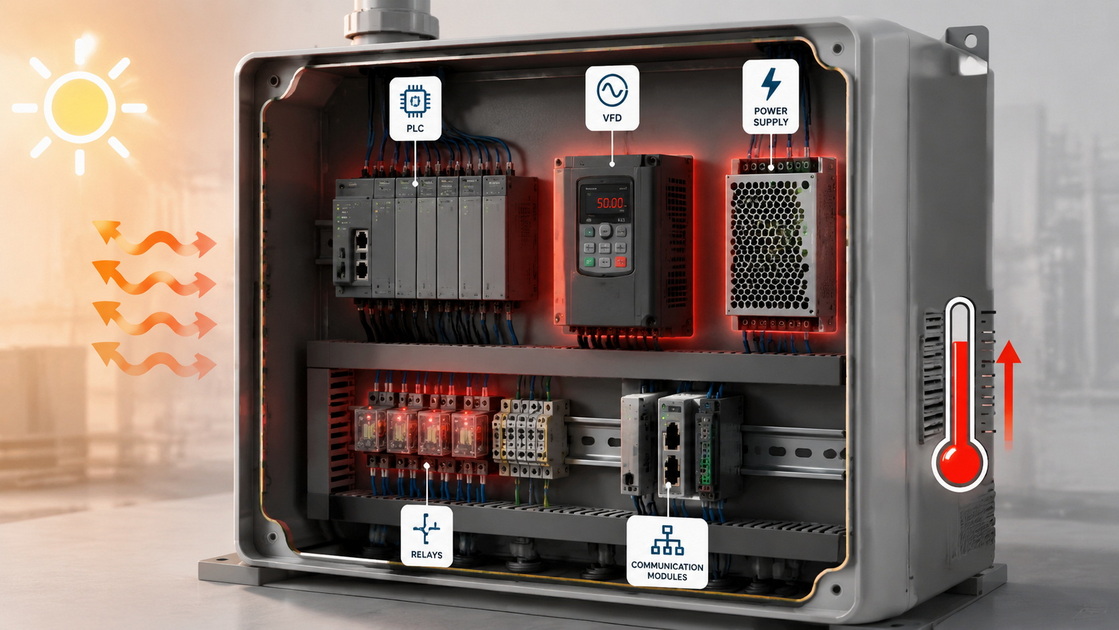
Heat load is the total power converted to heat inside the enclosure. To estimate: [thermaledge]
1. List all components (PLCs, drives, relays, power supplies, contactors, communication modules). [thermaledge]
2. Obtain each component's power loss or power consumption, usually from datasheets. [thermaledge]
3. For simple devices (relays, contactors), heat loss ≈ coil wattage; for PLCs, use the power supply power consumption. [thermaledge]
4. For VFDs/rectifiers, calculate heat loss as \(P_{\text{loss}} = P_{\text{output}} \times (1 - \eta)\), where \(\eta\) is efficiency. [thermaledge]
Example from industry guidance:
- A 10 kW VFD with 90% efficiency produces about 1 kW of waste heat. [thermaledge]
Add all the individual losses together to obtain the total internal heat load (W). [thermaledge]
As an enclosure manufacturer, we sometimes provide engineering support to help customers estimate the heat load, especially when large drives or power supplies dominate the thermal profile. [eabel]
Even with the same internal heat load, enclosure temperature differs significantly depending on:
- Enclosure size: Larger enclosures often run cooler because heat spreads over a larger surface area. [pcbway]
- Material and color: Metal vs. plastic, light-painted vs. dark-painted surfaces, insulation layers. [eabel]
- Installation: Free-standing with air circulation vs. recessed in a wall or clustered with other cabinets. [edadirect]
- Solar radiation: Outdoor enclosures in direct sun can experience dramatic internal temperature rises unless shaded or insulated. [thermaledge]
Technical white papers on enclosure thermal design highlight that conduction, convection, and radiation all contribute to heat transfer, and good design can reduce the required cooling capacity or even avoid active cooling entirely for some applications. [edadirect]
For customers in solar farms, EV charging stations, and energy storage, we frequently recommend shading elements or sun shields plus high-reflectivity coatings as low-cost measures to reduce solar gain before considering heavy-duty air conditioning. [rs-online]
Once you know the heat load and environmental conditions, you can estimate internal temperature in two main ways:
- Analytical or simplified formulas (taking into account enclosure surface area, heat transfer coefficients, and temperature difference). [eabel]
- Online enclosure temperature management (ETM) calculators offered by thermal management vendors. [thermaledge]
Several industrial sources recommend using ETM calculators rather than purely manual computation because the calculations are complex and must account for multiple correction factors. These tools typically ask for: [thermaledge]
- Enclosure dimensions and material. [thermaledge]
- Internal heat load (W). [thermaledge]
- Ambient temperature. [thermaledge]
- Environmental factors such as solar radiation and mounting conditions. [eabel]
The calculator then outputs either the expected internal temperature with natural convection or the required cooling capacity to keep the enclosure at a specified target temperature. [thermaledge]
If the predicted internal temperature is higher than your allowable limit, you definitively know that cooling is required. [thermaledge]
Before jumping to active cooling, evaluate whether passive measures can keep the enclosure within limits. These may include: [resources.sw.siemens]
- Increasing enclosure size to enhance natural convection. [pcbway]
- Improving internal layout to minimize hot spots and allow airflow around critical components. [pcbway]
- Using perforated or louvered panels (for indoor, clean environments) where protection rating allows it. [rs-online]
- Selecting more efficient devices to reduce heat generation. [resources.sw.siemens]
If these measures, confirmed by calculation or simulation, keep internal temperature below the target, additional cooling might not be required. However, if ambient temperatures are high or the environment is dirty or humid, natural ventilation often proves insufficient, and you will need active solutions. [resources.sw.siemens]
When your evaluation shows that cooling is required, the next question is: which method best fits your application, cost constraints, and environmental conditions? [thermaledge]
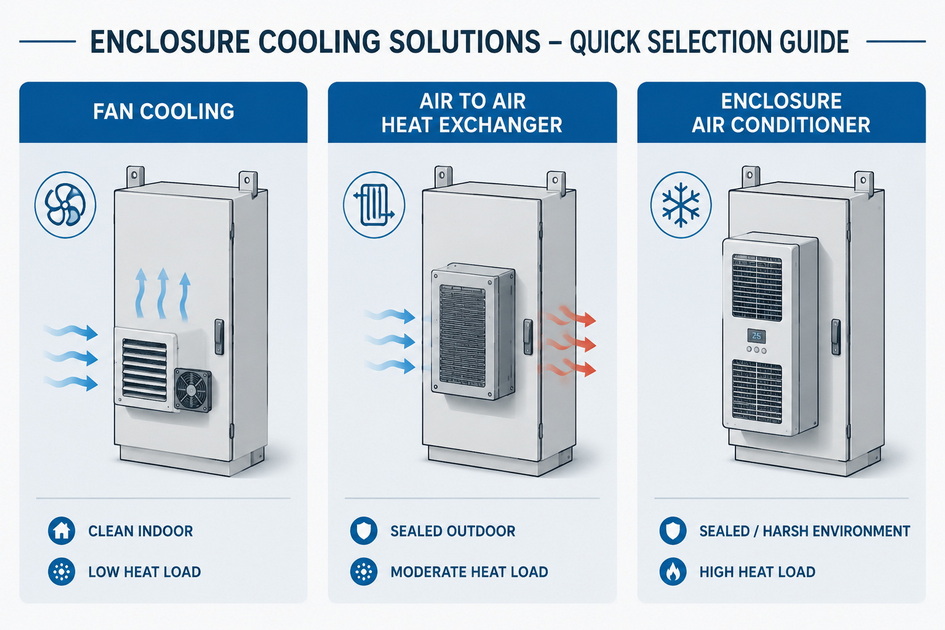
| Cooling method | Typical use case | Pros | Cons |
|---|---|---|---|
| Filtered fan (forced convection) | Clean, indoor environments with ambient below target temperature. thermaledge | Low cost, simple installation, good for moderate heat loads. thermaledge | Not suitable for dusty, corrosive or wet environments. thermaledge |
| Passive heat sinks/vented design | Low to moderate heat loads, good convection paths. resources.sw.siemens | No moving parts, low maintenance, silent. resources.sw.siemens | Limited capacity, depends strongly on ambient. eabel |
| Air-to-air heat exchanger | Sealed enclosures when ambient lower than internal target. thermaledge | Maintains NEMA/IP rating, moderate energy use. thermaledge | Cannot cool below ambient; requires careful sizing. thermaledge |
| Enclosure air conditioner | High heat load, high ambient, dirty or humid environment. thermaledge | Can cool below ambient, maintains sealed enclosure. thermaledge | Higher cost, power consumption, requires maintenance. thermaledge |
Industry guidance emphasizes that fan-based solutions work well when ambient is significantly lower than the desired internal temperature and the environment is clean, while closed-loop solutions (heat exchangers or air conditioners) are preferred when you must keep dust, moisture, or corrosives out of the enclosure. [rs-online]
A recurring pattern we see with customers is that cooling is often treated as an afterthought, added only when temperatures start to cause problems during commissioning. Thermal management specialists recommend the opposite: plan cooling during the enclosure design phase. [thermaledge]
Benefits include:
- More efficient equipment layout with clear airflow paths and separation of high-heat devices like VFDs. [pcbway]
- Ability to select enclosure size, mounting style, and door opening direction to support thermal performance. [thermaledge]
- Option to specify larger enclosures or modular enclosures that run cooler and are easier to cool with smaller, more efficient systems. [resources.sw.siemens]
From our manufacturing experience at Ningbo Bohui Electric, early collaboration with the customer's electrical and mechanical teams often leads to:
- Reduced cooling capacity thanks to better layout and enclosure design.
- Improved maintainability, since filters, fans, and air conditioners are placed in accessible positions.
- Fewer field modifications and retrofits, which can compromise IP/NEMA ratings and introduce new leakage paths.
Consider a typical industrial pumping station control panel containing PLCs, motor starters, and a VFD driving a large pump. [blog.airlinehyd]
- Internal heat load: dominated by the VFD and contactors, producing hundreds of watts of heat. [thermaledge]
- Environment: outdoor enclosure, high summer ambient, exposure to sun and possible water spray. [blog.airlinehyd]
- Requirement: NEMA 4 or IP66 for protection against rain and splashing water. [rs-online]
Following best-practice methods, engineers compute the total heat load and observe that even with natural convection, internal temperatures would exceed recommended limits on hot days. Because the environment is dusty and wet, filtered fans are not suitable; instead, they choose a closed-loop enclosure air conditioner sized for worst-case conditions and integrate shading elements to reduce solar gain. [blog.airlinehyd]
In our projects, we often support such customers by providing custom stainless steel enclosures with pre-cut openings and mounting plates for climate control units, ensuring that mechanical integration and sealing are maintained. [rittal]
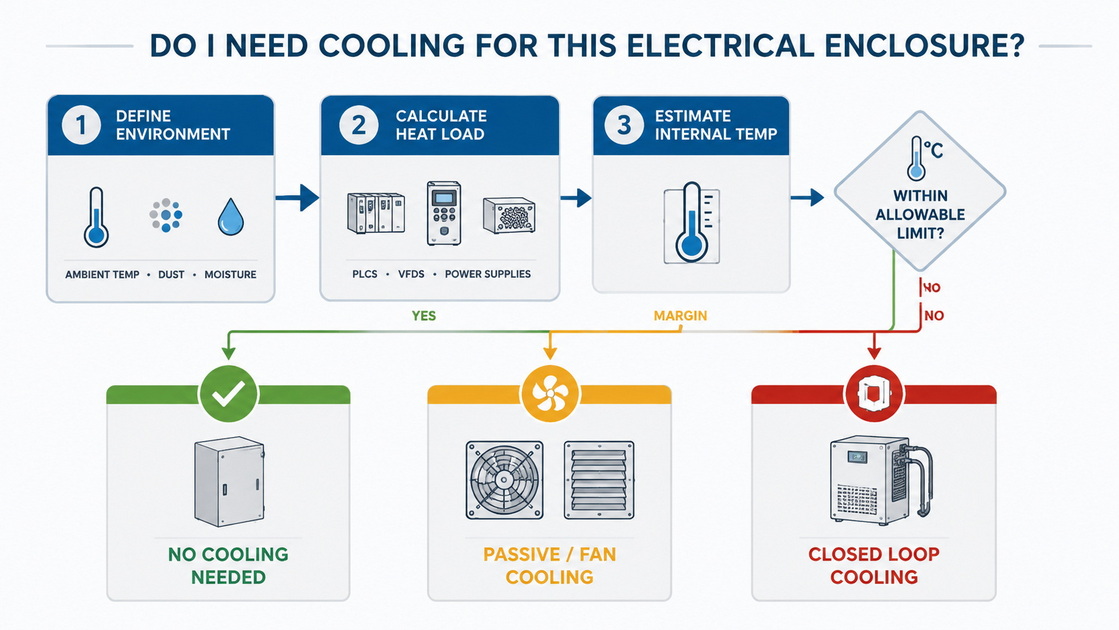
For daily engineering work, a simple decision flow can accelerate evaluations:
1. Is the enclosure in a harsh environment (dust, moisture, chemicals, high ambient)?
- If yes, favor sealed enclosure and consider closed-loop cooling if heat load is significant. [thermaledge]
2. Is ambient temperature close to or higher than component limits?
- If yes, passive ventilation alone is unlikely to be sufficient. [thermaledge]
3. Is internal heat load > 100–200 W for small enclosures or higher for larger ones?
- If yes, perform a heat load calculation or use an ETM calculator to confirm. [thermaledge]
4. Does quick calculation or ETM tool predict internal temperature above target?
- If yes, cooling is required, and you should select an appropriate method and size it properly. [thermaledge]
By standardizing such a checklist across your engineering team, you improve consistency and reduce the risk of missing critical thermal issues in complex projects.
Even when cooling is required, you can reduce capacity and energy use by following proven design practices. [resources.sw.siemens]
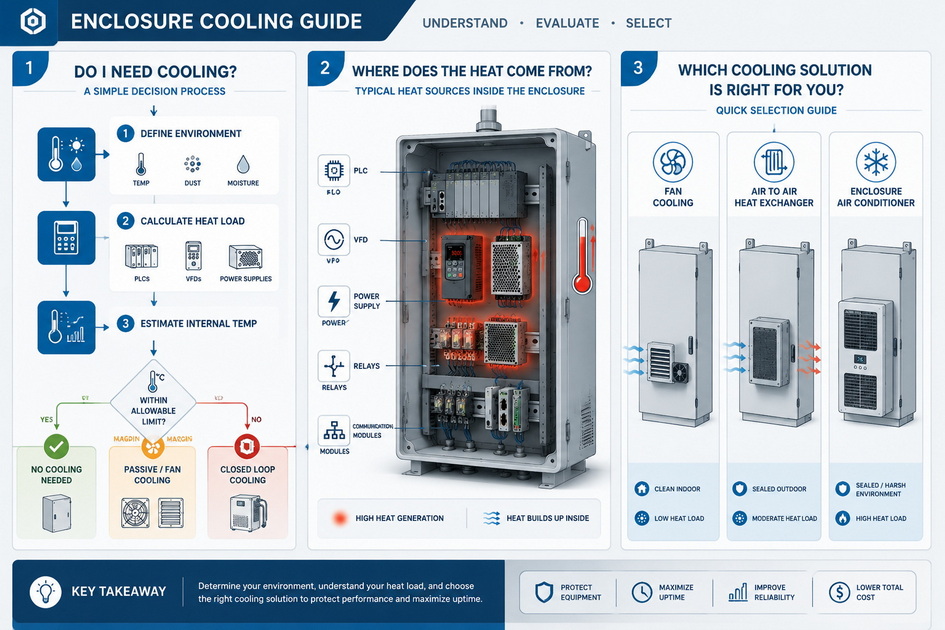
- Optimize airflow: Arrange inlet and outlet so that cool air flows from bottom-front to top-rear in fan-cooled systems, and ensure no components block airflow in closed-loop systems. [pcbway]
- Avoid stacking heat sources: Do not place high-loss components (e.g., VFDs, power supplies) above each other or above other heat producers; respect vendor spacing guidelines. [thermaledge]
- Seal correctly: For sealed cooling, ensure all cable entries, doors, and joints are properly sealed, since leaks reduce cooling efficiency and allow contaminants in. [thermaledge]
- Protect from external heat: Install enclosures away from ovens, furnaces, or direct sun; use shades or baffles when unavoidable. [thermaledge]
- Use intelligent controls: Use digital controllers, thermostats, and remote monitoring to ensure cooling equipment runs only when needed and to detect abnormal temperature rise early. [thermaledge]
These measures not only reduce the size and cost of cooling systems but also improve long-term reliability and energy efficiency. [resources.sw.siemens]
As a dedicated manufacturer of industrial electrical enclosures, we support customers across sectors such as power, telecom, networking, industrial automation, building systems, energy storage, EV charging, and pump control with enclosure solutions designed to integrate thermal management seamlessly. [rittal]
Typical value-added services include:
- Guidance on enclosure selection (size, material, protection rating) to match your thermal and environmental needs. [rittal]
- Pre-engineered mounting provisions for fans, heat exchangers, and air conditioners, simplifying integration and preserving sealing performance. [rittal]
- Customization for new energy and EV applications, where compact layouts and high power densities make thermal management critical. [blog.airlinehyd]
By engaging with our engineering team early in your project, you can make informed decisions about whether cooling is required and choose the most reliable, cost-effective solution compatible with your enclosure design.
If you are planning or upgrading electrical enclosures for industrial control, energy storage, EV charging, water pumping, or building systems, we recommend performing a structured heat load and thermal assessment before finalizing your design. Based on your component list, environment, and reliability targets, Ningbo Bohui Electric Co., Ltd. can help you determine whether cooling is required and provide enclosure solutions optimized for your specific thermal management strategy.
The simplest method is to calculate the internal heat load, note the maximum ambient temperature, then use an enclosure temperature management calculator to see whether the predicted internal temperature exceeds your components' limits. [thermaledge]
In clean, indoor environments with ambient temperatures well below the component limits, vents and passive convection may be adequate, especially for low heat loads and larger enclosures. However, in hot, dusty, or wet environments, passive vents often cannot maintain safe temperatures or required IP/NEMA ratings. [resources.sw.siemens]
Many thermal management recommendations suggest designing the enclosure internal temperature to be about 20 °F (11 °C) below the equipment's maximum allowable temperature to improve lifetime and reliability. This margin helps accommodate measurement uncertainties and unexpected ambient peaks. [blog.airlinehyd]
Closed-loop systems (air-to-air heat exchangers or air conditioners) are recommended when you must keep dust, moisture, or corrosive substances out of the enclosure, or when you need to cool the enclosure below ambient temperature. They are particularly important for outdoor installations and washdown environments. [blog.airlinehyd]
Best-practice guidance suggests regular inspections of filters, fans, and condensers, along with periodic verification of enclosure temperature and remote alarms. Proper maintenance ensures that cooling systems continue to provide the designed capacity and prevents unexpected thermal failures. [pim.galco]
1. Thermaledge. "How to Know How Much Cooling an Industrial Control Panel Needs." (2023). [thermaledge]
https://thermaledge.com/how-to-know-how-much-cooling-an-industrial-control-panel-needs/
2. Thermaledge. "5 Key Steps in Enclosure Cooling Design." [thermaledge]
https://thermaledge.com/5-key-steps-in-enclosure-cooling-design/
3. Thermaledge. "4 Electrical Component Cooling Best Practices." [thermaledge]
https://thermaledge.com/4-electrical-component-cooling-best-practices/
4. ThermalEdge / Siemens. "A Complete Guide to Enclosure Thermal Design – 14 Key Considerations." [edadirect]
https://resources.sw.siemens.com/en-US/white-paper-electronics-enclosure-thermal-design-guide/
5. RS Components. "What Are the Best Methods for Cooling Electrical Enclosures?" (2021). [rs-online]
https://www.rs-online.com/designspark/what-are-the-best-methods-for-cooling-electrical-enclosures
6. Airline Hydraulics. "Top Solutions for Cooling Electrical Enclosures." (2024). [blog.airlinehyd]
https://blog.airlinehyd.com/enclosure-climate-control-101
7. Eabel. "Heat Transfer Mechanisms & Cooling Solutions for Electrical Enclosures." (2025). [eabel]
https://www.eabel.com/heat-transfer-mechanisms-and-cooling-solutions-for-electrical-enclosures/
8. Nemaco. "Electrical Enclosure Cooling Calculations | NEMACO™." (2026). [nemaco]
https://www.nemaco.com/blogs/electrical-enclosure-cooling-methods-calculations-and-system-selection

2026-07-26

2026-07-24


