


Views: 222 Author: Bohui Electric Publish Time: 2026-06-16 Origin: Site


Content Menu
● What Is a Steel Electrical Enclosure?
● Why Steel Is Used for Electrical Enclosures
● Step‑by‑Step: How a Steel Electrical Enclosure Is Made
>> 1. Requirement Definition and Engineering Design
>> 2. Sheet Metal Blanking: Laser Cutting and Punching
>> 3. Bending and Forming: Creating the Enclosure Body
>> 4. Welding, Riveting, and Mechanical Assembly
>> 5. Surface Preparation and Anti‑Corrosion Treatment
>> 6. Gasket, Door, and Hardware Installation
>> 7. Electrical Enclosure Quality Control and IP Testing
>> 8. Packaging, Logistics, and On‑Site Installation
● Real‑World Use Cases: Where Steel Wall Mounted Enclosures Are Used
● Key Design Choices That Affect Performance
● Typical Manufacturing Flow for a Wall Mounted Enclosure (Table)
● Expert Tips for Buyers Evaluating Steel Enclosure Manufacturers
● Call to Action: From Design Concept to Reliable Wall Mounted Enclosures
● FAQ: Steel Electrical Enclosure Manufacturing
>> 1. What is the typical lead time for a custom steel electrical enclosure?
>> 2. How do I choose between mild steel, galvanized steel, and stainless steel?
>> 3. What IP rating do I need for outdoor wall mounted enclosures?
>> 4. Can cable entries and cut‑outs be customized?
>> 5. How is enclosure quality verified before shipment?
A steel electrical enclosure is made through a tightly controlled process that combines precision sheet metal fabrication, surface treatment, sealing, and rigorous testing to meet demanding electrical safety standards. As a wall mounted enclosure manufacturer in Ningbo, our daily work is essentially repeating and refining this process thousands of times to serve power, communication, industrial automation, building, and new energy projects worldwide. [wrekinsheetmetal.co]
A steel electrical enclosure is a protective metal housing that safely contains electrical components such as breakers, terminals, PLCs, communication devices, and control systems. It shields equipment from dust, moisture, mechanical impact, and unauthorized access while helping engineers meet standards like IP65, NEMA, and CE. [bohuitechnology]
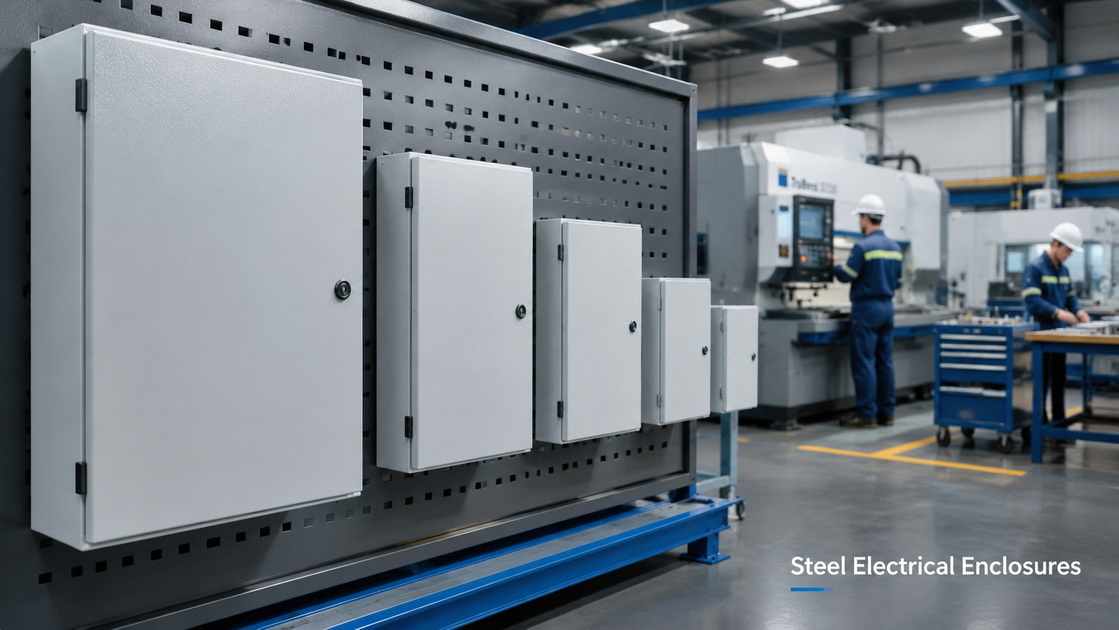
For wall mounted electrical enclosures, the design must balance three priorities: mechanical strength, corrosion resistance, and ease of installation and maintenance. In real projects, this means the enclosure must survive outdoor rain, indoor humidity, vibration from machines, or even corrosive atmospheres in new energy and industrial environments. [kdmsteel]
Steel remains the dominant material for industrial enclosures because it offers an excellent strength‑to‑cost ratio and is easy to fabricate with modern CNC equipment. Mild steel can be laser‑cut, bent, and welded efficiently, while stainless steel and galvanized steel offer superior corrosion resistance for harsh environments. [nemaenclosures]
For wall mounted enclosures, the most common options include: [wrekinsheetmetal.co]
- Cold‑rolled (mild) steel with powder coating for indoor or light outdoor use.
- Galvanized steel where added zinc protection against rust is required.
- Stainless steel (304/316) for food, chemical, coastal, or high‑corrosion environments.
In our own projects, the material is typically selected together with the customer at the quotation and design stage, based on IP rating, installation environment, and cost targets. [bohuielectric]
Below is an overview of how a steel electrical enclosure moves from engineering drawing to finished, wall‑mounted cabinet on site. [kdmfab]
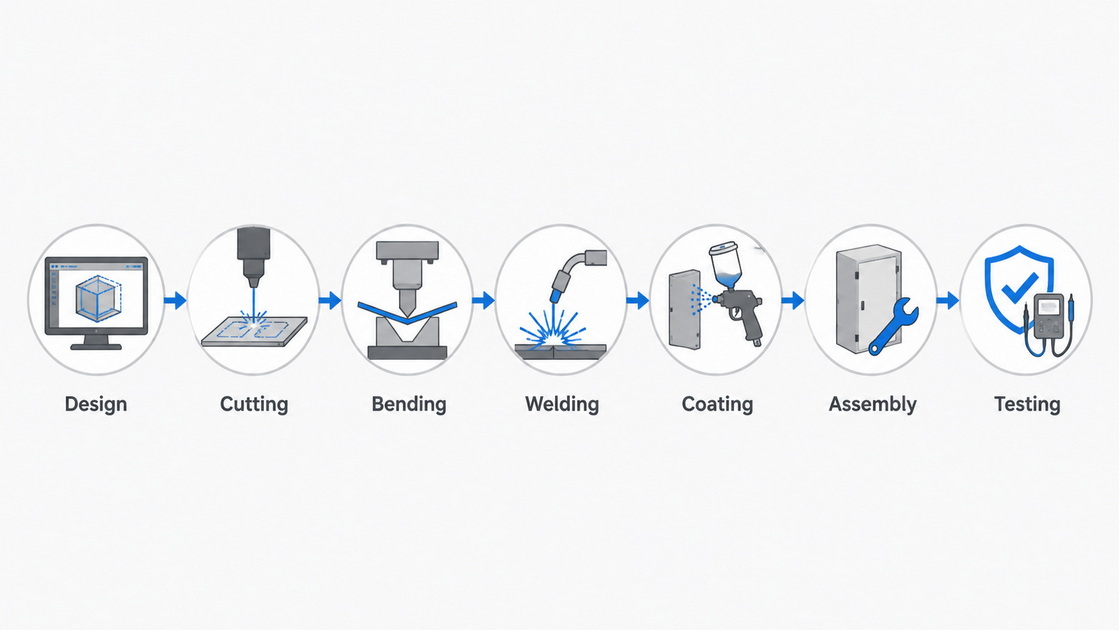
very enclosure starts with a requirements discussion between the customer and the engineering team. For OEM and project customers, this normally includes enclosure type (wall mounted, floor standing, modular), dimensions, door configuration, mounting features, and target standards (e.g. IP65). [dalsinind]
From there, engineers create 3D models and manufacturing drawings, specifying sheet thickness (e.g. 1.2–2.0 mm steel), bend radii, weld locations, reinforcement ribs, and mounting points for DIN rails, backplates, or busbars. In our factory, this CAD data is directly linked to CNC programming for laser cutting and panel bending, which minimizes manual errors and shortens lead times. [protocase]
nce the design is frozen, production begins with blanking—cutting flat steel sheets to shape. Modern sheet metal plants use laser cutting machines and CNC punching machines to produce door panels, side walls, brackets, and mounting plates with high accuracy. [bohuitechnology]
Key operations at this stage include: [kdmfab]
- Laser cutting openings for cable glands, ventilation slots, and windows.
- CNC punching for repeating patterns, knock‑outs, and mounting holes.
- Labeling and nesting parts to maximize material utilization and traceability.
At Ningbo Bohui, we run 24/7 CNC equipment for mass orders, combining different enclosure sizes on the same sheet to reduce scrap and cost for customers. [bohuitechnology]
fter blanking, flat parts go to CNC bending and panel forming lines. Here, programmed bending sequences create the three‑dimensional shape of the enclosure—sides, flanges, reinforcement bends, and door returns. [protocase]
Why bending quality matters for a wall mounted enclosure: [wrekinsheetmetal.co]
- Door alignment: precise bends ensure the door closes evenly and seals properly.
- Structural strength: well‑designed bends add rigidity without extra material.
- Mounting accuracy: back bends and mounting flanges must match wall brackets and backplates.
Our bending operators work closely with process engineers to fine‑tune tooling for repeatability across large batches, which is critical when the same enclosure is used on hundreds of cabinets in a smart factory or power project. [bohuitechnology]
nce bent, parts move to welding and mechanical assembly. For most steel electrical enclosures, this includes spot welding or MIG/TIG welding, plus riveting or clinching where welding is not ideal. [dalsinind]
Typical operations: [kdmfab]
- Welding corners and seams to form the rigid box.
- Adding hinge supports, reinforcement plates, and mounting brackets.
- Fixing studs, nuts, and hardware using self‑clinching fasteners or welding.
In our workshop, we use a combination of robotic welding for high‑volume parts and manual welding for customized enclosures, to balance efficiency with flexibility. Each welded enclosure is visually inspected, and critical joints are checked to avoid warping that may affect door sealing. [dalsinind]
efore coating, the steel surface must be thoroughly cleaned. This typically involves degreasing, pickling, phosphating, and rinsing to remove oil, rust, and contaminants and to improve paint adhesion. [eabel]
Depending on project requirements, three main surface solutions are used: [nemaenclosures]
- Galvanizing: a zinc coating that protects the steel substrate from corrosion, often via hot‑dip or electro‑galvanizing.
- Powder coating: applying dry powder and curing at high temperature to form a hard, uniform finish that resists scratches and corrosion.
- Stainless steel: relying on the material's natural corrosion resistance, sometimes with additional passivation.
For many IP65 wall mounted enclosures, a powder‑coated mild steel solution offers the best balance of durability, color flexibility, and cost. [bohuielectric]
fter coating, the enclosure body and door are ready for final mechanical assembly. At this stage, technicians install: [kdmsteel]
- Polyurethane or EPDM gaskets around the door frame to achieve IP65 dust‑ and water‑tight sealing.
- Door hinges (concealed or visible) and lock systems (key locks, quarter‑turn latches, or multi‑point handles).
- Wall mounting brackets, lifting lugs, and internal mounting plates for electrical equipment.
For Bohui wall mounted enclosures, foam‑in‑place gaskets can be applied in automated lines, improving consistency of sealing and reducing labor time compared with manually glued seals. [eabel]
igh‑quality steel electrical enclosures must undergo functional and protection testing before shipment. Common test items include: [kdmsteel]
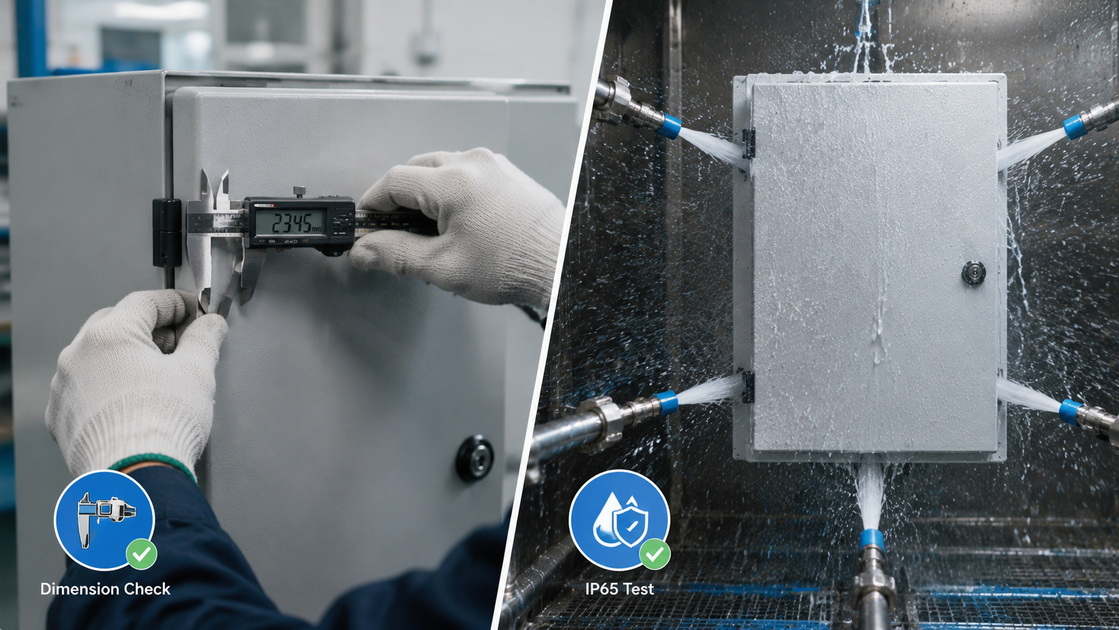
- Dimensional checks: verifying length, width, depth, and mounting points against drawings.
- Door operation and lock tests: ensuring smooth opening and closing and secure locking.
- Surface inspection: checking coating thickness, color, and finish for defects.
- Ingress protection (IP) testing: for IP65, tests simulate dust exposure and water jets to confirm sealing performance.
Our factory holds CE and IP65 certifications for many enclosure models, and we perform regular sample testing to ensure ongoing compliance, especially for export projects to Europe, Australia, the Middle East, and Southeast Asia. [bohuitechnology]
nce passed, enclosures are carefully packaged to prevent coating damage during international transport. Palletization, corner protection, and moisture‑resistant wrapping are commonly used for export shipments. [dalsinind]
For wall mounted enclosures, customers typically receive: [dalsinind]
- Individual cartons or palletized sets with hardware kits.
- Clear labels indicating model, size, and IP rating.
- Optional installation guides or drilling templates.
In real projects—from industrial automation lines to new energy storage systems—installers mount the enclosure to walls or support frames, feed cables through knock‑outs or gland plates, and then integrate breakers, PLCs, communication modules, or power electronics into the cabinet. [bohuitechnology]
Because of their robustness, steel electrical enclosures are widely used across industrial and infrastructure sectors. Ningbo Bohui's wall mounted enclosures are applied in: [bohuitechnology]

- Power distribution: low‑voltage distribution boxes, metering cabinets, and control panels.
- Communication and network: telecom distribution boxes and network equipment housings.
- Industrial automation: PLC control cabinets, sensor junction boxes, machine control panels.
- Building and HVAC: building management systems, pump control, fan and motor control.
- New energy and EV: charging station control boxes, energy storage system interfaces, and auxiliary power cabinets.
In these scenarios, the enclosure is not just a box—it is a safety barrier and reliability guarantee that directly influences system uptime and maintenance cost. [nemaenclosures]
rom an engineer's perspective, small design decisions can dramatically change enclosure performance and lifecycle cost. When we consult with customers, we often focus on: [protocase]
- Material and thickness: balancing mechanical strength, corrosion resistance, weight, and budget. [wrekinsheetmetal.co]
- IP rating and sealing structure: gasket type, door overlap design, and cable entry plan for dust/water exposure. [eabel]
- Thermal management: potential need for vents, fans, heat exchangers, or sunshield panels to avoid overheating. [dalsinind]
- Mounting and access: wall brackets, removable doors, internal swing frames, and space for wiring tools. [kdmsteel]
For customers in industrial smart manufacturing and new energy, we increasingly see requirements for custom punched patterns, special lock systems, and integrated climate‑control features, all of which can be integrated at the design stage rather than modified on site. [bohuielectric]
he table below summarizes the main stages in a wall mounted steel electrical enclosure project from a manufacturer's viewpoint. [kdmfab]
| Stage | Main Activities | Key Outcomes |
|---|---|---|
| Engineering & Design | Requirements discussion, 3D modeling, drawings, CNC programming | Confirmed dimensions, material, IP rating, and production files |
| Blanking | Laser cutting, CNC punching, part labeling | Accurate flat parts ready for forming |
| Bending & Forming | CNC panel bending, forming flanges and ribs | Box components with precise geometry |
| Welding & Assembly | Welding, riveting, installing studs and brackets | Rigid enclosure body and door assemblies |
| Surface Treatment | Cleaning, phosphating, galvanizing, powder coating | Corrosion‑resistant, finished surfaces |
| Final Assembly | Gasket, hinges, locks, mounting accessories | Fully assembled enclosure with IP sealing |
| Testing & Packaging | Dimensional check, IP tests, visual inspection, packing | Certified enclosure ready for shipment and installation |
rom an industry and buyer's perspective, choosing the right steel enclosure supplier can significantly reduce project risk. Based on common issues seen in the field, consider these factors: [dalsinind]
- Process capability: look for factories with laser cutting, CNC bending, welding, and surface treatment in‑house to avoid quality gaps between subcontractors. [dalsinind]
- Certification and testing: confirm IP and CE reports, and ask how often they conduct re‑testing for standard models. [eabel]
- Customization support: check whether engineering teams can support small modifications (extra knock‑outs, special locks, non‑standard sizes) without long lead times. [bohuielectric]
- Export experience: for global projects, suppliers with regular shipments to the US, Europe, and Asia typically understand compliance and packaging requirements better. [bohuitechnology]
Ningbo Bohui positions itself as a one‑stop sheet metal enclosure partner, integrating design, fabrication, surface finishing, and assembly under one roof to reduce communication and logistics complexity for international customers. [bohuitechnology]
f you are planning a new power, communication, industrial automation, or new energy project, selecting the right steel electrical enclosure early will save time and rework later. By partnering directly with a manufacturer that combines engineering support, advanced sheet metal processing, and proven IP65 performance, you can move from CAD drawing to on‑site installation with fewer surprises. [nemaenclosures]
For custom wall mounted enclosures, you can share your drawings, specifications, or sample photos and request optimized solutions on materials, sizes, surface finishing, and accessories based on your installation environment and budget. [dalsinind]
Lead times vary by complexity, but with in‑house laser cutting, bending, welding, and coating, many manufacturers can deliver standard or slightly customized designs in a matter of weeks for medium‑sized batches. [dalsinind]
Mild steel with powder coating suits general indoor or light outdoor applications, galvanized steel adds rust protection in more aggressive environments, and stainless steel (304/316) is preferred for high‑corrosion or hygienic sites like coastal, food, or chemical facilities. [nemaenclosures]
For most outdoor installations exposed to rain and dust, IP65 is a common baseline, providing dust‑tight protection and resistance to water jets; more extreme conditions may require additional design measures or higher ratings. [kdmsteel]
Yes, CNC punching and laser cutting allow manufacturers to customize knock‑outs, gland plate openings, and window cut‑outs according to your wiring layout, which reduces on‑site cutting and maintains coating integrity. [kdmfab]
Manufacturers typically perform dimensional checks, coating inspection, door and lock function tests, and, for certified models, regular IP and performance tests according to relevant standards such as IP65 and CE. [eabel]
1. Wrekin Sheetmetal – "What Is The Steel Enclosure Manufacturing Process?"
https://www.wrekinsheetmetal.co.uk/what-is-the-steel-enclosure-manufacturing-process/ [wrekinsheetmetal.co]
2. KDM – "Electrical Enclosure Manufacturing Process in 7 Steps"
https://kdmfab.com/electrical-enclosure-manufacturing-process/ [kdmfab]
3. Ningbo Bohui Technology Co., Ltd. – Company and Product Information
https://www.bohuitechnology.com [bohuitechnology]
4. Ningbo Bohui Technology – Customized Enclosure Products
https://bohuitechnology.com/lists/29-4-.html [bohuitechnology]
5. Bohui Electric – Electrical Enclosure Product Range
https://www.bohuielectric.com/fil/ [bohuielectric]
6. NEMA Enclosures – Electrical Enclosure Materials
https://www.nemaenclosures.com/materials/ [nemaenclosures]
7. Eabel – "Step‑by‑Step Guide to Electrical Enclosure Manufacturing"
https://www.eabel.net/knowledge-of-electrical-enclosures-en/step-by-step-guide-to-electrical-enclosure-manufacturing/ [eabel]
8. Dalsin Industries – Custom Electrical Enclosure Fabrication
https://www.dalsinind.com/custom-electrical-enclosure.html [dalsinind]
9. Protocase – "Electronic Enclosure Design 101 – Sheet Metal Design Guide"
https://www.protocase.com/blog/2017/02/16/electronic-enclosure-design-101/ [protocase]

2026-07-26

2026-07-24


