


Views: 222 Author: Bohui Electric Publish Time: 2026-05-19 Origin: Site


An AC junction box is a specialized electrical enclosure designed to house and protect connections for alternating current (AC) wiring systems. It serves as a controlled, code‑compliant space where conductors can be spliced, branched, or terminated without exposing live parts to dust, moisture, or accidental contact. [semrush]
In practical terms, whenever you see multiple cables entering a wall, ceiling, machine, or outdoor pedestal and converging in one protected point, there is almost always a junction box behind it. The box provides mechanical protection, fire risk reduction, and easier maintenance, all of which are now essential requirements across power, communications, industrial automation, and new energy sectors. [bohuitechnology]
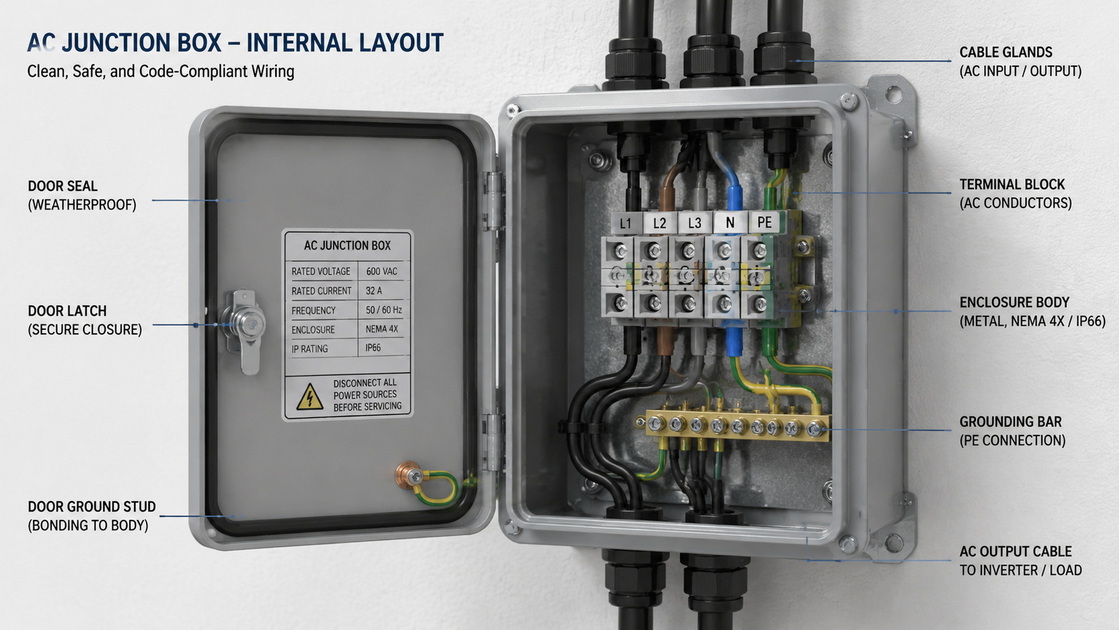
From a safety engineer's perspective, the junction box is where you either control risk or concentrate it. When connections are left exposed or buried without a box, you increase the probability of arcing, overheating, and difficult fault‑finding later. [yg-enclosure]
Key safety roles include: [semrush]
- Shock protection – live conductors are isolated from touch by a rigid enclosure and cover.
- Fire prevention – the box contains any sparks or hot particles from loose connections or insulation breakdown.
- Environmental sealing – weatherproof designs keep out moisture, dust, and corrosive agents that can degrade insulation.
- Code compliance – electrical codes and standards explicitly require junction boxes at splice points and terminations, and mandate that they remain accessible for inspection and repair. [yg-enclosure]
For project owners and EPC contractors, code‑compliant junction boxes also reduce liability risk, improve inspection outcomes, and stabilize the total cost of ownership over the system's life.
An AC junction box does more than just "hold wires"; it provides a structured interface between the wiring and the environment. [semrush]
Typical functions: [yg-enclosure]
- Provide a safe space for wire terminations and branching of the same circuit.
- Organize conductors so each connection can be traced, tested, and serviced.
- Create strain relief and cable routing to prevent mechanical damage at entry points.
- Maintain required creepage and clearance distances to avoid tracking and flashover.
Key features commonly found in quality AC junction boxes include: [semrush]
- Rigid body and cover (metal, engineered plastic, or fiberglass) with secure fastening.
- Knockouts or gland holes that accept certified cable glands or conduit fittings.
- Grounding studs or bars to ensure continuous protective earth.
- Options for weatherproofing (gaskets, IP65–IP68 sealing) and corrosion resistance for outdoor, coastal, or industrial environments. [alibaba]
> Recommended visual: Insert a labeled diagram of an AC junction box showing body, cover, cable glands, terminal block, and earth bar directly under this section to help non‑technical readers visualize the internal layout.
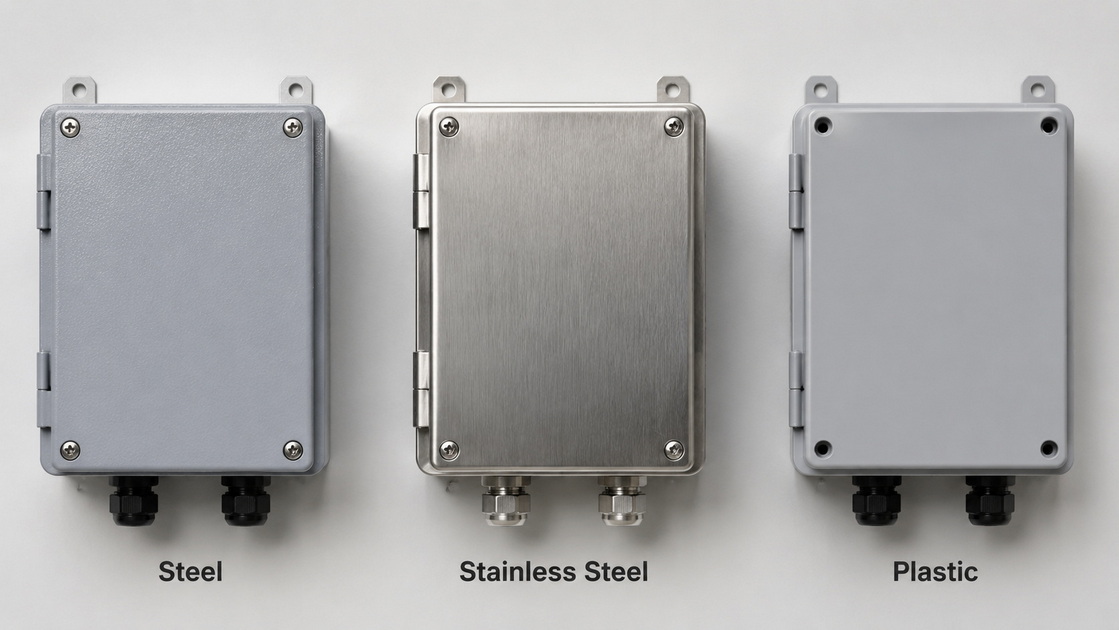
From an enclosure manufacturer's standpoint, the material choice is one of the most strategic decisions in a project, because it affects lifespan, safety, and total installed cost. [bohuitechnology]
Common materials include: [yg-enclosure]
- Steel or aluminum (sheet‑metal enclosures) – High mechanical strength, excellent grounding, and robust EMI performance; widely used in power distribution, industrial automation, and building services. [imexbb]
- PVC / engineering plastics – Lightweight, corrosion‑resistant, and easy to install; typical in residential and light commercial applications when mechanical loads are modest. [semrush]
- Fiberglass – Strong resistance to chemicals, UV, and extreme temperatures; often chosen for petrochemical plants, wastewater treatment, and coastal environments. [semrush]
- Weatherproof IP‑rated designs (IP65–IP68) – Enhanced gaskets and sealing for outdoor junction boxes in solar, EV charging, telecom base stations, and pump stations. [alibaba]
For wall‑mounted sheet‑metal junction boxes, like those produced by Ningbo Bohui, our customers in new energy storage, EV charging, and industrial IoT often require a combination of powder‑coated steel, stainless steel, and IP65 sealing, so that one enclosure can survive both indoor workshops and exposed outdoor installations. [imexbb]
> Recommended visual: A comparison photo of three enclosures (painted steel, stainless steel, plastic) in similar sizes, with captions highlighting when to choose each.
Because AC power reaches almost every sector, AC junction boxes show up in dozens of application scenarios. [bohuitechnology]
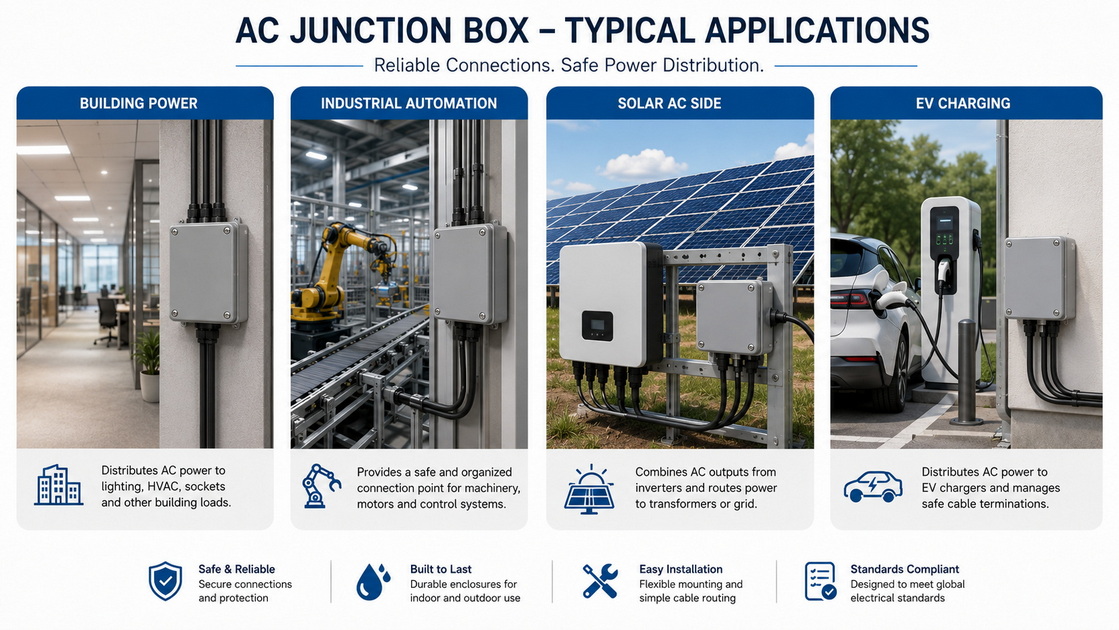
Residential and commercial buildings: [yg-enclosure]
- Ceiling and wall light fixtures, including LED drivers and dimming controls.
- Power distribution in ceilings and raised floors for offices, retail, and public buildings.
- Outdoor and landscape lighting, signage, and security camera power feeds using weatherproof boxes. [semrush]
Industrial and smart manufacturing: [bohuitechnology]
- Machine connection points where motors, sensors, or actuators are fed from a central panel.
- Cable transition points between rigid trunking, tray, and flexible conduits on production lines.
- Local junction nodes for industrial Ethernet, fieldbus, and power‑over‑Ethernet devices when combined with appropriate terminal hardware.
New energy and EV ecosystems: [bohuitechnology]
- Solar PV systems (AC side) where inverter outputs connect to distribution or combiner equipment.
- Battery energy storage systems (BESS) for AC coupling to site power or grid interconnects.
- EV charging infrastructure, where AC junction boxes support feeders to chargers, switchgear, and protection devices.
Water pumps, HVAC, and infrastructure: [yg-enclosure]
- Pump cabins, booster stations, and HVAC units where external power and control cables are landed.
- Municipal lighting, traffic systems, and smart city assets, often using stainless or high‑IP wall‑mounted enclosures.
AC junction boxes often appear side by side with DC junction boxes, especially in solar and storage projects, but they are optimized for very different conditions. [semrush]
Key differences include: [semrush]
- Type of current
- AC junction boxes combine and distribute alternating current after it has been converted by inverters, typically at 120 V, 240 V, or 480 V. [semrush]
- DC junction boxes manage higher‑voltage direct current from PV strings (often several hundred volts up to 1,000+ V) before the inverter. [semrush]
- Internal components
- AC boxes generally use AC circuit breakers, contactors, and monitoring devices rated for AC switching. [semrush]
- DC boxes rely on DC‑rated fuses, disconnects, and surge protection devices, which are designed to deal with the different arcing behavior of DC. [semrush]
- Safety behavior
- AC current naturally crosses zero, which helps extinguish arcs during interruption.
- DC current is continuous, so the enclosure design and internal clearances must be optimized to manage longer, more persistent arcs. [semrush]
Using a DC box as if it were an AC junction box (or vice versa) can result in underrated protection, excessive heating, or unsafe arc behavior, which is why project specifications must clearly distinguish AC and DC enclosures.
In larger systems—especially solar—the terms "junction box" and "combiner box" are sometimes confused, but they serve distinct roles. [semrush]
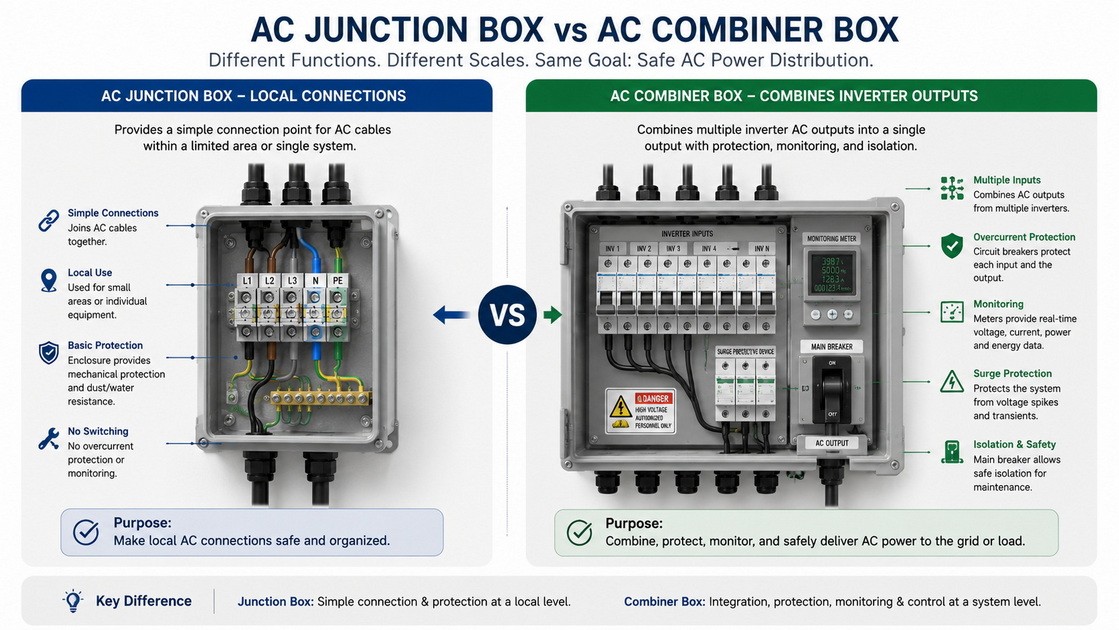
- An AC junction box focuses on protecting and organizing connections at a local point: it is a splice and termination hub for cables. [semrush]
- An AC combiner box is a higher‑level device that combines the outputs of multiple inverters or feeders into a single AC bus, usually with integrated protection and monitoring. [semrush]
Typical differences: [semrush]
- Complexity – Junction boxes are mechanically simple; combiner boxes integrate breakers, metering, communication, and sometimes switching.
- Location – Junction boxes sit close to loads or connection points; combiner boxes are placed between inverters and the main distribution or grid interface.
- Function – Junction boxes provide environmental protection and connection points; combiner boxes actively manage power flow and overcurrent protection.
For EPCs, choosing between a junction box and a combiner box is not either/or; both appear in the same single‑line diagram, fulfilling different layers of the protection and distribution hierarchy.
Based on installation feedback from electricians and integrators we work with, successful junction box projects tend to follow a consistent set of practices. [reddit]
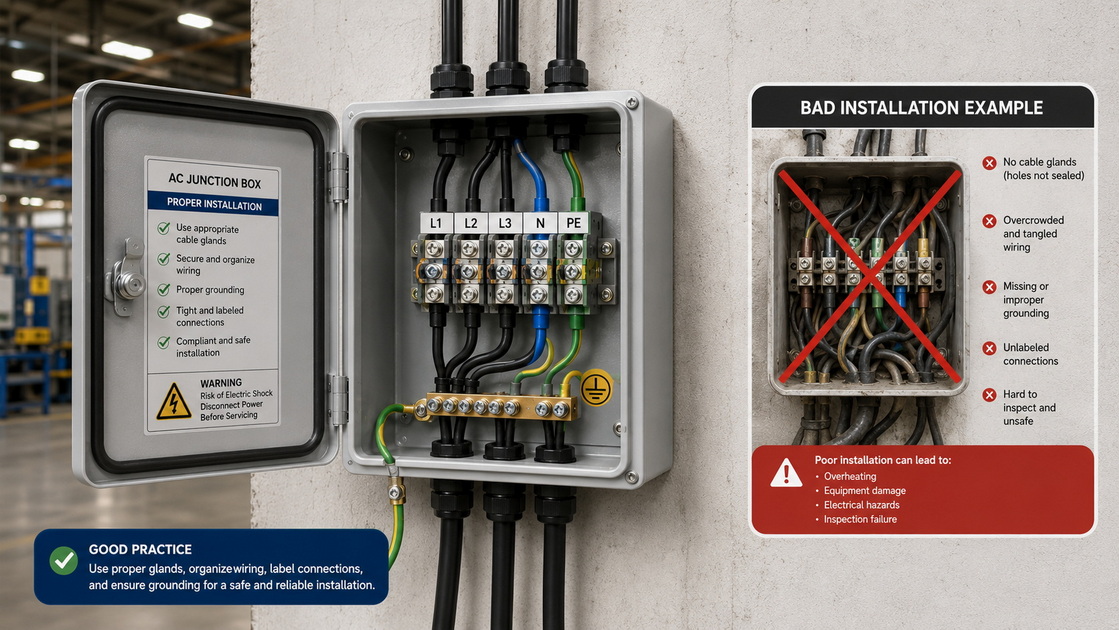
1. Size the enclosure for today and tomorrow
- Allow space for conductor bending radius, terminal blocks, and possible future circuits.
- Overspecifying by one size can dramatically improve serviceability at minimal extra cost.
2. Plan cable entry and routing
- Pre‑define gland or knockout positions to avoid on‑site improvisation that compromises sealing.
- Use proper cable glands or conduit fittings to maintain IP rating and strain relief. [semrush]
3. Maintain accessibility
- Codes require junction boxes to remain accessible for inspection and maintenance, not permanently buried behind finishes. [yg-enclosure]
- In industrial settings, accessibility also means considering door swing, adjacent piping, and safe working clearances.
4. Grounding and bonding
- Always connect metallic enclosures to the protective earth system via dedicated studs or bars. [semrush]
- For painted steel cabinets, ensure that grounding points are properly prepared to make reliable metal‑to‑metal contact. [bohuitechnology]
5. Match the environment
- For outdoor, coastal, or corrosive sites, use IP‑rated, corrosion‑resistant enclosures and stainless fasteners. [alibaba]
- In dusty or damp industrial spaces, consider higher IP rating and appropriate ventilation or breather solutions.
> Recommended visual: A simple "good vs bad" installation photo pair: one with correct gland selection and cable routing, one with overcrowded, unsealed entries.
From a specifier's viewpoint, choosing a junction box is a decision about risk, environment, and lifecycle cost, not just dimensions and price. [bohuitechnology]
You can frame the selection process in five practical steps:
1. Define the environment
- Indoor vs outdoor, clean vs dusty or corrosive, temperature extremes, vibration level.
- This drives the IP rating, material, and coating choice. [alibaba]
2. Identify electrical parameters
- Voltage level, number of circuits, conductor sizes, and fault current expectations.
- These determine required clearances, terminal types, and internal hardware ratings. [yg-enclosure]
3. Check compliance and standards
- Confirm alignment with local codes and industry standards (e.g., NEC, IEC, UL/CE as applicable in your market). [stellarcontent]
- For global OEMs, selecting enclosure platforms that can be certified across markets reduces redesign effort.
4. Plan future maintenance and expansion
- Build in spare terminal capacity and space for additional gland entries.
- Consider transparent doors or internal labeling systems to support faster troubleshooting. [yg-enclosure]
5. Align with your supply chain and customization needs
- For OEMs and system integrators, partnering with a dedicated enclosure manufacturer allows custom cutouts, pre‑installed mounting plates, and modular accessories that simplify assembly and reduce field time. [imexbb]
In recent years, we have seen three clear trends across customer projects in new energy storage, EV charging, and intelligent manufacturing.
1. Higher integration and smarter enclosures
- Customers increasingly ask for pre‑engineered enclosures that can accept sensors, metering modules, and communication devices as part of the junction box assembly.
- This reduces time spent drilling and modifying boxes on site and improves consistency and sealing performance. [wellows]
2. Stronger focus on environmental performance
- Projects in coastal, desert, or chemical environments demand enhanced corrosion protection, better gasket design, and UV‑stable coatings, even for standard wall‑mounted junction boxes. [alibaba]
- IP65 and above has become a default requirement for outdoor energy, water, and transport projects, rather than a special option. [imexbb]
3. Globalization of standards and long‑term partnerships
- International OEMs want a single enclosure platform that can be shipped worldwide, which pushes manufacturers to align with multiple standards and offer stable quality over long production runs. [stellarcontent]
- Long‑term cooperation with a specialist enclosure manufacturer simplifies design, sourcing, and life‑cycle management for complex equipment lines.
For Ningbo Bohui Electric, these trends have translated into more customized sheet‑metal junction boxes with integrated mounting solutions, special powder coatings, and project‑specific dimensional series for strategic customers in power, automation, and new energy. [imexbb]
Although plastic junction boxes are common in low‑risk environments, sheet‑metal wall‑mounted enclosures are often the better choice in demanding projects. [bohuitechnology]
They are especially suitable when:
- The installation involves industrial machinery, power distribution, or control systems that require mechanical robustness and reliable earthing. [imexbb]
- The environment exposes equipment to impact, vibration, or higher ambient temperatures, where metal performs better than plastic. [semrush]
- The design needs flexible customization—for example, cutouts for fans, meters, cable entry plates, or special mounting provisions—where metal fabrication is more practical than custom molding. [bohuitechnology]
For customers in power, communications, intelligent manufacturing, construction, and new energy, a properly specified wall‑mounted sheet‑metal junction box becomes a long‑term asset, not a consumable component.
> Recommended visual: A technical drawing or 3D render of a wall‑mounted sheet‑metal junction box with mounting holes, door, hinges, and gland plate highlighted.
If your project involves AC junction boxes for power, communications, industrial automation, new energy storage, EV charging, or pump systems, working with a dedicated enclosure manufacturer can significantly reduce risk and engineering time. [imexbb]
Ningbo Bohui Electric Co., Ltd. focuses on high‑quality sheet‑metal distribution boxes and wall‑mounted electrical enclosures, with more than 20 years of experience serving power, industrial automation, construction, communications, and new energy sectors. By collaborating early at the specification stage, we can help you choose or customize AC junction boxes that match your electrical design, environment, and compliance requirements. [imexbb]
Ready to optimize your AC junction box design? Contact our engineering team to review your single‑line diagram, enclosure list, or upcoming project, and we will propose a tailored enclosure solution that balances safety, durability, and cost‑effectiveness.
Yes. Electrical codes in most jurisdictions require splices and terminations to be enclosed in an accessible junction box to prevent shock, fire, and mechanical damage. [yg-enclosure]
For typical outdoor installations, IP65 or higher is recommended to protect against dust and powerful water jets, with higher IP ratings for harsh or submerged conditions depending on the site. [alibaba]
In most cases, you should avoid mixing AC and DC circuits in the same enclosure unless it is specifically designed and rated for that purpose and local codes allow it, because separation, labeling, and safety requirements are different. [stellarcontent]
The box must be large enough to maintain required conductor bending radii and fill limits, with extra space for terminations and potential future circuits, as defined by relevant codes (e.g., NEC box fill rules). [yg-enclosure]
A junction box is primarily used for splicing and branching conductors, while a pull box is used to facilitate cable pulling in long runs without necessarily containing any splices, though both are forms of protective enclosures. [reddit]
1. VIOX Electric – "What Is an AC Junction Box" (definition, features, materials, applications, AC vs DC, AC junction vs AC combiner).
https://viox.com/what-is-an-ac-junction-box/
2. VIOX Electric – Japanese version "ACジャンクションボックスとは" (supporting content on purpose, construction, applications, installation, AC vs DC, combiner).
https://viox.com/ja/what-is-an-ac-junction-box/
3. Semrush – "Google E‑E‑A‑T: What It Is & How It Affects SEO" (guidance on expertise, experience, authority, trust and sourcing).
https://www.semrush.com/blog/eeat/
4. Wellows – "E‑E‑A‑T Checklist for SEO: Strengthen Content with LLM Insights" (technical E‑E‑A‑T, schema, authorship, citations).
https://wellows.com/blog/e-e-a-t-checklist/
5. Yongu – "FAQs about an Electrical Junction Box" (importance, safety, maintenance, code compliance, overloading).
https://www.yg-enclosure.com/article/faqs-about-an-electrical-junction-box.html
6. Ningbo Bohui Technology Co., Ltd. – About us (manufacturer profile, sectors served, experience).
https://bohuitechnology.com/about.html
7. IMEXBB – "Electrical Enclosure, Steel Cabinet, Wall-Mounted Enclosure Manufacturer" (Bohui as professional electrical enclosure manufacturer, IP65 enclosures).
https://www.imexbb.com/electrical-enclosure-steel-cabinet-wall-mounted-enclosure-manufacturer-10923273.htm
8. SAIPWELL – Outdoor Electrical Junction Box Waterproof IP65–IP68 (examples of IP‑rated outdoor enclosures).
https://www.alibaba.com/supplier/outdoor-electrical-junction-box.html
9. StellarContent – "The Complete Guide to Google E‑E‑A‑T: How to Improve SEO" (use of expert creators, sourcing, STEM content expectations).
https://www.stellarcontent.com/blog/seo/the-complete-guide-to-google-e-a-t-what-is-it-why-is-it-and-how-do-you-create-it/
10. Reddit r/electrical – "What is a J‑Box actually used for?" (practical usage notes on same‑circuit branching and commercial practice).
https://www.reddit.com/r/electrical/comments/12hebcj/what_is_a_jbox_actually_used_for/

2026-07-26

2026-07-24


