


Views: 222 Author: Bohui Electric Publish Time: 2026-06-11 Origin: Site


Content Menu
● Why Junction Boxes Matter for Safety
● Types of Junction Boxes and Enclosures
>> Function- and Application-Based Types
● Typical Applications Across Industries
>> Residential and Commercial Buildings
>> Industrial Automation and Smart Manufacturing
>> Power Distribution and Energy Storage
>> Pumps, Water Systems, and Infrastructure
● Key Design Factors When Choosing a Junction Box
>> Material and Environmental Protection
>> Compliance, Accessibility, and Maintenance
● Sheet Metal Junction Boxes: An Expert's View
● Practical Installation and Maintenance Tips
● Example Use Case: Industrial Smart Manufacturing Line
● Call to Action: Selecting the Right Junction Box Enclosure Partner
>> 1. What is the main purpose of a junction box?
>> 2. Where are junction boxes required?
>> 3. What is the difference between a junction box and a pull box?
>> 4. Why choose a metal junction box over plastic?
>> 5. How do I select the right junction box size?
A junction box is a protective enclosure that safely houses electrical connections, keeps wiring organized, and shields people and equipment from electrical faults in residential, commercial, and industrial systems. In modern power, communication, and industrial automation projects, well-designed metal junction box enclosures are critical for safety, reliability, and long-term system performance. [nuwattlighting]
A junction box (often called a "j-box") is an enclosure that contains and protects electrical connections where wires are joined, branched, or transitioned from one cable or conduit type to another. In simple terms, any time you need to splice wires or distribute power to multiple devices, you are required by code in most markets to place those connections inside a junction box rather than leaving them exposed. [en.wikipedia]

These boxes are typically made from metal (steel, stainless steel, aluminum) or non-metallic materials (PVC and other plastics), and they are designed to withstand environmental, mechanical, and electrical stresses depending on the application. In industrial and commercial environments, junction box enclosures often carry NEMA or IP ratings to indicate their level of protection against dust, water, and mechanical impact. [revcoelectric]
The primary role of a junction box is to reduce the risk of electric shock, short circuits, and electrical fires. When connections are left exposed or overcrowded, they can overheat, loosen over time, or be damaged by dust, moisture, and impact, leading to dangerous failures. By housing all splices and terminations inside a box with a cover, installers create a contained, inspectable, and code-compliant environment for wiring. [eabel]
From a safety engineering perspective, a properly rated junction box contributes to:
- Fire prevention by isolating sparks or overheated connections. [nuwattlighting]
- Shock protection by providing a physical barrier between live parts and users or technicians. [en.wikipedia]
- Code compliance with electrical standards that require all splices and terminations to be enclosed and accessible. [reddit]
As an industry practitioner, I often see inspection failures not because the system design was wrong, but because splices were hidden in walls or ceilings without an accessible junction box, which creates long-term safety and maintenance issues. [eabel]
Different environments and loads require different junction box designs. Below is an overview of the most common types used across residential, commercial, and industrial projects. [automationdirect]
- Metal junction boxes
Metal boxes are typically made from steel, stainless steel, or aluminum and provide excellent mechanical strength and heat resistance, making them ideal for industrial and heavy-duty applications. They can be combined with special coatings or stainless alloys to resist corrosion in harsh environments like chemical plants or coastal installations. [automationdirect]
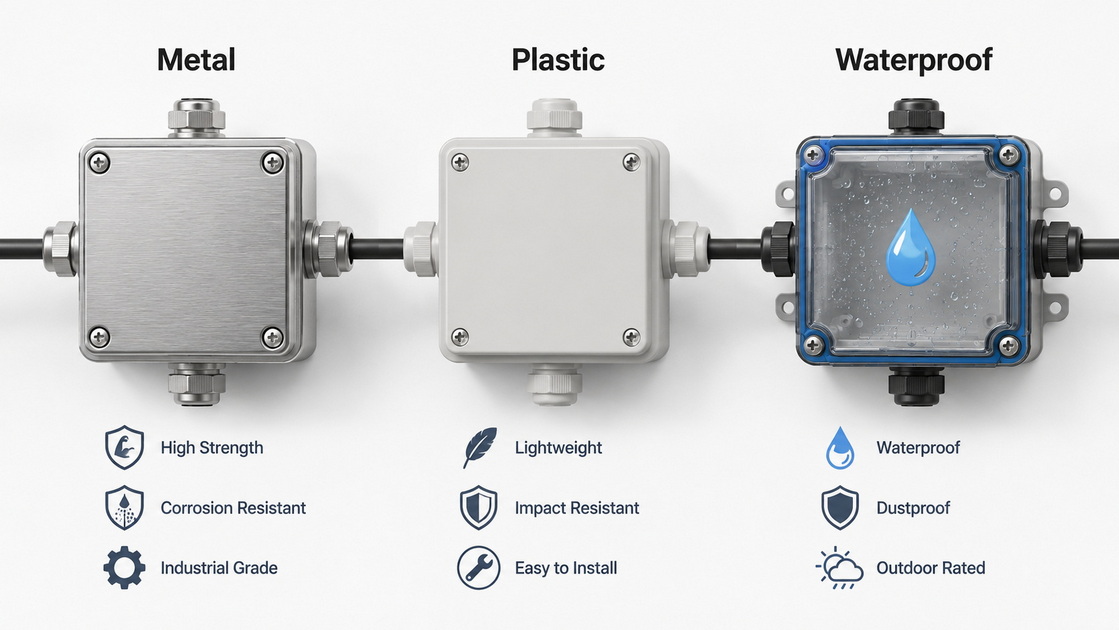
- Plastic (PVC) junction boxes
Plastic boxes offer corrosion resistance and electrical insulation and are commonly used in residential and light commercial settings where mechanical impact risk is lower. They are lighter and often more cost-effective but may require additional protection when installed outdoors or in high-impact areas. [eabel]
- Waterproof and outdoor junction boxes
These enclosures integrate seals and gaskets and typically carry high IP ratings (such as IP65 or IP66) to prevent water ingress in outdoor or washdown environments. They are essential for applications in renewable energy, pump stations, and building exteriors where weather exposure is unavoidable. [automationdirect]
- General-purpose junction and pull boxes
These boxes are designed to act as junction, pull, or switch boxes for commercial and industrial applications and are available in multiple sizes and mounting configurations. They are commonly used to route and splice feeders, branch circuits, or control wiring in factories and commercial buildings. [revcoelectric]
- Hazardous-location junction boxes
For environments classified as Zone 0, 1, or 2, junction boxes must be engineered with flameproof or intrinsically safe designs and materials that withstand explosive atmospheres and mechanical impact. These products often require higher IK ratings (for example, IK08 to IK10) to resist impact and maintain enclosure integrity. [linkedin]
- Signal and sensor junction boxes
In industrial automation, some junction boxes are designed specifically for sensor signal aggregation, converting signals such as 4–20 mA or RS‑485 from multiple sensors into a consolidated feed for control systems. These junction boxes help organize wiring and ensure reliable communication between field sensors and central controllers. [heltec]
Junction boxes are used literally anywhere electrical power or signals need to be branched, extended, or transitioned. Below are key sectors where junction box enclosures play a central role. [revcoelectric]
In homes and offices, junction boxes are used to:
- Connect and distribute power to lighting circuits, outlets, and switches. [nuwattlighting]
- Provide access points for future modifications such as adding new lights or receptacles. [reddit]
- Safely route wiring through ceilings, walls, and attics, especially when ceiling grids or finishes will be installed later. [reddit]
As many electricians note, junction boxes make life easier during remodeling, allowing them to extend existing circuits or transition from one wiring method to another (for example, from PV wire or Q-cable to Romex or THHN) without running entirely new cables. [reddit]
In factories and smart manufacturing environments, junction box enclosures form the backbone of control and instrumentation wiring. They are used to: [eabel]
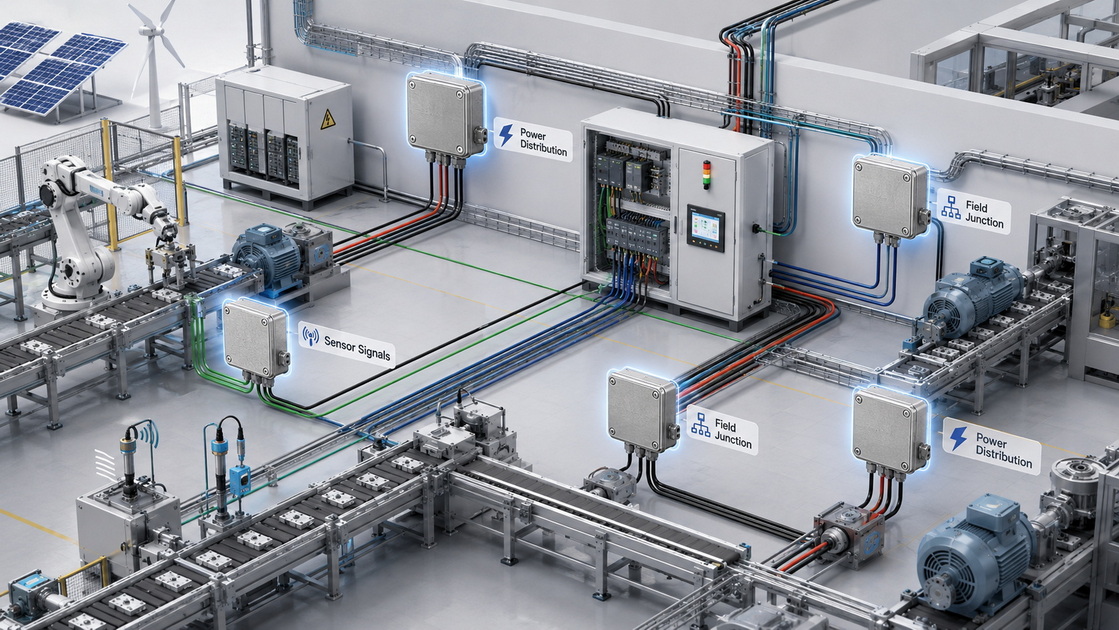
- Terminate and distribute control signals from programmable logic controllers (PLCs) to field devices.
- Aggregate sensor and actuator wiring into organized, labeled termination points for easier maintenance. [heltec]
- Protect power and signal connections in harsh environments where vibration, dust, and moisture are present. [automationdirect]
Metal sheet junction boxes with appropriate IP and NEMA ratings are particularly valuable here because they combine mechanical robustness with customizable layouts for terminals and cable entries. [bohuitechnology]
In power distribution and emerging energy storage and renewable energy applications, junction box enclosures:
- Connect arrays of solar panels, battery packs, or inverters, consolidating multiple strings or modules. [heltec]
- Serve as transition points between field wiring and switchgear or control cabinets, especially outdoors. [eabel]
- Ensure that high-current connections remain protected from weather, contamination, and unauthorized access. [automationdirect]
For new energy vehicles and charging infrastructure, engineered metal junction boxes provide secure housing for high-voltage connections and control wiring, supporting both safety and maintainability. [eabel]
In water and wastewater treatment, pump stations, and municipal infrastructure, junction boxes:
- Protect motor and sensor connections in wet or corrosive environments. [automationdirect]
- Provide accessible points for service technicians to test, replace, or reroute wiring without shutting down entire systems. [eabel]
- Coordinate signals from level sensors, pressure transmitters, and actuators back to centralized control systems. [heltec]
As an engineer or project owner, choosing the right junction box enclosure means balancing safety, environment, capacity, and future maintenance. Below are the main factors professionals consider. [automationdirect]
The box must be large enough to accommodate all incoming and outgoing conductors, connectors, and any terminal blocks without overcrowding. Overfilling a box increases the risk of overheating, makes inspection difficult, and can violate local codes that specify minimum free volume for a given number of conductors. [reddit]
Installers look at environmental conditions such as humidity, temperature, dust, and chemical exposure when choosing between metal and plastic, and when specifying IP or NEMA ratings. For example: [eabel]
- Waterproof stainless steel boxes for outdoor or washdown areas.
- High-impact metal enclosures for locations with mechanical risks. [automationdirect]
- Plastic boxes for indoor, low-impact locations where corrosion resistance is more important than impact strength. [eabel]
Most electrical codes require that junction boxes:
- Remain accessible (not permanently buried behind walls or ceilings). [reddit]
- Be properly grounded and compatible with the wiring method used.
- Be installed with covers and fasteners appropriate to the environment and safety classification. [automationdirect]
From a maintenance perspective, well-designed metal enclosures with clear labeling, removable panels, and organized terminals can dramatically cut downtime and troubleshooting effort. [eabel]
From the perspective of a manufacturer of sheet metal junction box enclosures, there are several areas where engineered metal boxes add unique value compared with commodity products. [bohuitechnology]
- Mechanical strength and durability: Metal enclosures provide superior structural rigidity, making them ideal for industrial automation, building infrastructure, and transportation projects. [automationdirect]
- Customization: Modern sheet metal fabrication allows custom cutouts, mounting patterns, and internal layouts, enabling OEMs and integrators to standardize their designs across projects. [bohuitechnology]
- Aesthetic and branding options: For visible installations in commercial buildings or equipment, high-quality finishes and branding elements on metal boxes support both safety and visual integration. [bohuitechnology]
With more than 20 years of industry experience, professional manufacturers focusing on sheet metal distribution boxes and cabinets are able to support power, industrial automation, construction, communications, and new energy customers with both standard and fully customized solutions. [bohuitechnology]
From a field-experience standpoint, several best practices repeatedly show up in successful installations and inspection reports. [revcoelectric]
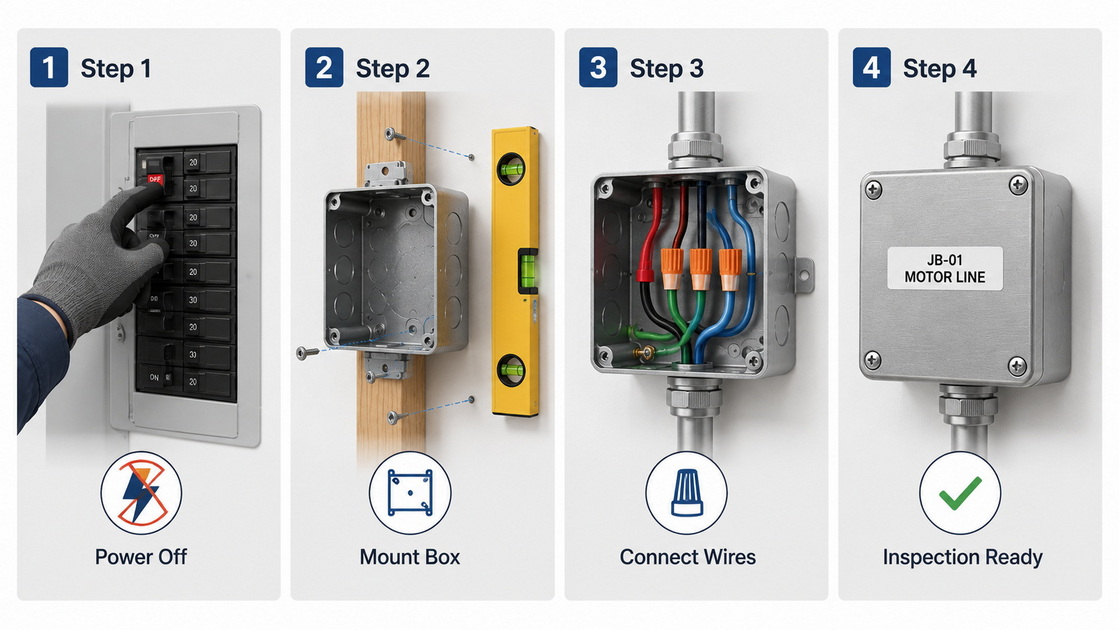
1. Plan junction box locations early
Map out wiring routes in design phase so that junction boxes are located where they remain accessible for future maintenance and expansions. [reddit]
2. Avoid mixing circuits unnecessarily
Junction boxes are typically intended for splicing the same circuit rather than combining different circuits, which can create fault and code issues. [reddit]
3. Respect bend and fill limits
On larger runs, use pull or junction boxes to ensure total conduit bends do not exceed allowable limits and that conductor fill remains within code. [reddit]
4. Label everything
Clear labeling of circuits, terminals, and cable entries on the junction box reduces troubleshooting time and minimizes human error. [eabel]
5. Schedule regular inspections
Periodic checks for loose connections, corrosion, moisture ingress, and mechanical damage can extend the life of both the box and the connected equipment. [eabel]
To illustrate how these principles work in practice, imagine a smart manufacturing line integrating robotics, sensors, and energy-efficient drives. In such an environment:
- Sensor junction boxes collect 4–20 mA and RS‑485 signals from multiple field devices and transmit them to a central sensor hub. [heltec]
- Power junction boxes distribute three-phase power to motors, drives, and control cabinets, ensuring proper protection and isolation at each node. [revcoelectric]
- Stainless steel or coated metal enclosures with high IP ratings protect all connections from dust, coolant, and cleaning fluids, maintaining uptime and safety. [automationdirect]
In my experience, the most successful projects treat junction boxes as strategic infrastructure components rather than low-cost commodities, giving deliberate attention to enclosure quality, layout, and future scalability. [bohuitechnology]
If you are designing or upgrading electrical systems for power, communication networks, industrial automation, smart buildings, new energy storage, EV infrastructure, or pump systems, choosing the right junction box enclosures is a strategic decision. Beyond simple safety compliance, high-quality sheet metal enclosures offer long-term reliability, easier maintenance, and greater flexibility for future expansion. [bohuitechnology]
When you evaluate suppliers, look for partners who:
- Have decades of experience in sheet metal distribution boxes and cabinets.
- Offer standard and fully customized enclosures tailored to your environment and project requirements. [bohuitechnology]
- Understand the specific needs of your industry segment—whether that is power distribution, industrial automation, building construction, or new energy sectors. [bohuitechnology]
By collaborating with a professional metal enclosure manufacturer, you can ensure that your junction box strategy supports both today's operational needs and tomorrow's digital transformation goals. [bohuitechnology]
A junction box's main purpose is to house and protect electrical connections where wires are joined, reducing risks of shock, fire, and mechanical damage while keeping installations code-compliant. [en.wikipedia]
Junction boxes are required anywhere electrical wires are spliced, branched, or transitioned, including ceilings, walls, attics, industrial control systems, and outdoor installations. Electrical codes in many regions mandate that these splices be contained in accessible boxes with covers. [revcoelectric]
A junction box contains splices where conductors are joined, while a pull box is mainly for pulling and routing conductors without splices, especially on long or complex conduit runs. In practice, some enclosures can serve both roles depending on how they are used. [revcoelectric]
Metal junction boxes offer higher mechanical strength, better heat resistance, and robust protection in industrial and heavy-duty environments, whereas plastic boxes are lighter and corrosion-resistant but less impact-resistant. The choice depends on environmental conditions, mechanical risks, and project requirements. [eabel]
Choose a box large enough to provide required free volume for all conductors and accessories, considering code requirements and future expansions. Oversizing slightly can improve airflow, reduce stress on conductors, and simplify maintenance. [reddit]
1. Nuwatt Lighting. "What Is a Junction Box? Uses & Purpose." Available at: https://www.nuwattlighting.com/blogs/news/what-is-a-junction-box [nuwattlighting]
2. Heltec Automation. "Junction Box – Sensor Signal Acquisition and Conversion." Available at: https://heltec.org/project/junction-box/ [heltec]
3. LinkedIn Article. "Engineering Junction Boxes for Hazardous Locations – Design Considerations." Available at: https://www.linkedin.com/pulse/engineering-junction-boxes-hazardous-locations-design-considerations-mjagf [linkedin]
4. Ningbo Bohui Technology Co., Ltd. "Metal Box Enclosures and Sheet Metal Distribution Boxes." Available at: https://www.bohuitechnology.com [bohuitechnology]
5. Wikipedia. "Junction Box." Available at: https://en.wikipedia.org/wiki/Junction_box [en.wikipedia]
6. Revco Electric. "Conduit Junction Boxes: Uses, Benefits, and Installation Tips." Available at: https://www.revcoelectric.com/roller/blog/entry/conduit-junction-boxes-uses-benefits [revcoelectric]
7. Eabel. "The Important Role of the Junction Box in Industrial Environments." Available at: https://www.eabel.com/the-important-role-of-the-junction-box-in-industrial-environments/ [eabel]
8. Ningbo Bohui Technology Co., Ltd. "Customized Enclosure Products." Available at: https://bohuitechnology.com/lists/29-4-.html [bohuitechnology]
9. Reddit r/electrical. "What is a J-Box Actually Used For?" Available at: https://www.reddit.com/r/electrical/comments/12hebcj/what_is_a_jbox_actually_used_for/ [reddit]
10. AutomationDirect. "Junction Boxes | Enclosures and Racks." Available at: https://www.automationdirect.com/adc/overview/catalog/enclosures_-a-_racks/junction_boxes [automationdirect]


