


Views: 215 Author: Bohui Electric Publish Time: 2026-07-20 Origin: Site


Content Menu
● B Openings, Hubs, and Knockouts
● Why B Openings Matter for Protection Ratings
● Typical Applications of B Openings
● Practical Guidance for Engineers and Installers
>> Step‑By‑Step Considerations
>> When Field Drilling Is Needed
● Design Perspective for Industrial Enclosure Manufacturers
● Enhancing Usability and Installation Experience
● FAQs
>> Q1: What exactly does a B opening indicate on an enclosure drawing?
>> Q2: Is a B opening the same as a knockout?
>> Q3: Can I use any hub in a B opening if the diameter seems close?
>> Q4: How do B openings affect outdoor installations?
>> Q5: What should I do if my enclosure does not have a factory B opening where I need one?
In industrial power distribution and control systems, seemingly small design details often determine whether an installation is safe, reliable, and easy to maintain over the long term. One of these details is the B opening on an electrical enclosure.
A B opening is a standardized, factory-punched hole on a safety switch or circuit breaker enclosure designed to accept a specific bolt-on hub size. Instead of listing raw diameters on every enclosure drawing, manufacturers use letter-coded opening designations—A, B, C, D, and so on—to indicate which hub size fits each opening. When you order or install an enclosure, choosing the correct opening and hub combination ensures that cables and conduit enter the enclosure through a controlled, properly sealed path.
For anyone responsible for designing or specifying enclosures for power, telecommunications, industrial automation, building services, energy storage, or EV charging, understanding this designation is essential. It directly affects equipment protection, environmental sealing, and compliance with widely used enclosure rating systems such as NEMA and IP.
A B opening is part of a family of letter-coded openings that manufacturers use to standardize cable and conduit entry on their enclosure product lines. Instead of saying "this wall accepts a 1‑1/2 inch hub," the drawing may say "B opening," and the matching hub catalog will specify which hub model fits that opening.
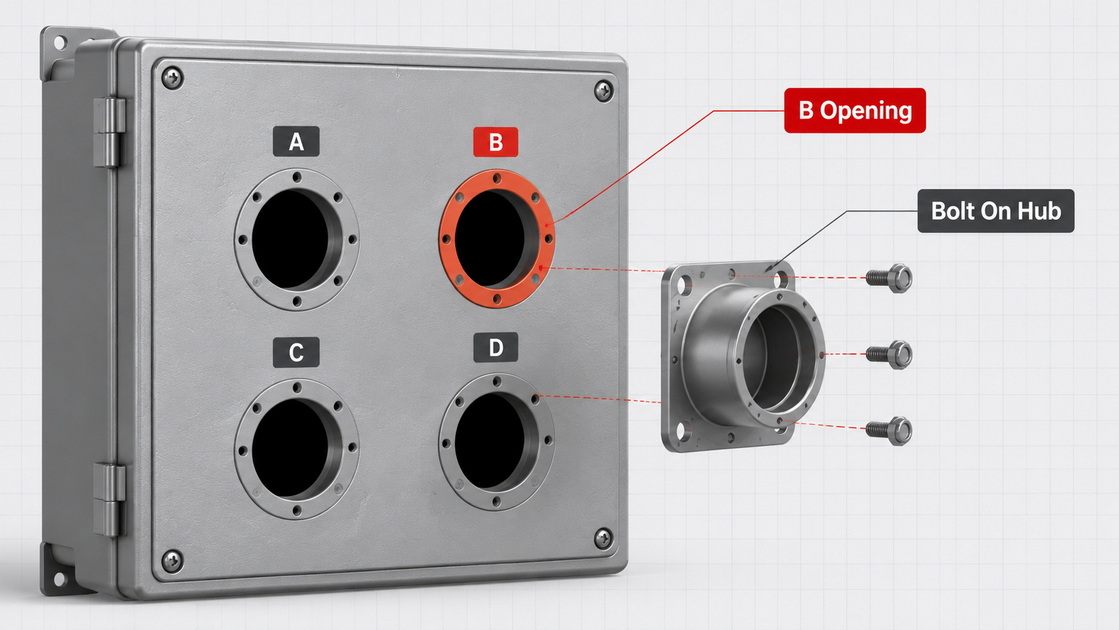
In practice, a B opening:
- Is a pre-sized, factory-machined or punched hole in the enclosure wall.
- Is designed to match a corresponding bolt-on hub with a specific diameter and mounting pattern.
- Appears most commonly on general duty and heavy duty safety switches and on circuit breaker enclosures.
Manufacturers use this approach to keep drawings clean and to ensure that installers and distributors use the correct listed accessories. When you see product descriptions like "closing cap for B opening, NEMA 3R," it means the cap is engineered to fit one particular opening size and to maintain the enclosure's environmental protection level when the opening is not used.
To really understand B openings, it helps to distinguish them from other common enclosure features: hubs and knockouts.
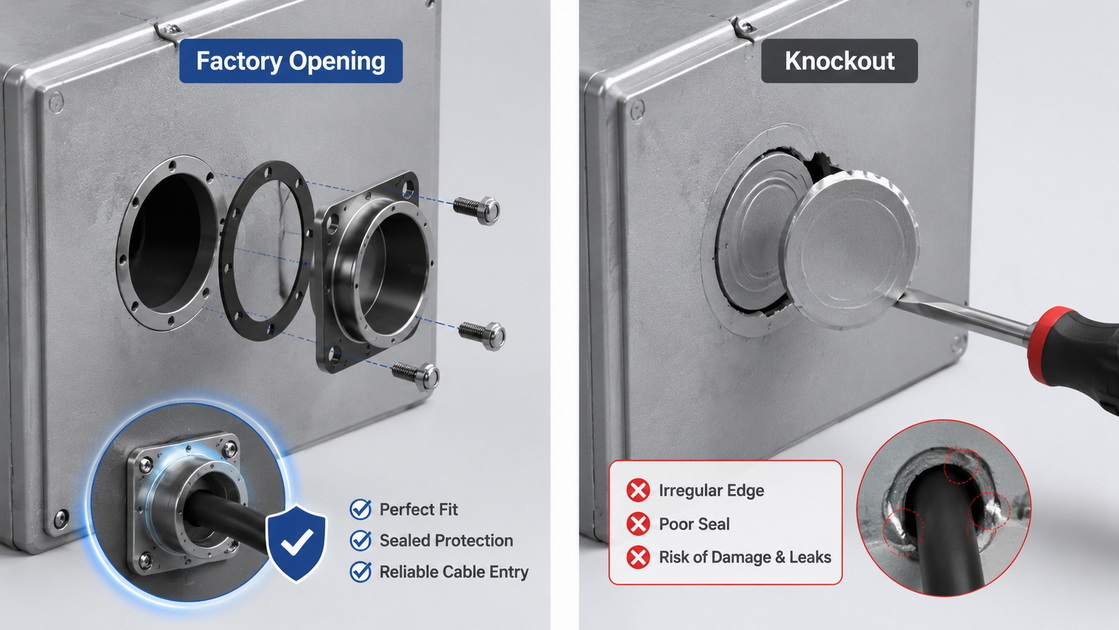
A bolt-on hub is a threaded fitting that mounts over a designated opening on an enclosure. It creates a sealed mechanical interface between the enclosure and the conduit or cable entry point. Typical characteristics of a hub include:
- A threaded interior to accept rigid metal conduit or other fittings.
- A flange or plate that bolts to the enclosure wall around the opening.
- Gasket surfaces designed to preserve the enclosure's protection rating.
When a hub is described as being "for B opening," it means the mounting pattern and gasket surfaces are sized to that specific letter-coded opening. Matching the hub to the opening avoids gaps, misalignment, and stress points that could lead to leaks or mechanical failure.
A knockout is a thin, removable disc formed into the enclosure wall at the factory. Installers use a punch or screwdriver to remove the disc, creating a hole. Knocking out the disc gives access for conduit or cable entry, but the raw hole still needs a connector or hub to make the connection safe and secure.
Key points about knockouts:
- They provide flexibility, allowing installers to select the hole they need.
- Once removed, they create a generic opening that must be fitted with a proper connector or hub.
- Unused knockouts or openings must be covered with listed caps or plugs to prevent moisture, dust, or contact with live parts.
While knockouts offer flexibility, B openings represent a more controlled, engineered approach—each opening is designed to accept a specific hub or cap, with predictable performance characteristics.
Electrical enclosures are often classified using standardized protection rating systems. In North America, the most common system is the set of NEMA enclosure types, while globally many projects rely on IEC 60529 IP ratings. These ratings describe how well an enclosure resists:

- Ingress of solid objects such as dust.
- Ingress of water from rain, splashing, or hose-directed spray.
- Other conditions, such as corrosion or ice formation, depending on type.
Openings are one of the most critical points at which these ratings can be weakened. Even if the enclosure body is perfectly sealed, an oversized, poorly sealed, or improperly capped opening can:
- Allow water to enter and accumulate.
- Create a path for dust and debris.
- Expose internal live parts to accidental contact.
Because of this, B openings are designed with precise dimensions and gasket interfaces, and the corresponding hubs or closing caps are engineered to preserve the enclosure's rating when correctly installed. This is especially important for Type 3R units and other outdoor enclosures, where resistance to rain and moisture is essential.
B openings are widely used in the kinds of projects where our company's sheet metal enclosures frequently appear. These openings are common in:
- Power distribution equipment, such as service entrance safety switches and feeder disconnects.
- Industrial control panels, where multiple conduits bring power and signal lines into one cabinet.
- Telecommunications and network infrastructure, especially outdoor or rooftop installations.
- New energy storage systems, where power conversion equipment connects to battery racks and distribution lines.
- Charging stations for new energy vehicles, which often rely on weather-resistant switchgear and breaker enclosures.
- Pump control systems, typically located in damp or semi-outdoor environments.
In all of these systems, properly sized and sealed openings help protect expensive electrical components from corrosion, contamination, and mechanical damage.
When specifying or installing enclosures with B openings, a structured approach greatly reduces risk:
1. Identify the device series and rating. Confirm whether you are working with a general duty or heavy duty safety switch, a circuit breaker enclosure, or a control panel, and note the current and voltage ratings. Larger devices often require field-drilled holes instead of factory openings.
2. Review the manufacturer's drawings. Locate the letter-coded openings (A, B, C, D) on the enclosure diagram and cross-reference them to the hub size chart. This ensures you select a hub or cap that is dimensionally compatible.
3. Confirm the required protection level. Determine whether the installation requires a rainproof, watertight, dust-tight, or corrosion-resistant enclosure. This drives the choice of hub materials, gaskets, and sealing methods.
4. Use listed hubs and caps. Select accessories specifically listed for use with the enclosure type and opening letter. Using ad‑hoc fittings or drilling oversized holes may save time initially but often leads to inspection failures and rework.
5. Inspect and torque properly. During installation, clean the gasket surfaces, apply any required sealing compounds as recommended, and torque mounting hardware evenly. After assembly, visually inspect around the opening for gaps and misalignment.
Not every enclosure comes with factory-provided B openings. In higher-current applications or heavy custom designs, field drilling may be the only option. In those cases:
- Place openings in structurally reinforced areas, avoiding bends, weld seams, and critical support ribs.
- Maintain appropriate edge distances from corners and mounting flanges to prevent cracking under vibration.
- Use proper punches or hole saws designed for sheet metal to avoid warping the enclosure wall.
- After drilling, treat edges carefully (deburring, painting) to prevent corrosion and cable damage.
Even when field drilling is necessary, many of the same principles apply: the goal is to create an opening that works like a B opening—consistent, well sealed, and reliable.
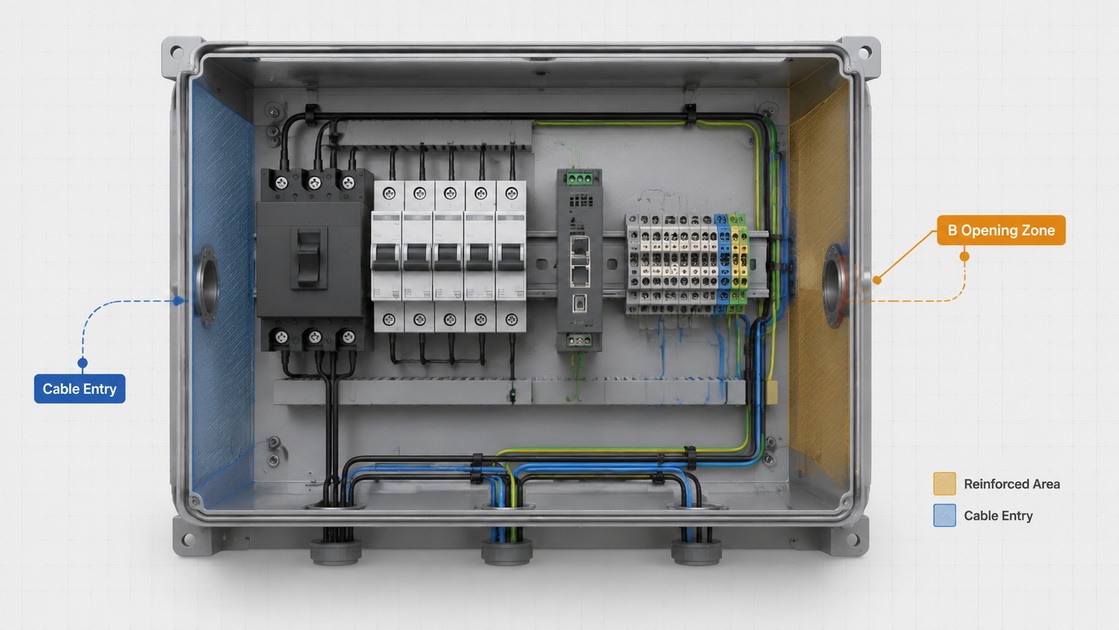
From a sheet metal enclosure manufacturer's standpoint, the concept of the B opening illustrates how standardization and engineering discipline can greatly improve product performance. When designing enclosures for critical applications—including power, communications, industrial automation, new energy storage, and EV charging—several design priorities emerge:
- Pre-engineered opening zones: The enclosure wall is modeled in CAD with dedicated areas capable of supporting hubs, cable glands, or entry plates, without compromising strength.
- Compatibility with multiple standards: Openings and sealing solutions are designed to support both regional classifications (such as NEMA types) and international standards (such as IP ratings).
- Material and corrosion considerations: The opening area must be treated carefully, especially in stainless steel or coated steel enclosures, to preserve corrosion resistance after punching and finishing.
- Thermal and layout implications: Opening placement should consider heat dissipation, internal cable routing, and clearances around sensitive components such as busbars or power electronics.
A robust design process ensures that every B opening, and every other cable entry point, works as part of a complete system—not as an afterthought. For complex projects spanning multiple disciplines and markets, this level of detail significantly reduces installation risk and lifetime maintenance costs.
Beyond ratings and dimensions, B openings also play a role in overall usability. Well-designed openings and hub systems can:
- Simplify cable routing, reducing installation time and minimizing tight bends that strain conductors.
- Support modular layouts, where different enclosures in a system share common opening sizes and accessory parts.
- Improve safety for technicians, by maintaining clear separation between live parts and the entry path of cables and conduits.
For installers and maintenance teams working on power, communication, automation, and water systems, consistent opening design and clearly documented letter codes remove guesswork. This leads to faster installations, fewer surprises in the field, and more predictable long-term performance.
Understanding B openings in electrical enclosures is more than learning a single letter code. It is about recognizing how standardized openings, properly matched hubs, and carefully sealed cable entry points work together to protect critical equipment and people in real-world environments.
For organizations operating in sectors such as power distribution, telecommunications, industrial automation, building infrastructure, new energy storage, and EV charging, getting these details right is essential. When engineers, specifiers, and installers choose enclosures with well-designed B openings and compatible accessories, they are investing in safer installations, smoother inspections, and more reliable long-term operation.
If you are planning a new project or upgrading existing equipment, taking the time to review enclosure opening design, hub compatibility, and rating requirements will pay off in reduced risk, fewer installation surprises, and better protection for your electrical systems.
A B opening indicates a specific, standardized hole size and mounting pattern designed to accept a matching bolt-on hub or closing cap. It allows the manufacturer to use a simple letter code instead of listing raw dimensions and helps ensure installers use compatible accessories.
No. A B opening is a fully defined, pre-sized opening meant for a particular hub model, while a knockout is a removable disc that creates a generic hole when punched out. Knockouts offer flexibility, but B openings offer more precise control over sealing and mechanical performance.
It is strongly recommended to use hubs specifically designed for the designated opening. Even small mismatches in diameter, gasket thickness, or mounting pattern can compromise the enclosure's protection level and lead to inspection issues or premature failure.
In outdoor installations, openings are critical points where moisture can enter. Correctly selected hubs or closing caps for B openings help maintain rainproof and dust-resistant performance, which is essential for reliable operation of switches, breakers, and control equipment exposed to weather.
If factory openings are not available in the required location, you may need to drill an opening in the field. In that case, plan the opening in a reinforced area, follow the manufacturer's guidelines for minimum distances and hole sizes, use proper tools, and select a compatible hub to maintain structural integrity and protection level.
1. ANSI/NEMA 250 – *Enclosures for Electrical Equipment (1000 Volts Maximum).*
https://blog.ansi.org/ansi/electrical-enclosures-ansi-nema-250-2020/
2. Schneider Electric – *BCAP: Cap, safety switch, for bolt-on hub, B opening, NEMA 3R.*
https://www.se.com/us/en/product/BCAP/cap-safety-switch-for-bolt-on-hub-b-opening-nema-3r/
3. City Electric Supply – *Bolt-on Hub Closing Cap, Safety Switch, B Opening, NEMA 3R.*
https://www.cityelectricsupply.com/p/square-d-bolt-on-hub-closing-cap-safety-switch-b-opening-nema-3r-bcap
4. Siemens – *General Duty Safety Switch VBII 200A 240V 3R Outdoor (Product Manual).*
https://manuals.plus/m/8186b3ed0a2307fe6ca2baffabb0bedb1686f4ff118f911feea0ea59746ce939
5. Siemens – *Power Products Safety Switches (Catalog and design information).*
https://assets.new.siemens.com/siemens/assets/api/uuid:7b421a25-fd31-4d7a-8add-21582daf7259/s03-safety-switches.pdf
6. Schneider Electric – *Enclosed Safety Switches Catalog (General Duty and Heavy Duty).*
https://www.productinfo.schneider-electric.com/3100ct1602ess/3100ct1602-enclosed-safety-switches-catalog/
7. Standard Electric Supply – *Square D H075 Switch Hub.*
https://www.standardelectricsupply.com/Square-D-H075-Switch-Hub
8. YG Enclosure – *Essential Design Standards for Industrial Control Enclosures.*
https://www.yg-enclosure.com/article/essential-design-standards-for-industrial-control-enclosures.html
9. Polycase – *Electrical Enclosure Standards: NEMA, IP and UL Ratings.*
https://www.polycase.com/techtalk/electronics-junction-boxes/electrical-enclosure-standards.html
10. Jaspector – *Knockout — Electrical Box Conduit Opening Explained.*
https://www.jaspector.com/wiki/knockout/

2026-07-26

2026-07-24


