


Views: 222 Author: Amanda Publish Time: 2026-02-03 Origin: Site


Content Menu
● What Is a Wall Mounting Enclosure?
● Key Benefits of Wall Mounted Electrical Enclosures
● Applications in Power, Telecom, Networking, and New Energy
>> 1. Power and Electrical Distribution
>> 2. Telecommunications and Networking
>> 3. Industrial Automation and Smart Manufacturing
>> 4. Building Infrastructure and Smart Buildings
>> 5. New Energy and Energy Storage
>> 6. New Energy Vehicles and Charging Infrastructure
>> 7. Water Pumps and Water Treatment
● Types of Wall Mounting Enclosures
>> Vented and Fan-Cooled Wall Enclosures
>> Lockable Electrical Enclosures
● Materials for Wall Mounted Enclosures
● IP and NEMA Ratings for Wall Enclosures Explained
>> IP Rating (Ingress Protection)
>> NEMA Ratings
● Step-by-Step Guide to Choosing the Right Wall Mount Enclosure
● Installation and Maintenance Best Practices
● Latest Industry Trends in Wall Mounted Enclosures
● Where Wall Mounting Enclosures Add the Most Value
● Take the Next Step: Partner with a Professional Enclosure Manufacturer
● FAQs About Wall Mounting Enclosures
>> 1. What is the main purpose of a wall mounting enclosure?
>> 2. How do I know which IP rating I need?
>> 3. When should I choose stainless steel instead of carbon steel?
>> 4. Can wall-mounted enclosures be used for networking equipment?
>> 5. Are NEMA and IP ratings equivalent?
Wall mounting enclosures are critical for protecting electrical, communication, and control equipment in modern power, telecom, networking, industrial automation, and new energy systems. By choosing the right wall-mounted enclosure type, material, and protection rating, you can significantly improve safety, system reliability, and lifecycle operating costs.

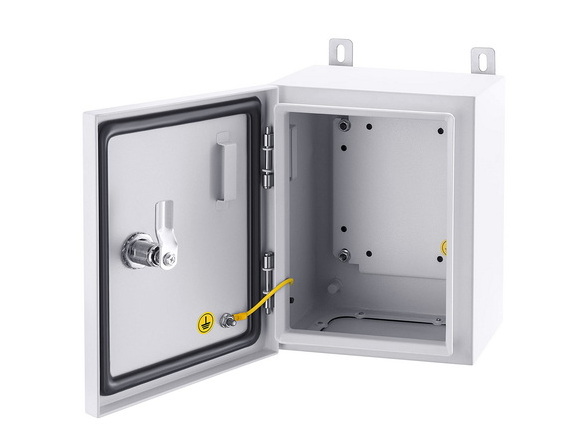
A wall mounting enclosure is a secure cabinet or box fixed to a wall that houses electrical, electronic, or network components, protecting them from dust, moisture, mechanical impact, and unauthorized access. It is widely used when floor space is limited, or when equipment must be elevated for safety, visibility, or maintenance convenience.
Typical components housed in wall-mounted enclosures include circuit breakers, control relays, PLCs, power supplies, communication switches, network patch panels, sensors, and security devices.
Wall-mount enclosures deliver multiple practical benefits across residential, commercial, and industrial environments.
- Space-saving in crowded plant rooms, data closets, and equipment corridors.
- Improved protection from dust, water, corrosion, and accidental contact.
- Enhanced safety by isolating live components from operators and the public.
- Easier cable organization and maintenance access at eye or working height.
- Better security with lockable doors and tamper-resistant designs.
- Electrical distribution panels and small switchboards.
- Telecom distribution frames and fiber patch panels.
- Network switches, PoE injectors, and edge computing devices.
- Pump controllers, HVAC controls, and industrial I/O modules.
- CCTV power supplies and security system controllers.
Wall mounting enclosures play a central role in many industries, especially those served by professional enclosure manufacturers such as Ningbo Bohui Electric Co., Ltd.
- Protects low-voltage distribution boards, metering devices, and control relays.
- Used in substations, commercial buildings, and industrial power rooms.
- Helps achieve compliance with local electrical safety regulations and standards.
- Houses fiber termination units, patch panels, and switches at remote nodes.
- Ideal for corridors, small communication rooms, or outdoor telecom cabinets.
- Often combines cable management features with lockable front doors.
- Encloses PLCs, I/O modules, motor starters, and industrial gateways.
- Protects sensitive electronics from dust, oil mist, vibration, and splashing water.
- Supports modular expansion as smart factories scale up production lines.
- Controls lighting, HVAC, access control, fire detection interfaces, and monitoring.
- Enables distributed control architectures, with enclosures mounted on each floor or zone.
- Supports integration of building management systems.
- Protects battery management systems, inverters, and DC combiner units in energy storage systems and solar installations.
- Requires enhanced protection against temperature, humidity, UV, and corrosive atmospheres.
- Often uses stainless steel or high-performance plastics with high protection ratings.
- Houses control electronics, metering, and communication modules for EV chargers.
- Provides safe isolation between high-voltage components and user touchpoints.
- Needs robust sealing and impact resistance for parking lots and outdoor sites.
- Encloses pump controllers, variable frequency drives, and level monitoring devices.
- Must withstand moisture, splashing, and sometimes corrosive or humid atmospheres.
- Frequently uses higher protection ratings for harsh utility or irrigation environments.
Different enclosure types are optimized for specific environments, loads, and installation conditions.
Weatherproof enclosures are designed to prevent water ingress from rain, splashing, or hose-directed water, making them suitable for outdoor and wet indoor areas.
- Used for outdoor distribution boards, pool areas, and wash-down zones.
- Available with different ingress protection levels to match environmental risk.
Vented wall-mounted enclosures incorporate louvers or perforations to allow natural airflow, and many support optional fan kits for active cooling.
- Ideal for equipment generating significant heat, such as transformers, power supplies, UPS modules, and CPUs.
- Must balance ventilation with dust and moisture protection based on the environment.
Lockable designs use integrated locks or padlockable latches to provide enhanced security.
- Common lock types include cam locks, quarter-turn locks, and padlock hasps.
- Used wherever safety, ingress protection, and access control are all priorities, such as in public spaces, schools, or production lines.
Choosing the right enclosure material directly affects corrosion resistance, mechanical strength, and cost.
Material | Key Features and Typical Uses |
Carbon steel | Strong, cost-effective, suitable for most indoor industrial applications. |
Stainless steel | Excellent corrosion resistance, ideal for food, chemical, and outdoor coastal sites. |
Aluminum | Lightweight, corrosion-resistant, good for telecom and outdoor electronics. |
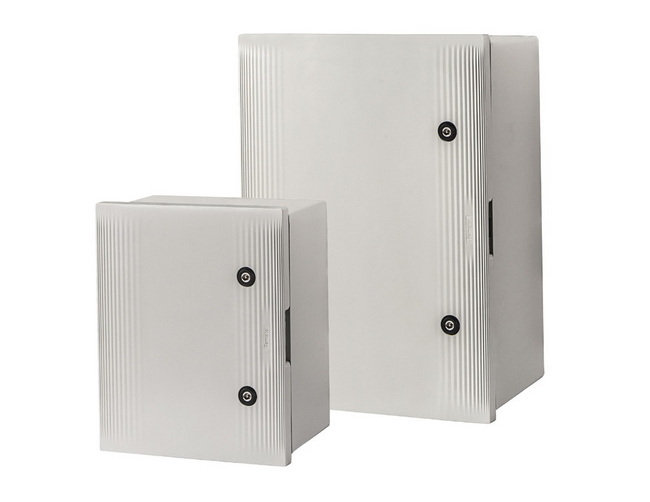
Plastic (ABS, PC) | Lightweight, non-conductive, good UV stability in certain grades, used for small control boxes and IoT nodes. |
Most enclosures are supplied with one or two doors, and some models add transparent windows or fully glazed doors for easy status monitoring without opening the box.
Correctly interpreting protection ratings is essential to selecting a suitable wall-mounted enclosure.
- The IP code uses the format “IP” plus two digits (for example, IP54, IP65, IP66).
- First digit (0–6): Protection against solid particles such as dust and foreign objects.
- Second digit (0–8): Protection against water, including drips, spray, jets, or immersion.
Examples:
- IP54: Limited dust ingress and protection against splashing water.
- IP65: Dust-tight and protected against water jets.
- NEMA enclosure types (such as NEMA 1, 3, 4, 4X, 6P) describe environmental protection and sometimes corrosion resistance.
- NEMA 4 and 4X are commonly used for wash-down and outdoor applications, with 4X adding corrosion resistance.
- NEMA ratings do not map perfectly to IP ratings, but guidance charts show approximate correspondences, such as NEMA 4 or 4X roughly aligning with IP65 or IP66.
When specifying an enclosure, define the actual environment and hazards first, then select the NEMA or IP rating that matches those conditions.
Following a structured selection process ensures you choose an enclosure that is safe, reliable, and cost-effective over its life.
1. Define the installation environment
Consider whether the location is indoor or outdoor, the temperature range, humidity level, and any exposure to chemicals, salt spray, or wash-down processes.
2. Identify environmental hazards
Evaluate dust, water, UV, mechanical impact, vibration, corrosion, and risk of unauthorized access.
3. Determine protection rating requirements
Select an IP or NEMA rating based on the worst-case condition, not just typical operation.
4. List the components and layout
Measure space for all devices, wiring, and future expansion; plan for mounting plates, DIN rails, terminals, and cable entry areas.
5. Select material and door design
Choose between steel, stainless, aluminum, or plastic according to environment and weight constraints; decide on solid or transparent doors.
6. Plan thermal management
Estimate total heat load of internal components and consider vents, filters, or fans to prevent overheating.
7. Define locking and access control
Choose the lock type and number of access points to balance security with serviceability and maintenance frequency.
8. Check standards and certifications
Confirm that enclosures comply with the relevant NEMA, IP, UL, IEC, or local electrical standards for your target market.
Proper installation and ongoing maintenance are just as important as choosing the right enclosure.
- Verify that the wall or mounting surface can safely support the enclosure plus the full load of installed components.
- Use appropriate mounting hardware for the wall material, following manufacturer recommendations.
- Keep sufficient clearance around the enclosure for door opening, cable routing, and ventilation.
- Maintain vertical alignment to prevent door distortion and ensure correct sealing of gaskets.
- Periodically inspect seals, gaskets, hinges, and locks for wear or damage.
- Check for signs of condensation, corrosion, or dust build-up and resolve the root cause promptly.
- Review thermal performance; if components run hot, consider adding ventilation, heat exchangers, or active cooling.
- Keep documentation inside or near the enclosure, such as wiring diagrams and labels, to support faster troubleshooting.
Recent trends are reshaping how wall mounting enclosures are designed and deployed.
- Growing use of compact enclosures for edge computing, IoT gateways, and distributed sensors.
- Increasing demand for higher IP or NEMA ratings in outdoor and renewable energy applications.
- Adoption of modular designs that allow quick expansion, reconfiguration, or integration of new devices.
- Integration with Industry 4.0 and smart factory concepts, where enclosures host intelligent controllers and communication modules.
Manufacturers that combine mechanical design expertise with electrical and digital know-how are well-positioned to support these emerging applications.
Illustrative scenarios help highlight practical value and support better decision-making.
- Factory upgrade project: Legacy open panels are replaced with IP-rated steel wall enclosures to improve operator safety and reduce downtime caused by dust contamination.
- Telecom street cabinets: Outdoor wall-mounted boxes with high ingress protection and anti-corrosion finishes safeguard fiber and active equipment in harsh climates.
- Energy storage container: Stainless steel wall enclosures with robust sealing secure BMS modules, contactors, and monitoring electronics in a humid coastal site.
If you are planning projects in power distribution, telecommunications, networking, industrial automation, building control, new energy storage, EV charging, or water pump systems, choosing the right wall mounting enclosure is critical for long-term safety and reliability. To ensure that every enclosure fully matches your environmental, electrical, and regulatory requirements, contact a professional enclosure manufacturer such as Ningbo Bohui Electric Co., Ltd. for customized solutions, engineering support, and certified protection performance tailored to your specific application.
Contact us to get more information!
The main purpose of a wall mounting enclosure is to protect electrical and electronic equipment from environmental hazards and unauthorized access while saving floor space and organizing cabling.
You should assess dust, water, and cleaning conditions in the target environment and then select an IP rating that covers the most demanding scenario, such as IP65 for dusty or outdoor sites exposed to water jets.
Stainless steel is recommended in corrosive environments, including chemical plants, food and beverage wash-down areas, and coastal outdoor installations where long-term corrosion resistance is essential.
Yes, many wall-mounted enclosures are specifically optimized for switches, routers, patch panels, and fiber terminations, often with additional ventilation or cooling options for higher heat loads.
NEMA and IP systems describe similar concepts but are not directly equivalent. However, guidance tables show approximate correspondences, for example, NEMA 4 or 4X often meets or exceeds the performance of IP65 or IP66 in many applications.
1. https://uk.rs-online.com/web/content/discovery/ideas-and-advice/wall-boxes-guide
2. https://mechpowertech.com/knowledge/wall-mount-enclosures-16/what-is-a-wall-mount-enclosure-and-their-applications-28
3. https://www.nemaenclosures.com/enclosure-ratings/ip-enclosures.html
4. https://anaheimautomation.com/media/wysiwyg/manuals/NEMA_UL_and_IP_Rating_Codes.pdf
5. https://www.budind.com/nema-vs-ip-protection-ratings/
6. https://www.rittal.com/us_en/apps/download/img/uploads/US517-BR-TR%20Wallmount%20Enclosure%20Technical%20Guide.pdf
7. https://www.nvent.com/sites/default/files/acquiadam/assets/User-00031.pdf
8. https://www.molexces.com/webfoo/wp-content/uploads/0187000566.pdf
9. https://dohoelectric.com/what-is-electrical-enclosure/
10. https://blog.rittal.co.uk/functionality-and-benefits-wall-mounted-enclosures

2026-07-26

2026-07-24


