


Views: 222 Author: Bohui Electric Publish Time: 2026-04-25 Origin: Site


Content Menu
● What Is the Real Difference?
● How NEC Treats Pull Boxes and Junction Boxes
>> Junction Boxes – NEC 314.16 (Box Fill)
>> Pull Boxes – NEC 314.28 (Wire‑Bending Space)
● Materials, NEMA/IP Ratings, and Real‑World Environments
>> Protection Ratings: NEMA and IP
● How Pull and Junction Boxes Work Inside Wall‑Mount Enclosures
● Practical Selection Checklist (From Real Projects)
● Industry‑Specific Use Cases (Power, Telecom, New Energy, Pumps)
>> 1. Power Distribution and Industrial Automation
>> 2. Telecom and Network Infrastructure
>> 3. New Energy Storage and EV Charging
>> 4. Water Pumps and Utility Infrastructure
● Common Mistakes We Still See (And How to Avoid Them)
● How a Professional Wall‑Mount Enclosure Manufacturer Adds Value
● When to Choose a Wall‑Mount Enclosure for Pull and Junction Boxes
● Call to Action: Get Expert Help on Your Next Enclosure Project
● FAQ
>> 1. Can I use a pull box as a junction box if I am short on space?
>> 2. How do I know if my junction box is big enough?
>> 3. Why do industrial projects prefer metal wall‑mount enclosures over plastic boxes?
>> 4. Do I always need a wall‑mount enclosure, or are separate junction boxes enough?
>> 5. What information should I prepare before asking an enclosure manufacturer for a quote?
When I walk a project site with an electrical engineer or panel builder, one of the most common points of confusion I still see is the mix‑up between pull boxes, junction boxes, and the wall‑mounted enclosures that actually host these boxes in real‑world systems. As a manufacturer of wall mount enclosures serving power, telecom, industrial automation, building, and new energy projects, I've learned that choosing correctly is not only about NEC clauses—it is about uptime, maintainability, and long‑term safety. [bohuitechnology]

From an industry perspective, the fastest way to separate the two is this: junction boxes are for splicing, pull boxes are for pulling. A junction box is the protected space where conductors are joined, branched, or terminated, while a pull box provides access space so cables can be pulled through long or complex conduit runs without damage. [etcnmachining]
In practice:
- Junction box:
- Used for splicing, branching, and terminating conductors. [wp101]
- Must comply with NEC 314.16 box fill rules. [wp101]
- Common around lighting, outlets, control panels, and field devices. [proax]
- Pull box:
- Used purely to aid wire pulling through long runs, tight bends, or large conductors. [kdmfab]
- Governed by NEC 314.28, which focuses on wire‑bending space and minimum dimensions instead of fill volume. [enerconpower]
- Typically found in industrial raceway systems, underground and rooftop runs, or utility corridors. [proax]
| Feature | Junction Box | Pull Box |
|---|---|---|
| Primary purpose | Splicing, branching, terminating conductors wp101 | Facilitating pulling of conductors in conduit runs wp101 |
| NEC section | NEC 314.16 – box fill wp101 | NEC 314.28 – bending space & dimensions wp101 |
| Splicing allowed | Yes – that is its core use wp101 | Generally no – not intended for splices wp101 |
| Typical environment | Residential, commercial, light industrial wp101 | Industrial, infrastructure, long feeders, utilities wp101 |
| Drives sizing | Conductor count and size (volume) wp101 | Raceway size, routing geometry, bending radius wp101 |
For visual UX, this is a good place to insert:
- One diagram showing a wall‑mount enclosure with an internal junction box and an in‑line pull box on the conduit run.
As soon as you move from theory to installation, code compliance is where projects succeed or fail. [atlasmfg]
In a junction box, every conductor, device yoke, and internal clamp counts against the allowed box volume. The NEC provides per‑conductor volume allowances (for example, a 12 AWG conductor typically requires 2.25 in³ of box volume), and the total adjusted conductor equivalent must not exceed the marked cubic inch capacity of the box. [wp101]
A typical worked example:
- 4 × 12 AWG current‑carrying conductors. [wp101]
- 1 device yoke (counts as 2 conductors). [wp101]
- 1 internal clamp (counts as 1 conductor). [wp101]
- Equipment grounds counted together as 1 conductor. [wp101]
This gives 8 conductor equivalents, which at 2.25 in³ each requires at least 18 in³ of box volume. If the box is stamped 20 in³, the installation passes box‑fill requirements with margin. [wp101]
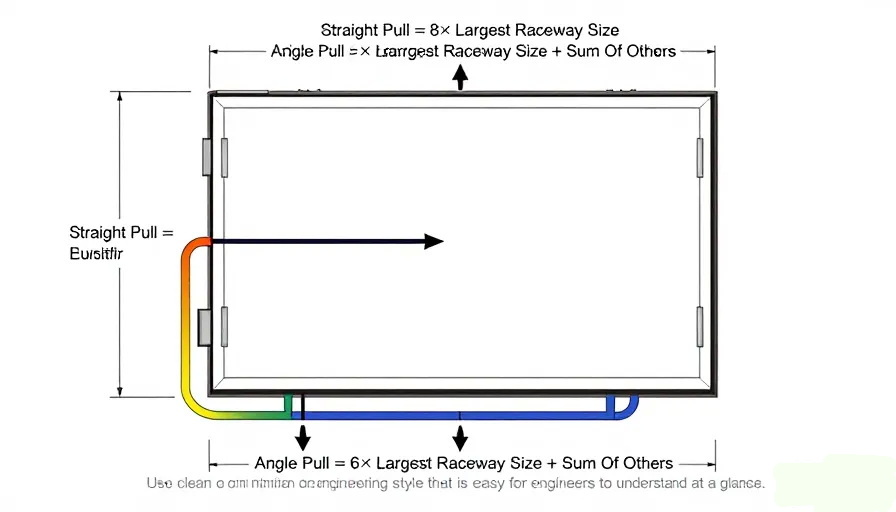
With pull boxes, volume is almost irrelevant compared to dimensions and wire‑bending space. [enerconpower]
- Straight pulls: minimum box length must be 8× the largest raceway trade size on that run. [wp101]
- Angle or U‑pulls: the minimum dimension along the wall with raceways is 6× the largest raceway trade size + the sum of the others on that wall. [wp101]
Example from the field:
- One 3‑inch conduit and one 2‑inch conduit entering at 90°. [wp101]
- Required dimension along that wall: \(6 × 3 + 2 = 20\) inches. [wp101]
Ignoring these rules is one of the fastest ways to create a system that is technically installed but almost impossible to re‑pull or upgrade later. [proax]
For better UX, you can add:
- A dimensioned sketch of a pull box with straight and angle pulls labeled.
From a manufacturer standpoint, what matters is not just which box type you specify, but what enclosure you put it in and how that enclosure survives in its environment. [bohuitechnology]
Both junction and pull boxes are available in:
- Steel – cost‑effective, strong, widely used in indoor and light outdoor settings. [proax]
- Aluminum – lighter than steel, corrosion‑resistant, popular in coastal or mobile applications. [atlasmfg]
- Stainless steel – high corrosion resistance for food, chemical, or marine environments. [atlasmfg]
- Fiberglass / reinforced plastic – non‑conductive, resistant to many chemicals, good for aggressive or wet environments. [enerconpower]
Our own wall‑mount enclosures are typically fabricated in precision‑bent sheet steel or stainless steel with powder‑coated finishes, then matched to the correct sealing and rating level for the target industry. [imexbb]
Choosing correctly between NEMA and IP ratings is where many designs gain or lose robustness. [atlasmfg]
- Junction boxes in residential or light commercial spaces often use NEMA 1 or NEMA 3R, providing basic indoor or weather‑resistant protection. [proax]
- Pull boxes in industrial plants, water treatment, or outdoor power systems frequently require NEMA 4/4X or IP65+ to resist wash‑downs, dust, and chemical exposure. [enerconpower]
- For renewable energy, EV charging, and outdoor telecom, we increasingly see specifications for IP65–IP66 and stainless bodies to handle UV, rain, and airborne contaminants. [bohuitechnology]
This is a strong spot to include:
- A table or infographic mapping common applications (indoor panel, rooftop solar, EV charger, pump station) to typical NEMA/IP levels and enclosure materials.
In many real projects, the question is not "pull box vs junction box" but "how should I integrate them into a wall‑mount enclosure or cabinet?" [bohuitechnology]
From our experience supplying wall‑mounted enclosures to power, communication, and industrial automation customers, we see three recurring patterns: [imexbb]
1. Field junction boxes feeding a main wall‑mount enclosure
- Field devices (sensors, pumps, gateways) terminate in local junction boxes. [proax]
- Multi‑core cables or conduits then route back to a central wall‑mounted cabinet. [bohuitechnology]

2. Inline pull boxes along long conduit runs leading to a wall‑mount enclosure
- For long feeders between building sections or outdoor yards, pull boxes relieve pulling tension and protect cable jackets. [enerconpower]
- The wall‑mount enclosure at the end hosts terminals, breakers, and control gear. [bohuitechnology]
3. Internal junction space designed into the wall‑mount enclosure
- Instead of multiple discrete junction boxes, the main cabinet includes segregated wiring chambers with clearances and DIN‑rail terminals. [bohuitechnology]
- This reduces clutter, improves maintenance access, and simplifies labeling. [atlasmfg]
In all three cases, the mechanical quality of the wall‑mount enclosure—door stiffness, gasket design, lock reliability, and mounting strength—directly affects long‑term reliability and safety. [bohuitechnology]
When I review designs with customers, I use a simple decision flow that blends NEC rules with enclosure engineering. [atlasmfg]
1. Define the function of the box
- If you need splices, branches, or terminations, you are looking at a junction box. [wp101]
- If you only need access for pulling cables, you are looking at a pull box. [kdmfab]
2. Check environmental conditions
- Indoor, controlled, low dust → usually NEMA 1/12 inside a wall‑mount cabinet. [proax]
- Outdoor, wash‑down, chemicals, or dust → NEMA 4/4X or IP65+ metal enclosure. [enerconpower]
3. Confirm code and sizing
- For junction boxes, perform a box‑fill calculation and verify stamped volume. [wp101]
- For pull boxes, calculate straight or angle pull dimensions per NEC 314.28. [enerconpower]
4. Plan for future expansion
- Leave extra volume or bending space for future conductors. [atlasmfg]
- Choose wall‑mount cabinets with spare DIN‑rail, panel space, and knockouts. [bohuitechnology]
5. Check mounting and access
- Confirm that the enclosure can support weight, cable loads, and service access. [proax]
- For wall‑mount enclosures, pay attention to hinge quality, door opening angle, and lock type. [bohuitechnology]
Formatting idea: present this as a numbered UX checklist graphic or a flowchart in the final page design.
To add real‑world depth beyond generic NEC explanations, it helps to show how different sectors actually deploy pull and junction boxes within wall‑mount enclosures. [bohuitechnology]

In power distribution rooms and MCC corridors, junction boxes typically handle control and signal cabling, while pull boxes support long feeder runs. [enerconpower]
- Junction boxes are mounted on or near wall‑mount enclosures to collect I/O from field devices before entering the cabinet. [proax]
- Pull boxes are placed along conduits between transformers, switchboards, and remote distribution cabinets to ease cable routing. [enerconpower]
- Wall‑mounted enclosures host protection relays, PLCs, and low‑voltage distribution hardware that tie everything together. [bohuitechnology]
In telecom and networking, clarity and cable management become as critical as electrical code. [proax]
- Outdoor pull boxes are used along duct banks and risers to pull fiber and power cables up towers or across campuses. [enerconpower]
- Junction boxes inside or near network cabinets handle power splices, transient protection, or DC distribution to radios and switches. [etcnmachining]
- Operators often specify IP‑rated wall‑mount enclosures to protect both power and network components in one integrated housing. [bohuitechnology]
Energy storage systems and EV charging sites push enclosures into harsher outdoor conditions with more demanding safety expectations. [bohuitechnology]
- Large DC or AC feeders between containers, pads, or charging islands rely on pull boxes to meet bending radius requirements. [enerconpower]
- Local junction boxes collect sensor wiring, low‑voltage control, and auxiliary power before entering the main BESS or charger cabinet. [etcnmachining]
- Wall‑mount enclosures are often specified with stainless steel and high NEMA/IP ratings to handle UV, rain, and vibrations. [bohuitechnology]
Pump stations and utility sites frequently combine wet environments with limited access, so enclosure engineering matters. [proax]
- Pull boxes help route long pump feeders from MCCs to field pumps through buried or elevated conduits. [proax]
- Junction boxes at pump skids consolidate motor, level sensor, and valve wiring. [etcnmachining]
- A properly sealed wall‑mount enclosure centralizes control logic, VFDs, and protection relays while keeping condensation and splash‑water out. [bohuitechnology]
Even experienced teams repeat a few high‑impact mistakes when specifying or installing pull and junction boxes. [atlasmfg]
1. Using a pull box for splicing
- This violates the intent of NEC 314.28 and can create unsafe, cramped splice conditions. [enerconpower]
- The fix: reserve pull boxes for pulling tasks only; perform splices in properly sized junction boxes or within designed junction compartments in the main enclosure. [atlasmfg]
2. Overfilling a junction box
- Ignoring box‑fill rules leads to overheated conductors, damaged insulation, and failed inspections. [atlasmfg]
- Always calculate conductor equivalents and compare to the marked volume, leaving margin for future changes. [atlasmfg]
3. Under‑sizing pull boxes on long industrial runs
- Too small a box makes every cable pull more dangerous and time‑consuming, and can damage high‑value cables. [proax]
- Calculating straight and angle pulls correctly up front saves labor and rework. [enerconpower]
4. Ignoring grounding and bonding inside metal enclosures
- Failing to bond metal junction boxes, pull boxes, and the wall‑mount enclosure itself can compromise fault clearing and safety. [atlasmfg]
5. Mismatching connectors and enclosure ratings
- Using unsuitable fittings can downgrade a NEMA 4/4X or IP65 enclosure to something effectively open to dust or moisture. [proax]
This is an excellent place to add real field photos (blurred labels for privacy) of good vs. bad practice to make the content more tangible.

From the outside, a box is just a box; from the inside of a project, the right manufacturer can make or break schedule, safety, and maintainability. [imexbb]
As a sheet‑metal enclosure manufacturer with over 20 years of experience, we focus on design details that align with how electricians and engineers actually use junction and pull boxes in the field. Some of the areas where a specialized manufacturer adds real value: [imexbb]
- Application‑matched designs
- Enclosures sized with realistic bending space, cable entry layouts, and internal mounting options so you do not fight the cabinet during installation. [bohuitechnology]
- Customization
- Pre‑punched knockouts, cutouts for cable glands, dedicated junction compartments, and pre‑installed mounting plates tailored to your project. [bohuitechnology]
- Certified quality
- Adherence to relevant NEMA, IP, and quality system standards to ensure repeatable performance and safety. [bohuitechnology]
- Support from engineers, not just sales
- Guidance on enclosure sizing, layout, and material selection for power, telecom, industrial automation, building, storage, EV, and pump applications. [bohuitechnology]
When your enclosure partner understands how pull and junction boxes are used inside and around the cabinet, you get cleaner layouts, faster installation, and fewer surprises at inspection. [bohuitechnology]
Engineers often ask whether to use separate field boxes or consolidate terminations in a single wall‑mount cabinet. Based on typical projects, a wall‑mount enclosure is usually the better choice when: [bohuitechnology]
- You need centralized control and protection for a system segment. [bohuitechnology]
- Cable or conduit entries from multiple directions make a flat junction box layout messy. [enerconpower]
- The environment demands higher NEMA/IP ratings than inexpensive plastic boxes can reliably provide. [proax]
- You want clear access for maintenance, with organized terminals, labeling, and room for test equipment. [atlasmfg]
In these cases, pull boxes still live out in the conduit system, but splices and device connections move into a purpose‑built cabinet that is easier to work in and protect. [bohuitechnology]
If you are planning a new power, telecom, industrial, new energy, EV, or pump project and you are not fully confident in your current box and enclosure layout, this is the right moment to bring in a specialist. [bohuitechnology]
Whether you need standard wall‑mount enclosures, customized cabinets with pre‑engineered junction spaces, or guidance on integrating pull and junction boxes into a complete system, our engineering team can help you optimize for safety, code compliance, and long‑term maintainability. [imexbb]
Reach out with your single‑line diagram, layout, and environmental requirements, and we will help you specify the right enclosure solution for your application. [bohuitechnology]
In most cases, no. Pull boxes are dimensioned for wire‑bending space, not for safe, maintainable splices, and combining both functions can create code and safety problems. [enerconpower]
You must calculate the conductor equivalents based on conductor size, devices, clamps, and grounds, then ensure the total required volume is less than the box's marked cubic inches with some margin. [wp101]
Metal cabinets provide higher mechanical strength, better sealing options, and often easier integration of door‑mounted equipment, while aligning with NEMA/IP requirements and industry expectations for robustness. [bohuitechnology]
For small, simple circuits, separate junction boxes can be sufficient, but as soon as you centralize controls, protection, or multiple feeders, a dedicated wall‑mount enclosure usually improves safety, orderliness, and maintainability. [atlasmfg]
Provide your single‑line diagram, list of devices, expected cable/conduit entries, environmental conditions, target NEMA/IP rating, and any industry standards you must meet so the manufacturer can recommend a properly sized and configured solution. [bohuitechnology]
1. Lianjie: "Pull Box vs Junction Box: Ultimate Comparison Guide 2026."
<https://www.lianjer.com/pull-box-vs-junction-box/> [wp101]
2. Ningbo Bohui Technology Co., Ltd – Company and product information (wall‑mount enclosures, sheet‑metal distribution boxes).
<https://bohuitechnology.com> [bohuitechnology]
3. Proax: "Guide to Selecting Industrial Electrical Enclosures."
<https://proax.ca/en/blog/post/selecting-industrial-electrical-enclosures> [proax]
4. Enercon Power: "Guide to Selecting the Right Enclosures for Industrial Power Systems."
<https://www.enerconpower.com/post/guide-to-selecting-the-right-enclosures-for-industrial-power-systems-part-1> [enerconpower]
5. Atlas Manufacturing: "The Ultimate Checklist for Selecting Electrical Enclosure Manufacturers."
<https://atlasmfg.com/blog/electrical-enclosure-manufacturers> [atlasmfg]
6. ETCN Machining: Junction box fundamentals (Chinese‑language guide).
<https://etcnmachining.com/zh-CN/blog/junction-box/> [etcnmachining]
7. KDM Fab: "Junction Box vs Pull Box" (comparison resource).
<https://kdmfab.com/ko/junction-box-vs-pull-box/> [kdmfab]
8. Bohui – Electrical Enclosure, Steel Cabinet, Wall‑Mounted Enclosure product listing.
<https://www.imexbb.com/electrical-enclosure-steel-cabinet-wall-mounted-enclosure-manufacturer-10923273.htm> [imexbb]

2026-07-26

2026-07-24


