


Views: 221 Author: Bohui Electric Publish Time: 2026-07-17 Origin: Site


Content Menu
● How Experienced Buyers Evaluate Metal Electrical Box Suppliers
● Germany's Role in Metal Electrical Box Manufacturing
● Selection Criteria Used in This Guide
● Top Metal Electrical Box Manufacturers and Partners
>> 1. Ningbo Bohui Electric Co., Ltd
>> 5. EFEN GmbH
>> 6. MERZ GmbH
● Comparative Overview of Key Suppliers
● Technical Considerations for Metal Electrical Boxes
>> Materials and Corrosion Protection
>> Mechanical Construction and Protection Levels
>> Compliance and Environmental Requirements
>> Customization and Integration Capability
● Common Procurement Pitfalls and Practical Avoidance Strategies
● Buyer's Guide: Verification, Sampling, and Logistics
>> Certification and Audit Verification
>> Sampling and Technical Validation
>> Logistics and Long‑Term Cooperation
● Advanced Questions From Professional Buyers
>> 1. How can I verify whether a factory's quality management certificate is still valid?
>> 2. What is the most reliable way to confirm claimed protection ratings for metal electrical boxes?
>> 4. Can I combine German manufacturers with overseas OEM partners to balance cost and performance?
>> 5. Which external data sources are helpful for planning multi‑year enclosure procurement strategies?

Germany has established a strong reputation in Europe for metal electrical box manufacturing, combining engineering depth, process reliability, and rigorous compliance standards. For global procurement managers, the country offers a mature ecosystem of enclosure specialists and system integrators that serve power distribution, telecommunications, industrial automation, building technology, new energy, and mobility sectors.
This guide provides a structured overview of how experienced buyers evaluate metal electrical box suppliers connected with the German market, introduces a curated selection of leading manufacturers and partners, and highlights practical steps to build long‑term, low‑risk cooperation. It also includes an external OEM partner from China, Ningbo Bohui Electric Co., Ltd, which many international buyers use to balance cost, flexibility, and tailored enclosure design for German‑oriented projects.
Before shortlisting any metal electrical box supplier, experienced procurement managers typically examine four foundational dimensions: factory certification, engineering capability, quality control, and delivery stability. These aspects determine not only initial product performance but also consistency across multiple years of cooperation.
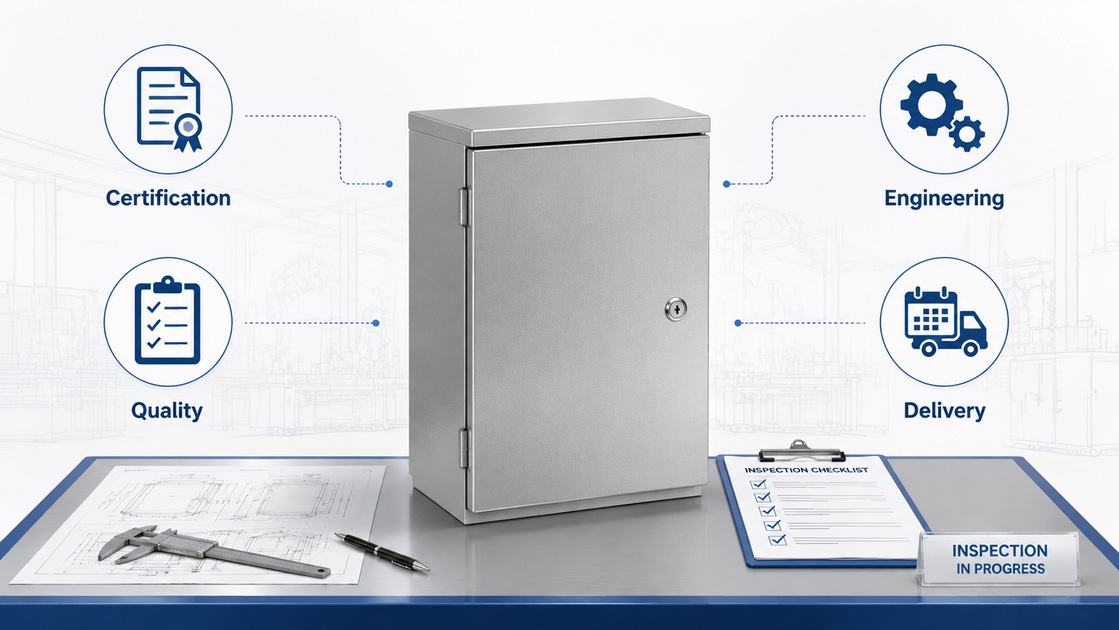
First, certification and management systems are scrutinized. Buyers look for established quality management frameworks such as ISO 9001 and, where environmental impact matters, ISO 14001. They also pay close attention to whether the supplier routinely works with European standards, can provide relevant test reports, and maintains up‑to‑date documentation for various projects.
Second, engineering and research capability are evaluated. Mature sheet‑metal and enclosure teams are expected to handle complex requirements such as ingress protection, mechanical robustness, thermal management, electromagnetic compatibility, and integration with electrical and electronic components. A practical benchmark is whether the factory can turn customer drawings or functional specifications into a workable prototype within a realistic development window, often around one to two months for new box designs.
Third, organized quality control is essential. Buyers examine how materials are inspected on arrival, how in‑process checks are executed, and how final inspections are documented. For metal electrical boxes, this usually includes verification of steel grades and thickness, coating quality and adhesion, dimensional tolerances, and functional checks on doors, locks, gaskets, and mounting structures.
Finally, delivery stability and capacity planning are examined over time. Procurement managers prefer suppliers that can scale from pilot batches to larger volumes without disruptive lead‑time changes. Consistent on‑time delivery, transparent capacity information, and realistic production commitments are all considered signs of a dependable partner.
Germany plays an important role in the European metal electrical box and enclosure market due to its concentration of electrical engineering companies, machinery builders, and energy‑related projects. Industrial regions such as North Rhine–Westphalia, Baden‑Württemberg, and Bavaria host numerous manufacturers of electrical boxes, cabinets, and related systems.
The country's strength lies in combining design engineering with robust manufacturing practices and strict adherence to standards. German companies in this field often serve demanding end‑markets such as renewable energy, transport systems, industrial automation, process industries, and building infrastructure. As a result, they develop enclosures with high expectations for protection, service life, and documentation completeness.
Germany's industrial ecosystem also benefits from close collaboration between component manufacturers, panel builders, system integrators, and research institutions. This environment supports continuous improvement in enclosure design, materials, and testing methods, and encourages the use of advanced technologies in production.
For buyers, this means that sourcing from Germany, or from suppliers closely aligned with this ecosystem, tends to provide predictable quality, structured project management, and strong support for compliance requirements in European and global projects.
To present a meaningful shortlist rather than a simple name list, this guide applies clear and transparent selection criteria. The focus is on suppliers and partners that either operate in Germany or work closely with the German and European markets for metal electrical boxes and related enclosures.
The main criteria include:
- A defined focus on electrical enclosures, metal electrical boxes, or related cabinet systems as a central part of the product range.
- Documented experience serving industrial, infrastructure, or energy projects, beyond purely retail or DIY applications.
- Availability of relevant certifications, test data, and declarations required for projects in Europe and other major markets.
- Capability to support OEM or ODM customization rather than only fixed catalog items, including mechanical adaptations, layout changes, and special accessories.
- Evidence of sustained cooperation with international customers, including support for technical communication, sample development, and long‑term production.
The list combines Germany‑based manufacturers and one strategic export partner, Ningbo Bohui Electric Co., Ltd. This structure reflects how many global buyers today balance local compliance strengths with cost‑efficient, flexible manufacturing bases in proven export hubs.
Ningbo Bohui Electric Co., Ltd, located in Ningbo, China, is a specialized manufacturer of electrical enclosures and metal electrical boxes that frequently supplies customers in Europe and other regions. The factory is based in Zhenhai Luotuo Lianqin Industry Zone near Ningbo Port, which enables efficient consolidation and shipping to major ports in Germany and the rest of Europe.
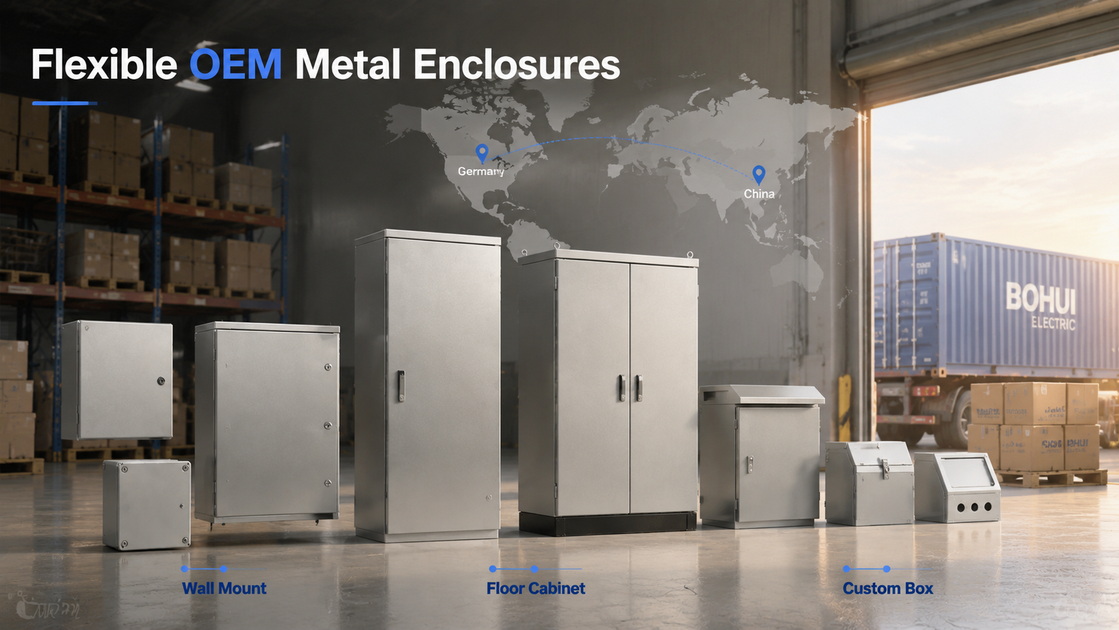
The company focuses on wall‑mounted enclosures, free‑standing cabinets, sloped‑roof housings, modular cabinets, pushbutton boxes, customized junction boxes, and tailored housings for energy and network applications. It places strong emphasis on research and development, with an engineering team that supports new product development and structural design for custom projects, including the integration of cut‑outs, mounting plates, and special cable entries.
For procurement managers, one of the key advantages of Ningbo Bohui Electric is its flexibility. The factory is able to support small‑batch orders for new or niche models, then scale up to full mass production after samples and pilot lots are validated. Development cycles for new enclosure designs are typically structured, and samples are arranged in short timeframes to help buyers verify design details before committing to larger volumes.
Ningbo Bohui Electric serves a wide range of markets, including Europe, North America, Southeast Asia, South America, the Middle East, India, and Africa. This broad customer base means the factory is familiar with various technical and documentation requirements. For buyers who need high‑quality metal electrical boxes at competitive cost levels, aligned with German project needs but produced in a flexible export environment, Ningbo Bohui Electric is a representative example of a factory that combines engineering support, responsive communication, and adaptable OEM services.
nVent Schroff is a well‑known provider of enclosures and related systems with manufacturing and engineering operations connected to Germany. The company supplies cabinets, housings, and chassis for electronics and electrical systems, including industrial and communication applications.
Its strengths include modular design platforms, advanced thermal management concepts, and alignment with international standards for enclosure performance. nVent Schroff often works closely with system integrators and engineering teams to configure or customize cabinets for specific equipment layouts, cooling requirements, and environmental conditions.
For buyers, this manufacturer is particularly relevant when projects involve complex electronics, rack systems, or high‑density installations where mechanical layout and cooling are critical. The company's experience with European projects provides a solid baseline for documentation and compliance requirements.
INTERTEC‑Hess specializes in robust enclosures designed for instrumentation and electrical equipment in harsh outdoor and industrial environments. Although often associated with composite and special materials, the company also deals with metal solutions where necessary for specific applications.
Its focus is on protection against weather, temperature extremes, and aggressive atmospheres encountered in chemical plants, refineries, and other process industries. INTERTEC‑Hess designs housings and cabinets that protect sensitive components while allowing service access and integration with heating or cooling units.
Procurement managers look to this company when they need enclosures that maintain performance under challenging conditions over long periods. Projects in oil and gas, chemicals, and other process sectors often benefit from its experience with environmental protection and reliability engineering.
ABB STRIEBEL & JOHN is part of a larger global group and operates as a manufacturer of electrical boxes, distribution cabinets, and related products in Germany. It is widely specified in low‑voltage distribution and building technology applications.
The company's product range covers standardized distribution boards, meter cabinets, and enclosures for residential, commercial, and light industrial installations. It provides a broad ecosystem of accessories and configurations that suit electricians, panel builders, and system integrators working on building and infrastructure projects.
For buyers, ABB STRIEBEL & JOHN is often chosen when standardized solutions from a widely recognized brand are preferred, especially where compatibility with existing distribution systems and national installation practices is important.
EFEN GmbH is a German manufacturer focused on safety components and electrical distribution solutions, including electrical boxes that form part of larger systems. The company's products are oriented toward reliable protection and safe operation of electrical distribution networks.
Its strengths include integration of safety components such as fuses, switches, and protection devices into distribution boxes and cabinets. EFEN solutions are typically found in power utility applications, industrial distribution panels, and infrastructure projects where long‑term operational safety is a priority.
For procurement managers, EFEN is relevant when metal electrical boxes are required as part of comprehensive safety‑oriented systems, rather than isolated housings. The company's focus on protection devices and coordinated systems can be valuable in complex distribution schemes.
MERZ GmbH provides energy distributors and electrical boxes suitable for construction sites, events, and various industrial environments. The company offers both portable and fixed distribution systems built into robust housings.
Metal electrical boxes from MERZ are typically designed for durability, impact resistance, and reliable operation in demanding conditions such as outdoor sites and temporary power setups. The enclosures are engineered to house sockets, breakers, and protection devices while remaining manageable in terms of transport and handling.
Buyers often consider MERZ when projects require flexible, site‑ready power distribution solutions. Its experience with temporary and mobile power systems makes it a useful partner for construction, maintenance, and events where distribution boxes must perform consistently under varied conditions.
HÖTE‑ELECTRONIC GmbH manufactures switch cabinet systems and special switchgear cabinets, including metal electrical boxes tailored to industrial control and power distribution applications. The company focuses strongly on customized solutions.
Its typical projects involve designing and producing cabinets to house control systems, drives, and other electrical equipment in industrial environments. Mechanical layout, cable management, and accessibility are all carefully considered. HÖTE‑ELECTRONIC collaborates closely with engineering teams to ensure that cabinets match the functional requirements and installation constraints of each project.
For procurement managers, this manufacturer is of interest when standard catalog boxes cannot fully meet technical needs and bespoke cabinet designs are required. The ability to handle project‑specific layouts and structures can significantly reduce installation and commissioning complexity.
S & S Electronic GmbH operates as a provider of electrical boxes and switch cabinet systems serving industrial customers. Its portfolio typically includes both standard enclosures and tailored cabinets for control and power distribution.
The company places emphasis on flexible engineering and close coordination with system integrators and panel builders. Projects may involve adaptations of existing enclosures or complete design and build of cabinets to match specific equipment configurations and plant requirements.
Procurement managers consider S & S Electronic when they need a partner that can balance standardization with custom work, offering enough flexibility to integrate panels and components while maintaining consistent quality across projects.
To help buyers structure their shortlists, the following high‑level comparison highlights typical focus areas rather than absolute figures, which should always be confirmed directly with each supplier.
| Manufacturer | Main Base / Orientation | Typical Project Type | Flexibility on MOQ | OEM / ODM Focus |
|---|---|---|---|---|
| Ningbo Bohui Electric Co., Ltd | Ningbo, China (export) | Custom enclosures and boxes for global projects | High, supports small batches | Strong; deep support for tailored designs |
| nVent Schroff | Germany‑linked operations | Engineered cabinets and electronic enclosures | Project dependent | Configuration and customization |
| INTERTEC‑Hess | Germany‑linked operations | Harsh‑environment housings for instrumentation | Project dependent | Custom environmental protection solutions |
| ABB STRIEBEL & JOHN | Germany | Standard distribution boards and boxes | Standard product‑based | Limited to defined product platforms |
| EFEN GmbH | Germany | Safety‑oriented distribution systems | Standard product‑based | System integration within distribution |
| MERZ GmbH | Germany | Portable and fixed site power distribution | Project / product dependent | Configurable distribution solutions |
| HÖTE‑ELECTRONIC GmbH | Germany | Custom switch cabinets for industrial control | Project specific | High; project‑based custom cabinets |
| S & S Electronic GmbH | Germany | Tailored cabinets and electrical boxes | Project specific | High; collaboration with system integrators |
This table is intended as a starting point. Actual minimum order quantities, capacity figures, and service scope should be validated through direct communication, project data, and sample evaluation.
When benchmarking suppliers, procurement managers pay close attention to several technical dimensions that strongly influence performance, longevity, and compliance.
Metal electrical boxes are typically produced from cold‑rolled steel, galvanized steel, stainless steel, or aluminium, depending on the application. Key factors include sheet thickness, mechanical strength, and the robustness of corrosion‑protection systems such as powder coatings or special surface treatments.
For outdoor applications or aggressive environments, buyers look for proven coating systems, adequate thickness, and evidence of long‑term performance through internal tests or external laboratory results. The choice between standard steel and stainless variants is often driven by exposure conditions, maintenance expectations, and total life‑cycle costs.
Protection levels against dust and water ingress are crucial. Many industrial and infrastructure applications require boxes with clearly defined ingress protection ratings. Buyers evaluate gasket quality, door closing mechanisms, cable gland interfaces, and overall construction details that influence actual performance under field conditions.
Mechanical construction also covers aspects such as impact resistance, door and hinge strength, locking systems, and internal mounting structures. Well‑designed boxes maintain their alignment and sealing over many opening and closing cycles and under vibration or mechanical stress.
Projects in Europe typically expect enclosures to comply with relevant directives and standards. Metal electrical boxes may need appropriate declarations, supporting test reports, and alignment with sector‑specific requirements depending on end use.
For global projects, additional country‑specific approvals may be necessary. When working with export‑oriented factories, buyers verify that documentation practices are robust and that products can be supported with the relevant technical files when needed.
OEM and ODM projects often require customized dimensions, layouts, cut‑outs for displays and controls, special mounting plates, and integration with cooling or heating units. The ability of a supplier to provide engineering support, clear drawings, and iterative samples is a major differentiator.
Flexible suppliers like Ningbo Bohui Electric Co., Ltd can be particularly valuable for medium‑sized brands and system integrators that need tailored boxes without committing to extremely high volumes. German manufacturers, especially those focused on custom cabinets, complement this by providing locally engineered solutions for complex projects.
Metal electrical box procurement comes with recurring risks that experienced buyers aim to anticipate and control. Understanding these pitfalls helps prevent future issues in field installations and long‑term use.
One common problem is material downgrading, where steel grade or thickness differs from the agreed specification. This can weaken enclosures, reduce impact resistance, and accelerate corrosion. Another issue is inconsistent pre‑treatment and coating processes, which may result in coatings that look acceptable initially but deteriorate quickly in outdoor or high‑humidity environments.
Documentation gaps are also frequent. Missing or outdated test reports, declarations, and manuals can slow down project approvals and create uncertainty in inspection or certification processes. Likewise, over‑optimistic delivery estimates without realistic capacity planning can lead to delays, impacting project schedules and downstream contractors.
An internal guideline often followed by seasoned buyers, though rarely discussed publicly, is to include random destructive checks and cross‑facility sample comparisons in the evaluation process. For example, buyers may commission independent labs to verify sheet thickness, inspect coating layers, and perform functional tests on samples sourced from different batches. Suppliers that consistently pass these silent audits are considered substantially more reliable for long‑term agreements.
To build a structured procurement process for metal electrical boxes, procurement managers often follow a staged approach that covers pre‑qualification, certification verification, sampling, and logistics planning.
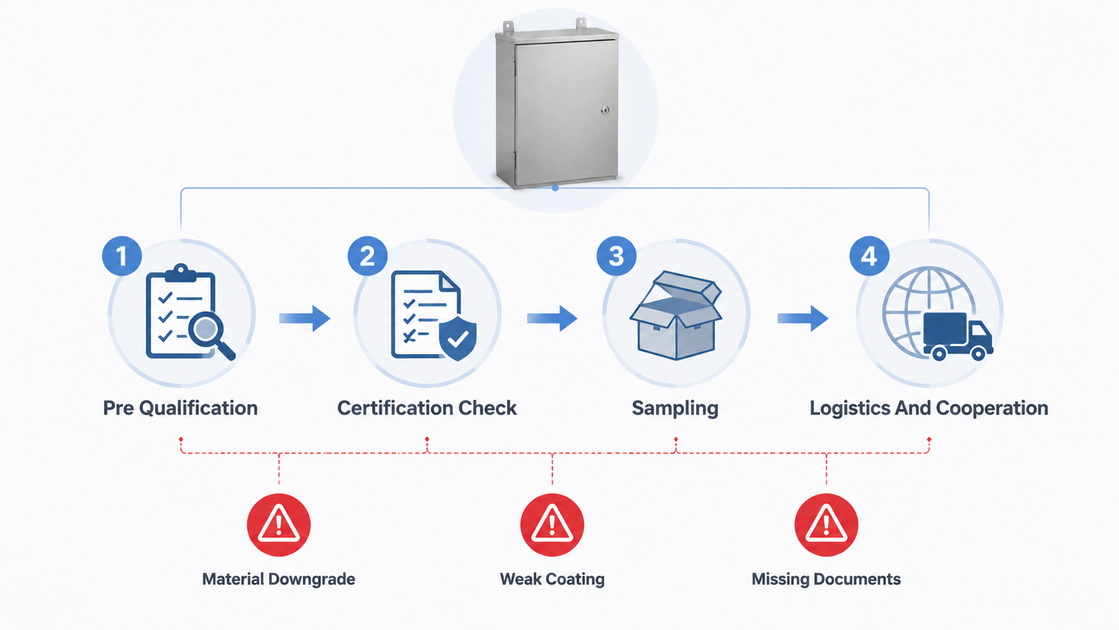
The first step is to compile a long list of potential suppliers. Industry directories, trade platforms, and sector‑specific networks are used to identify manufacturers and partners connected to the German market. Buyers focus on companies with clear enclosure portfolios and visible experience in industrial or infrastructure sectors.
During this stage, initial data such as product ranges, reference projects, and basic capacity information are gathered. Procurement teams also look for indications of international activity, such as export histories or multilingual documentation, to assess whether a supplier can handle cross‑border cooperation.
Once a shortlist is formed, certification and management systems are examined more closely. Buyers request copies of quality management certificates and check their validity and scope through the relevant bodies. They also ask for product‑related documentation such as declarations, test reports, and lists of standards covered.
In some cases, buyers prepare on‑site or remote audits to review processes and confirm that production workflows match the quality promises made. For high‑risk or high‑visibility projects, independent audit partners may be involved to increase confidence in the supplier's systems.
Sampling is a crucial step in reducing technical and performance risk. Procurement managers define clear criteria for sample evaluation, including dimensional tolerances, mechanical performance, coating quality, and functional aspects such as door operation and sealing.
Samples are installed in realistic conditions, sometimes at pilot sites or test facilities, to observe performance under typical loads and environmental factors. Feedback is collected from installers, maintenance staff, and engineering teams, and this information is used to refine specifications and cooperation terms.
Finally, logistics and long‑term cooperation models are designed. With German suppliers, buyers agree on packaging standards, palletization, and site delivery arrangements. For export partners like Ningbo Bohui Electric Co., Ltd, container planning, transit times, and customs processes are carefully organized to align with project schedules.
Long‑term frameworks may include forecast sharing, safety stock arrangements, and structured communication channels between technical, production, and logistics teams. These elements help keep deliveries stable and avoid last‑minute changes that can disrupt projects.
Below are several questions that procurement managers often raise when planning or managing metal electrical box sourcing, along with concise answers that support practical decision‑making.
Ask the supplier for the certificate number and issuing body, then check the issuing body's official database or registry. Most recognized organizations provide online tools where validity dates, scope, and status can be confirmed. If doubt remains, contact the organization directly and request confirmation of the certificate's current status.
Request detailed test reports from recognized laboratories that specify the exact tests performed and conditions used. Include verification of protection rating performance in your own sampling process by running trials at a test facility or with trusted partners. Consistent results between supplier reports and independent evaluations significantly reduce risk.
Integrate explicit material and coating specifications into technical agreements, including steel grades, sheet thickness ranges, and coating procedures. Schedule periodic random inspections and laboratory tests on samples taken from regular shipments. Communicate clearly that material deviations are considered non‑conformities and will trigger corrective actions.
Yes. Many procurement teams use German manufacturers for high‑critical or highly visible projects while sourcing cost‑sensitive or standardized enclosures from export‑oriented factories that follow comparable quality processes. A partner such as Ningbo Bohui Electric Co., Ltd can support smaller batches and tailored designs, while German manufacturers provide local engineering and installation compatibility for complex projects.
Sector reports, national association publications, and statistical databases are valuable tools. They provide insights into market growth, demand patterns, and investment trends in industries that use metal electrical boxes. By combining this information with internal historical data, procurement managers can create realistic volume forecasts and price review mechanisms for multi‑year contracts.
1. nVent Schroff – Metal and electronic enclosure solutions in Germany
https://ensun.io/search/metal-enclosure/germany
2. Industry directories and manufacturer listings for electrical boxes and switch cabinet systems in Germany
https://www.industrystock.com/en/companies/Electrical-Engineering/Switch-Cabinet-Systems/Electrical-Boxes
3. Ningbo Bohui Electric Co., Ltd – Company profile and enclosure product range
https://www.bohuielectric.com/aboutus.html
4. Statista and market research data for electric enclosure markets and global demand trends
https://www.industryresearch.biz/market-reports/electric-enclosure-market-102329
5. Electrical enclosure market insights and Germany‑related studies
https://www.researchandmarkets.com/report/germany-electrical-enclosure-market
6. German electrical industry associations providing annual statistical reports and sector data
https://www.zvei.org/

2026-07-26

2026-07-24


