


Views: 222 Author: Bohui Electric Publish Time: 2026-06-15 Origin: Site


Content Menu
● Introduction: Why Source Electrical Enclosures Around the Philippines
● How We Evaluate Electrical Enclosure Suppliers
>> Experience: What "real" factory capability looks like
>> Expertise: Technical details that matter for enclosures
>> Authoritativeness: Industrial clusters behind the brands
>> Trust: What we disclose about each factory
● Selection Criteria for This 2026 Shortlist
● Top Electrical Enclosure Manufacturers And Suppliers in Philippines (2026)
>> 1. Ningbo Bohui Electric Co., Ltd. (Strategic OEM Partner for Philippine Projects)
>> 2. Cherimel Philippines Inc. (Custom Sheet‑Metal Enclosures and Panel Enclosures)
>> 3. CYLC Allied and Trading Corp (Panelboards, Boxes, and Enclosures)
>> 4. Niolin Industrial (Supplier of Metal Enclosures and Hardware)
>> 5. RS Philippines (Global Industrial Distributor With Enclosures Portfolio)
>> 6. Global Enclosure Brands Relevant to Philippine Projects
● Quick Comparison Table: Representative Suppliers For Philippine‑Related Projects
● Industry Data: Why Demand Is Growing Into 2030
● Buyer's Guide: How to Vet Electrical Enclosure Suppliers
>> Step‑by‑step supplier verification
>> Common pitfalls and how to avoid them
>> Internal "insider" tip rarely written online
● Logistics and Project Execution Considerations
● Conclusion and Call to Action
● FAQ: Advanced Questions Procurement Managers Ask
>> 1. How can I verify whether a factory's ISO 9001 or other certification is still valid?
>> 2. What is a practical method to confirm IP rating claims for enclosures?
>> 3. How do I balance between local Philippine fabrication and imported OEM enclosures?
>> 4. What MOQ strategy works best for new enclosure designs?
>> 5. How can I reduce the risk of late deliveries for critical panels?
The Philippines has become a practical sourcing hub for electrical enclosures and related sheet‑metal fabrication, especially for panelboards, cable tray systems, racks, and custom metal boxes serving power, construction, and industrial projects. Local fabricators benefit from an English‑speaking workforce, strong EPC and construction ecosystems, and convenient logistics into Southeast Asia and Oceania. At the same time, many professional buyers still combine Philippine partners with specialized enclosure manufacturers in nearby Asian manufacturing clusters (notably coastal China) to balance cost, capacity, and advanced certification requirements. [cherimel]
For purchasing managers in power distribution, data centers, industrial automation, and new energy, the challenge is not finding *a* supplier, but selecting a few stable, technically capable partners who can support multi‑year programs with consistent quality and predictable lead times. This guide uses transparent criteria and current market data to shortlist representative manufacturers and suppliers serving the Philippine market, including regional OEM partners such as Ningbo Bohui Electric Co., Ltd. for cost‑effective, engineered enclosures. [eabel]
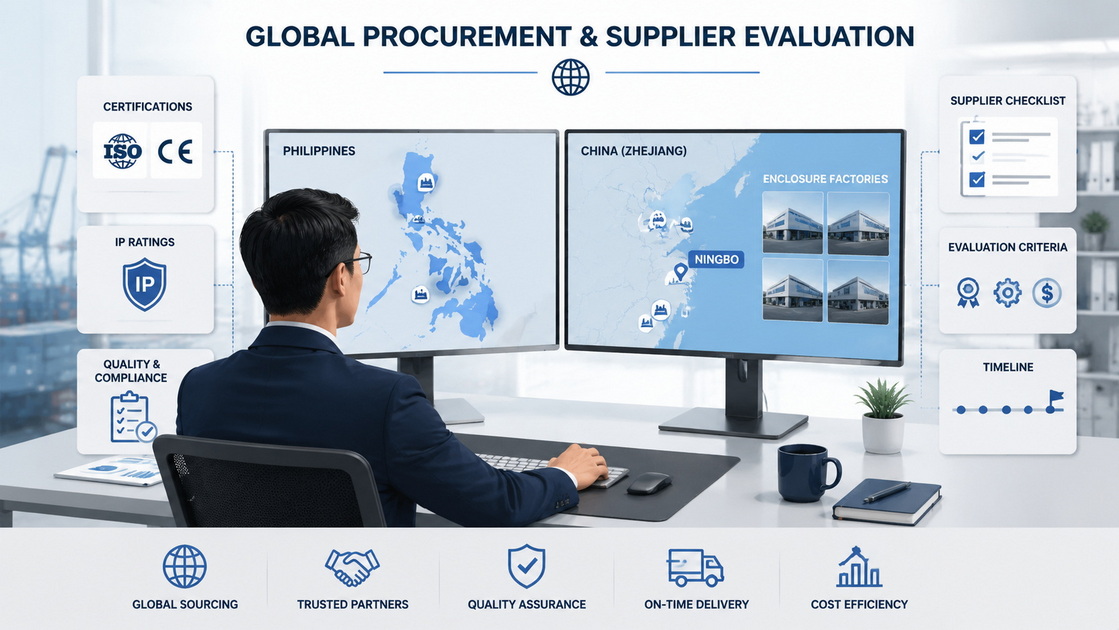
When assessing enclosure manufacturers, experienced buyers usually prioritize four dimensions:
- Factory certifications and audits
Look for ISO 9001 as a baseline, plus application‑specific standards such as UL/NEMA or IEC/EN for certain projects. Third‑party audits from global customers or EPCs are often more telling than a generic quality manual. [persistencemarketresearch]
- R&D and engineering support
Mature suppliers can develop new enclosure models in weeks, not months, and can adapt to customer drawings seamlessly. For example, Ningbo Bohui highlights the ability to develop a new product within about 40 days based on special requirements, supported by experienced sheet‑metal engineers. [bohuitechnology]
- Robust QC processes
A solid process covers raw‑material inspection, in‑process dimensional checks, IP sealing tests, coating thickness checks, and final functional tests before shipment. Consistency here directly impacts field failure rates and warranty exposure. [nemaenclosures]
- Delivery stability and scalability
Experienced factories can move from prototype to mass production with minimal learning‑curve defects and can scale capacity once samples are approved, while still keeping lead time and quality under control. [bohuitechnology]
From an engineering standpoint, qualified enclosure manufacturers must demonstrate deep understanding in several areas:
- Material grades and corrosion performance
Common choices include mild steel (often cold‑rolled), aluminum, and stainless steels (304/316) depending on the environment. For coastal or outdoor Philippine installations, higher‑grade coatings or stainless are often preferred to minimize corrosion. [youtube]

- Protection ratings: IP / NEMA
Industrial electrical enclosures are typically specified to IP54–IP66 or equivalent NEMA ratings for dust and water ingress protection. For outdoor telecom, solar, or EV charging, higher IP ratings and UV‑resistant coatings are frequently mandatory. [nemaenclosures]
- Standards and environmental compliance
Buyers increasingly expect compliance with CE marking, RoHS, and, in some cases, REACH and specific utility or data‑center standards. Documentation must be traceable to actual test reports, not only catalog claims. [persistencemarketresearch]
- Process capabilities
Advanced sheet‑metal shops combine precision laser cutting, automated punching, bending, robotic welding, and powder coating to achieve repeatable tolerances and durable finishes. Capability breadth is critical for complex, customized assemblies. [youtube]
In Asia‑Pacific, electrical enclosures benefit from well‑developed manufacturing clusters:
- Coastal China (e.g., Ningbo, Foshan, Shenzhen region) has mature ecosystems for sheet‑metal enclosures, EV charging cabinets, data racks, and industrial control cabinets, backed by export‑oriented supply chains and port infrastructure. [eabel]
- Southeast Asia, including the Philippines, has grown as a downstream fabrication and integration base, with local panel‑board builders, cable‑tray manufacturers, and metal fabrication companies supplying construction and industrial projects. [facebook]
Factories anchored in these clusters typically have faster access to raw materials, surface‑treatment houses, and logistics services, which directly influences cost and lead time for global buyers. [researchandmarkets]
For each featured company, this guide highlights:
- Founding or experience background
- Main product scope and focus
- Typical markets served
- OEM/ODM and customization strengths
- Where known, notes on MOQ, lead times, and certifications
This transparency is meant to help procurement managers shortlist candidates quickly, then move into RFQ and audit stages with a clearer understanding of each factory's positioning. [persistencemarketresearch]
To build this list of electrical enclosure manufacturers and suppliers active in or around the Philippine market, we applied the following criteria:
- Proven capability in metal or electrical enclosures
Companies must either manufacture enclosures (steel, stainless, aluminum) or provide custom sheet‑metal enclosures and panel enclosures as a core service. [youtube]
- Relevance to power, industrial, or ICT applications
Focus on applications such as electrical panelboards, data/network cabinets, power distribution boxes, EV/solar enclosures, or industrial automation cabinets. [eabel]
- Export or regional project track record
Preference given to companies serving international customers or large domestic projects, which generally implies better documentation and process maturity. [cherimel]
- Demonstrated engineering or customization capability
Evidence of custom fabrication, OEM/ODM work, or design‑to‑build services for client‑specific enclosures. [youtube]
- Access for international buyers
Availability of English‑language information, export experience, or established channels to support foreign procurement teams. [bohuitechnology]
In addition, we balance local Philippine options with regional OEM partners like Ningbo Bohui Electric Co., Ltd. for buyers who need volume capacity, broader product ranges, or more stringent global certifications while still serving projects in the Philippines. [researchandmarkets]
Although based in Ningbo, China, Ningbo Bohui Electric Co., Ltd. is increasingly used by Southeast Asian distributors, panel‑board assemblers, and integrators as a cost‑efficient OEM/ODM source for electrical enclosures supplied into Philippine projects. The factory designs and manufactures wall‑mount enclosures, free‑standing cabinets, modular cabinets, junction boxes, pushbutton enclosures, EV charger housings, data racks, and custom enclosures serving power, communications, industrial automation, construction, new energy storage, and EV charging. [eabel]
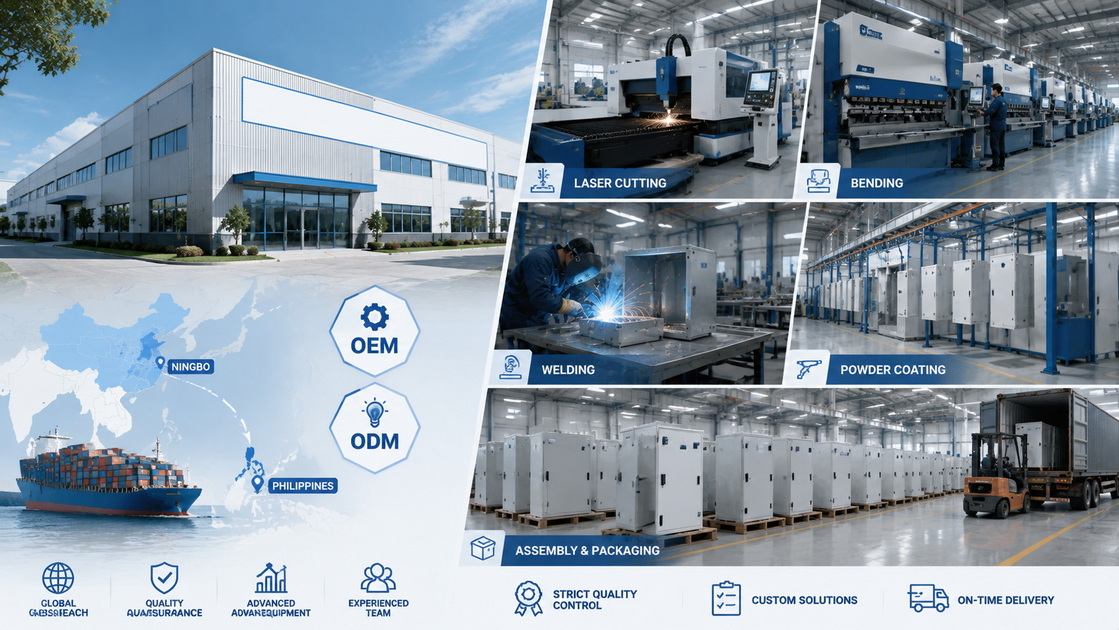
Located in Zhenhai Luotuo Lianqin Industrial Zone near Ningbo Port, Bohui benefits from convenient access to export logistics, enabling competitive lead times into Southeast Asia. The company emphasizes flexible sampling (often within about 5 days), small‑batch ordering, and fast scaling once samples are approved, which is attractive for medium‑sized brands and system integrators who need agile production rather than rigid MOQs. [bohuitechnology]
From a quality standpoint, Bohui maintains comprehensive inspection from raw materials to finished goods, targeting robust IP‑rated enclosures with durable coatings and strong mechanical performance. Products have obtained certifications such as CE and IP65 on associated lines, and are widely used in markets like North America, Europe, New Zealand, Southeast Asia, South America, the Middle East, India, and Africa. For buyers who need engineering collaboration, Bohui's team can develop new models in approximately 40 days according to customer specifications and can customize cutouts, mounting, and thermal‑management features as required. [bohuitechnology]
Positioning for buyers in or sourcing for the Philippines: A high‑value OEM/ODM partner when you want to control design, cost, and brand, while either stocking locally or integrating with Philippine panel‑board assemblers and distributors. [eabel]
Cherimel Philippines Inc. is a Philippine‑based sheet‑metal fabrication company offering a wide range of products including equipment racks, steel cabinets, lockers, cable trays, cable ladders, metal enclosures, kiosks, and electrical panel enclosures. The company accepts job orders for all sheet‑metal works and supports custom designs, which makes it relevant for project‑based enclosure requirements in construction, industrial facilities, and infrastructure. [youtube]
Their process capabilities include precision laser cutting, punching, bending, plasma cutting, and welding (spot, MIG, TIG), complemented by robotic welding for higher productivity and consistency. Material options range from mild steel and cold‑rolled steel to stainless steel and aluminum, allowing buyers to match corrosion and mechanical requirements to specific project environments. [youtube]
Cherimel's portfolio shows panel enclosures, tool cabinets, key cabinets, pull boxes, and stainless pump enclosures, indicating experience with enclosure‑type assemblies rather than just simple sheet parts. For local Philippine projects requiring rapid customization, closer communication, and on‑site coordination, Cherimel can be a strong candidate, especially when combined with imported standard enclosures from regional vendors. [cherimel]
CYLC Allied and Trading Corp is presented as a direct manufacturer and fabricator of premium panelboards, cable tray systems, boxes, and enclosures in the Philippines. Their portfolio includes main distribution panels (MDP), unitized panels, and related power‑distribution products, which usually require robust metal enclosures designed for electrical safety and ease of installation. [facebook]
For procurement teams, CYLC's integrated offering (panelboards plus enclosures plus cable trays) can reduce supplier fragmentation on construction or industrial projects. The company's positioning as both manufacturer and trading firm also allows it to complement in‑house fabrication with imported components and accessories, which may help in meeting tight project timelines. [facebook]
Niolin Industrial is a Philippines‑based distributor specializing in industrial and construction hardware products tailored to professional users, including metal enclosures such as the SASSIN metal enclosure 3SM series. While Niolin may not manufacture enclosures itself, it plays an important role as a channel for branded metal enclosures into the Philippine market, especially for standard distribution‑box and panel applications. [niolin-industrial]
For buyers who prefer off‑the‑shelf standardized products with known global brands, Niolin can serve as a convenient sourcing point, reducing import‑administration overheads and localizing after‑sales support. This is particularly useful when you want to combine local fabrication for non‑critical parts with standardized certified enclosures for main distribution or control panels. [niolin-industrial]
RS Philippines, part of the RS Group, offers a broad range of industrial products including enclosures, power supplies, and automation components, with a strong presence in Makati City. While RS is not a manufacturer, it distributes enclosures from multiple global brands, allowing Philippine buyers to access a wide catalog of IP‑rated, application‑specific enclosures through a single platform. [eabel]
For procurement teams managing multi‑country deployments, RS can help standardize enclosure specifications and simplify replacements or expansions over the lifecycle of a project. RS's digital catalog and logistics network also reduce sourcing friction for MRO and small‑batch demand in the Philippines, particularly in electronics, automation, and IT infrastructure projects. [eabel]
In addition to the regional players above, several global enclosure manufacturers have strong presence in Asia‑Pacific and are often specified in projects that touch the Philippines:
- E‑Abel – Focuses on creative and adaptable electrical enclosures, including general‑purpose boxes, distribution boxes, and IT/medical enclosures, with welding‑free concepts that simplify assembly. [persistencemarketresearch]
- Schneider Electric – Provides a comprehensive portfolio of electrical enclosures and server cabinets, often chosen when customers require integration with Schneider power and automation systems. [persistencemarketresearch]
- Hammond Manufacturing, Rittal, Pentair, nVent, ABB, Legrand, Emerson, Adalet – Global brands highlighted in recent 2025 industry overviews as key players for industrial and hazardous‑area enclosures. [persistencemarketresearch]
For Philippine projects, these brands are typically accessed via local distributors, panel‑board integrators, or regional stocking hubs rather than direct factory relationships. [ph.element14]
| Company / Role | Location | Main enclosure focus | Typical markets | OEM/ODM & customization notes |
|---|---|---|---|---|
| Ningbo Bohui Electric Co., Ltd. | Ningbo, China | Wall‑mount, free‑standing, modular, junction boxes, EV charger, data racks, custom enclosures | Power, communications, industrial automation, construction, new energy, EV, water pumps | Strong OEM/ODM for small–large batches; fast sampling (≈5 days) and new model dev. in ~40 days; supports custom cutouts, layouts, coatings. bohuitechnology |
| Cherimel Philippines Inc. | Philippines | Equipment racks, steel cabinets, lockers, metal & panel enclosures, cable trays | Construction, industrial facilities, infrastructure | Job‑order based custom sheet‑metal; supports client designs, multiple materials; suitable for project‑specific enclosures. youtube |
| CYLC Allied and Trading Corp | Philippines | Panelboards, cable trays, boxes and enclosures | Power distribution, building projects | Direct fabrication of panelboards and enclosures; integrated systems for local projects. facebook |
| Niolin Industrial | Philippines | Branded metal enclosures (e.g., SASSIN series) and hardware | Contractors, electricians, industrial users | Distributor model; customization usually via brand options rather than full OEM from Niolin. niolin-industrial |
| RS Philippines | Philippines | Wide catalog of enclosures and racks from various manufacturers | Industrial, automation, IT, MRO | Distributor with broad SKU range; limited customization but strong availability and logistics. eabel |
Recent market reports indicate that the global electrical enclosure market was in the range of roughly USD 8–9 billion around mid‑2020s and is projected to grow steadily, reaching above USD 15–16 billion toward the early 2030s, driven by industrial automation, data centers, renewable energy, and EV infrastructure. Regional research for Asia‑Pacific suggests a solid CAGR in the mid‑single to high‑single digits for electrical enclosures, supported by power‑grid upgrades and manufacturing investments. [sg.finance.yahoo]
More recent 2025–2026 analyses estimate the electric or electrical enclosure market value around USD 9–9.1 billion in 2025, with expectations to reach roughly USD 14–17 billion by early 2030s. For procurement managers, this sustained growth translates into tighter capacity in certain sub‑segments (such as outdoor IP66 enclosures for renewables and EV charging), making long‑term allocation and dual‑sourcing strategies increasingly important. [coherentmarketinsights]
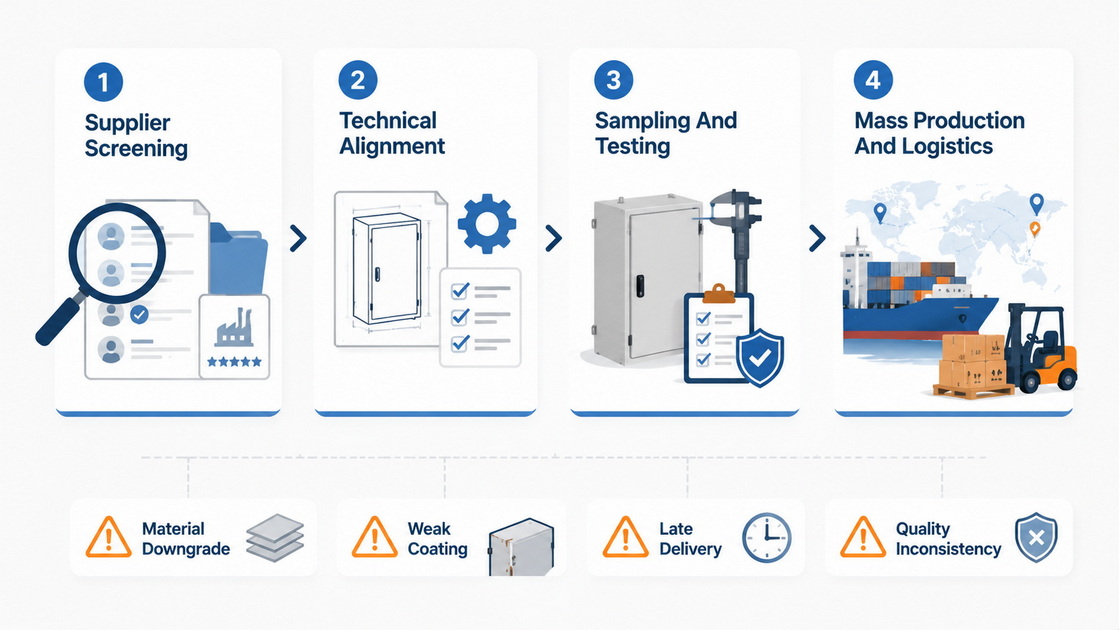
1. Shortlist and pre‑screen
- Use public information (websites, catalogs, certifications) to verify core capabilities, relevant application focus, and basic scale.
- Prioritize suppliers with clear product segmentation (indoor/outdoor, IP ratings, material options) and documented standards. [nemaenclosures]
2. Verify certifications and compliance
- Request ISO 9001, environmental certifications, and any UL/NEMA, CE, IP test certificates relevant to your application. [persistencemarketresearch]
- Confirm validity directly with issuing bodies or via online certificate lookup when available; watch expiry dates and scope of coverage.
3. Technical and drawing alignment
- Share 2D/3D drawings, bill of materials, and specification sheets; ask the supplier to mark up any deviations or suggested optimizations. [bohuitechnology]
- For OEM/ODM partners like Bohui, leverage their engineering input on manufacturability, material thickness, and coating systems. [bohuitechnology]
4. Sampling and pilot production
- Start with a small batch for fit‑up, thermal, and environmental testing; measure critical dimensions and check coating thickness.
- Use a structured sample approval form that records version, process notes, and any agreed changes before moving to mass production.
5. On‑site or remote audit
- Review incoming material inspection, laser/punching machines, welding quality, powder‑coating lines, and final‑test procedures. [youtube]
- Evaluate capacity utilization and lead‑time risks; scalable factories can ramp volume once your project stabilizes. [bohuitechnology]
6. Contracting and logistics
- Clearly define lead times, packaging standards, labeling, and incoterms; for cross‑border sourcing into the Philippines, align on port, customs responsibilities, and buffer stock strategy. [researchandmarkets]
- For local suppliers such as Cherimel or CYLC, detail site‑delivery expectations and coordination with project schedules. [facebook]
- Material downgrading
Some suppliers may quietly switch to thinner sheet or lower‑grade steel to cut costs. Mitigate by specifying material grade, thickness tolerance, and requiring mill certificates and random incoming checks. [nemaenclosures]
- Coating and corrosion issues
In tropical, coastal climates, insufficient pretreatment or thin powder coat can lead to early rust. Insist on documented coating systems, salt‑spray test data where relevant, and periodic inspection of early batches in the field. [fortunebusinessinsights]
- Over‑engineered or under‑specified IP ratings
Paying for IP66 when IP54 is enough wastes budget, while underspecifying for outdoor or wash‑down environments risks failures. Align IP/NEMA ratings with realistic installation conditions and safety margins. [nemaenclosures]
- Single‑sourcing risk
Relying on one factory can create bottlenecks as your demand grows or during capacity constraints. Use a dual‑sourcing approach: combine a flexible OEM like Bohui with at least one local fabricator or regional brand channel. [eabel]
A widely known but seldom stated practice among experienced buyers is to audit the supplier's "B‑grade" and rework handling rather than only inspecting their perfect showroom samples. If a factory cannot explain how they classify, rework, and (most importantly) *prevent* recurrence of enclosure paint defects, mis‑punching, or welding distortion, long‑term field quality will almost always suffer. Asking to see scrap records, rework areas, and corrective‑action reports often reveals more about real process control than any glossy certificate. [bohuitechnology]
For projects in the Philippines, logistics often shapes total cost and risk more than the unit price of the enclosure:
- Lead times and buffers
Sea freight from coastal China to the Philippines can be relatively short, but port congestion, customs clearance, and inland trucking still add variability. Build realistic buffer stock, particularly for critical enclosures that gate commissioning. [researchandmarkets]
- Packaging and labeling
Specify palletization, moisture protection, corner protectors, and clear product labeling to minimize damage and identification issues at site. Poor packaging can quickly erase savings from lower ex‑works pricing. [bohuitechnology]
- Coordination between OEM and local fabricators
Many buyers source standard enclosures from OEM exporters like Bohui, then rely on local Philippine shops (e.g., panel‑board assemblers or Cherimel‑type fabricators) for last‑mile modifications, cable‑tray integration, and installation. This hybrid model combines cost efficiency with local responsiveness. [youtube]
Selecting electrical enclosure partners for Philippine projects in 2026 requires more than checking a catalog; it demands structured supplier evaluation, attention to technical standards, and a clear sourcing strategy that balances local responsiveness with global manufacturing strengths. Local fabricators like Cherimel and CYLC provide agile project support on the ground, while regional OEMs such as Ningbo Bohui Electric offer scalable, cost‑effective, and engineering‑driven enclosure solutions that can underpin your branded systems across multiple markets. [eabel]
If you are planning new power, industrial automation, or renewable‑energy projects in or around the Philippines, consider building a dual‑sourcing roadmap that combines one flexible OEM partner with one or two local implementation partners. Share your target application (indoor/outdoor, IP rating, volume range), and we can help you refine a shortlist and draft an RFQ framework tailored to electrical enclosures.
Ask for a digital copy of the certificate and note the issuing body, certificate number, and expiry date, then cross‑check on the certification body's official website or accreditation database where available. For major bodies, online lookup tools are standard; any reluctance to share details is a red flag. [persistencemarketresearch]
Request third‑party test reports referencing relevant IEC/EN standards, plus photos or videos of IP testing setups for representative models. For critical installations, consider independent lab testing on random samples or require witnessed tests on your specific enclosure model. [nemaenclosures]
Use local fabricators for project‑specific or bulky items (large panels, custom racks) where freight costs and on‑site adjustments are significant, and import standardized IP‑rated enclosures from specialized OEMs for high‑value or high‑risk applications. Align your suppliers with your product segmentation and risk profile. [youtube]
Start with low to mid‑size MOQs at an agile OEM (like Bohui) to validate design and field performance, then lock in tiered pricing once volume stabilizes. Avoid committing to aggressive MOQs before you have run at least one full project cycle with real‑world feedback. [bohuitechnology]
Include capacity and lead‑time commitments in contracts, require frequent WIP visibility (photos, production dashboards), and consider dual tooling or dual‑sourcing for your highest criticality enclosures. For overseas suppliers, pair long‑term forecasts with rolling firm orders to secure production slots. [coherentmarketinsights]

2026-07-26

2026-07-24


