


Views: 222 Author: Amanda Publish Time: 2026-02-19 Origin: Site


Content Menu
● Understanding the Basic Architecture
● What Is a Marshalling Panel or Marshalling Cabinet
>> Why Marshalling Panels Matter
● Key Differences Between Marshalling Panel, Junction Box, and System Cabinet
● When You Need a Junction Box, Marshalling Panel, or System Cabinet
>> When to Use a Marshalling Panel
>> System Cabinets in All Modern Projects
● Design Best Practices for Marshalling Panels and Enclosures
● Application Examples by Industry
>> Process Industries and Water Treatment
>> New Energy and EV Infrastructure
● Practical Step‑by‑Step Selection Guide
● Smart Marshalling and Emerging Trends
● Work With a Specialist Electrical Enclosure Manufacturer
● Clear Call to Action: Start Optimizing Your Next Panel Project Now
● Frequently Asked Questions (FAQ)
>> 1. Can I skip the marshalling panel and connect junction boxes directly to the system cabinet
>> 2. Are marshalling panels still needed with electronic marshalling
>> 3. What IP rating should I choose for outdoor junction boxes
>> 4. How many signals should one marshalling cabinet handle
>> 5. What materials are best for coastal or chemical plant applications
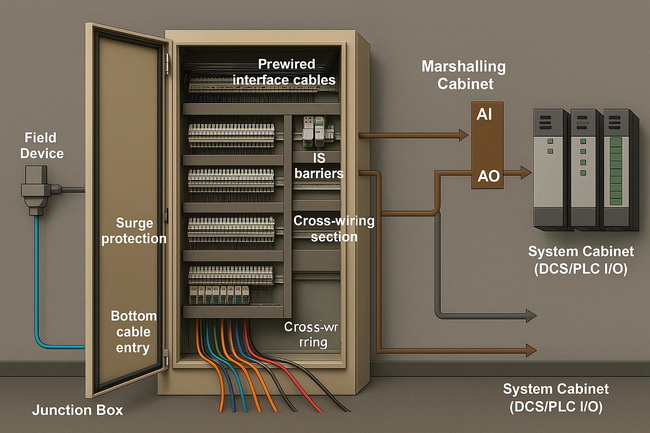
In a typical DCS or PLC control system, field instruments and devices do not connect directly to the control CPUs.
Instead, you usually see this signal path:
1. Field devices (sensors, valves, motors, pumps)
2. Junction boxes in the field
3. Marshalling panel or marshalling cabinet in the control room
4. System cabinet housing I/O modules, controllers, and communication hardware
Each stage has a specific role in organizing, protecting, and routing signals so that installation and maintenance remain manageable even when you have hundreds or thousands of I/O points.

A junction box is a protective enclosure that collects and consolidates wiring from field devices.
- Primary role: Aggregate multiple field cables into larger multi‑core “home‑run” cables going back to the control room.
- Signal path: Generally provides a direct connection from field devices to the marshalling or system cabinet, with minimal or no internal signal re‑routing.
- Location: Installed close to instruments, motors, pumps, or other field equipment to reduce cable runs and simplify layout.
- Terminal blocks or connectors for multiple instrument loops.
- Rated enclosure (for example IP65 or IP66) to protect against dust, water, and corrosion.
- Simple internal layout for maintenance technicians to add or replace circuits quickly.
A marshalling panel, also called a marshalling cabinet, is the interface between field junction boxes and the system cabinet.
- Signal interface: Provides the primary termination point for all incoming field cables and home‑run cables from junction boxes.
- Cross‑wiring and ordering: Allows engineers to re‑order and group I/O signals to match the physical layout of I/O cards in the system cabinet.
- Isolation and protection: Often houses surge protection devices, intrinsic safety barriers, and fuses to protect the control system.
- They decouple field wiring from the system cabinet, which reduces risk when I/O cards or control hardware are changed or upgraded.
- They enable the use of pre‑fabricated cables between marshalling cabinet and I/O modules, simplifying engineering and speeding up installation.
- In large plants, they significantly improve maintainability and fault‑finding by providing clear signal segregation and labeling.
A system cabinet, also called a system panel or control cabinet, houses the core automation hardware.
- Holds DCS or PLC controllers, I/O modules, power supplies, network switches, and communication gateways.
- Provides the interface to operator stations, SCADA systems, and higher‑level networks.
- Receives signals from the marshalling panel via pre‑fabricated multi‑core or ribbon cables.
- Thermal management with ventilation, fans, or air conditioning to protect electronics.
- EMC and grounding practices to minimize electrical noise and interference.
- Structured wiring channels and labeling to make I/O expansion and replacement efficient.
High‑quality metal system cabinets with proper IP ratings and robust sheet‑metal construction are essential to ensure long‑term performance in power, industrial, and new energy applications.
The table below summarizes the main differences so engineers and project managers can quickly select the right solution.
Aspect | Junction Box | Marshalling Panel or Cabinet | System Cabinet |
Primary Role | Collect and consolidate field wiring in the field. | Interface, cross-wire, and organize signals between field and system I/O. | Host controllers, I/O cards, and core automation hardware. |
Location | Near instruments, motors, pumps, outdoor equipment. | Control room or technical building. | Control room, MCC room, or server or automation room. |
Signal Management | Direct termination, minimal internal re-routing. | Cross-wiring, grouping, surge protection, IS barriers. | I/O cards receive prefabricated cables from marshalling cabinet. |
Complexity | Low, mainly terminal blocks. | Medium to high, includes terminal assemblies, jumpers, protection devices. | High, dense electronics, power, and networking equipment. |
Typical Use | Reduce cable lengths and simplify field wiring. | Large projects needing flexible I/O assignment and easy maintenance. | Centralized control and integration with plant systems. |
- Field devices are scattered over a wide area such as pipelines, tank farms, or water treatment basins.
- You want to avoid home‑running individual cables for every device to the control room.
- Maintenance teams need simple, local access for adding or checking signals.
- You have medium to large I/O counts and want flexible signal allocation without rewiring the system cabinet.
- Different disciplines such as process, electrical, and safety share the same control system and require clear signal segregation.
- You expect I/O expansion, system migration, or vendor changes over the life of the plant.
Every modern DCS or PLC installation requires at least one system cabinet for CPUs, I/O, and networking hardware.
The real question is whether you connect field signals directly to the system cabinet or via junction boxes and marshalling panels, based on project size, layout, and risk tolerance.
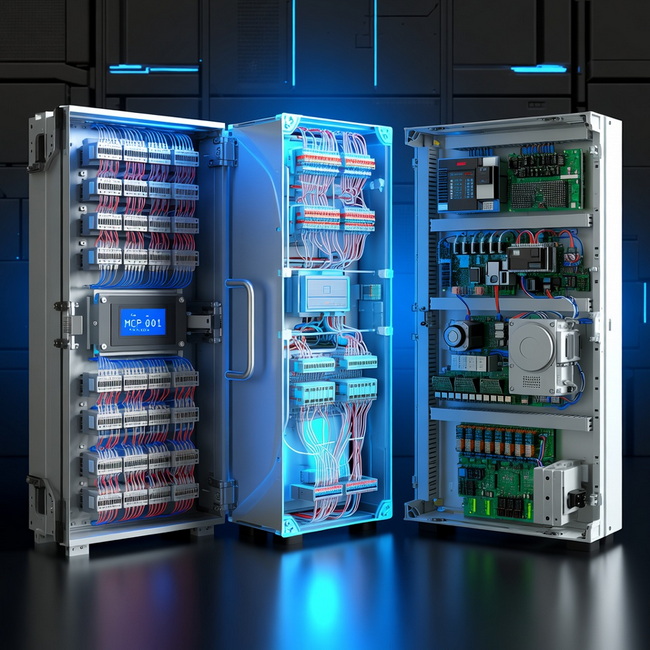
Well‑designed marshalling cabinets and junction boxes reduce failures, speed up commissioning, and support safe operation.
- Separate analog, digital, high‑voltage, and communication circuits into clearly marked zones.
- Provide adequate space for terminal blocks, surge protectors, and future spare signals.
- Maintain clear routing paths for cables to prevent congestion and overheating.
- Choose enclosures with sufficient IP rating such as IP65 or IP66 for outdoor or dusty or humid environments.
- Use corrosion‑resistant materials, for example stainless steel or coated steel, for coastal or chemical plant applications.
- Include surge protectors and intrinsic safety barriers for hazardous areas where required by local standards.
- Use consistent terminal numbering and clear signal tags that match P&IDs and I/O lists.
- Keep updated wiring diagrams inside or near each cabinet for fast troubleshooting.
- Standardize cable colors and ferrule schemes across the project.
High‑quality sheet metal enclosures from experienced manufacturers help maintain mechanical integrity and rating performance throughout these design practices.
In power generation and transmission, marshalling cabinets interface between protection relays, RTUs, and field CT or VT signals, while junction boxes collect signals from switchgear and yard equipment.
System cabinets typically host protection relays, PLCs, and communication equipment in control rooms or relay rooms.
Refineries, chemical plants, and water treatment facilities often use numerous junction boxes in the field connected to centralized marshalling cabinets.
This architecture simplifies upgrades and supports phased expansions, especially where new units are added over time.
In new energy storage systems, solar PV plants, and EV charging infrastructure, robust outdoor enclosures protect power electronics, combiner circuits, and control systems.
Selecting the right combination of junction boxes and system cabinets helps integrate renewable assets with grid control and monitoring platforms.
Use this quick decision process when designing your next control system.
1. Define I/O count and growth
- Small, fixed systems may connect field cables directly to a system cabinet.
- Large or expanding projects benefit from marshalling cabinets and standardized junction box groups.
2. Map physical layout
- If devices are concentrated, one or two junction boxes may be enough.
- For wide‑area sites, plan multiple junction boxes with clear zoning.
3. Assess environment and protection needs
- Outdoor or corrosive environments require higher IP ratings and robust materials.
- Hazardous areas may need flameproof or intrinsically safe designs.
4. Plan maintenance and lifecycle
- Choose marshalling panels when you expect I/O additions, vendor changes, or control system upgrades.
- Standardize enclosure types and internal layouts to simplify spares and training.
5. Select enclosure supplier
- Work with experienced enclosure manufacturers that can provide custom dimensions, cut‑outs, mounting options, and IP‑rated designs across junction boxes, marshalling panels, and system cabinets.
Recent projects increasingly adopt smart marshalling approaches that reduce cabinet count and simplify design.
- Integrate modular I/O and marshalling into more compact cabinets, cutting the number of traditional panels in many projects.
- Reduce building size and related HVAC and electrical loads by consolidating equipment.
- Still provide clear separation between field and system hardware for maintainability.
Electronic marshalling connects field signals directly to configurable I/O modules, minimizing cross‑wiring but placing more emphasis on early design decisions and robust junction box grouping.
Even with these trends, high‑quality enclosures remain critical to protect equipment and maintain system reliability over long lifecycles.
Choosing the correct marshalling panel, junction box, and system cabinet design is only part of the story; the quality of the enclosure itself has a direct impact on safety and reliability.
Professional enclosure manufacturers can provide:
- Custom sheet‑metal distribution boxes and control cabinets for power, automation, building, and new energy projects
- IP65 or IP66 outdoor junction boxes and rainproof stainless steel enclosures for harsh environments
- Flexible design support for cut‑outs, mounting plates, and accessories to match your internal hardware and layout
By combining a robust enclosure platform with a well‑planned signal architecture, project owners can reduce downtime, simplify maintenance, and extend the life of their control systems.
If you are planning a new substation, process line, water treatment upgrade, or energy‑storage system, this is the right time to review your approach to marshalling panels, junction boxes, and system cabinets.
Reach out to our engineering team with your single‑line diagrams, I/O lists, and environmental requirements, and we will help you define the most suitable enclosure configuration, materials, and protection levels for your project. By partnering early in the design phase, you can minimize rework, control total installed cost, and ensure that your electrical enclosures are ready for future expansion and digitalization.
Contact us to get more information!
In small systems with limited I/O and stable requirements, you can route field cables directly from junction boxes to the system cabinet. However, this approach reduces flexibility for future upgrades and cross‑wiring and can make maintenance more complex in the long term.
Electronic marshalling reduces traditional cross‑wiring, but many projects still use marshalling‑type cabinets to group I/O, protect electronics, and provide a clear maintenance interface. These cabinets can simplify signal organization, improve labeling, and provide space for surge protection and other ancillary devices.
For most outdoor industrial environments, IP65 or IP66 enclosures are recommended to protect against dust and water ingress. In very harsh or wash‑down conditions, you may consider higher ratings or additional protective measures such as sunshades and shelters.
Depending on design, a marshalling cabinet can handle from a few hundred up to several thousand signals. The exact number depends on available space, terminal density, spare capacity strategy, and cooling and accessibility requirements.
Stainless steel or high‑quality coated steel enclosures provide better corrosion resistance in coastal or chemically aggressive environments. Choosing the right material and surface treatment helps improve lifespan, reduce maintenance frequency, and maintain enclosure integrity over many years.
1. https://www.panelmatic.com/2025/01/08/marshalling-cabinet/
2. https://instrumentationtools.com/marshalling-cabinet/
3. https://automationforum.co/what-is-marshalling-cabinet/
4. https://www.hm-ec.com/blog-posts/control-systems
5. https://www.ijtsrd.com/papers/ijtsrd59893.pdf
6. https://www.bohuitechnology.com
7. https://www.bohuitechnology.com/e_products/

2026-07-26

2026-07-24


