


Views: 222 Author: Amanda Publish Time: 2026-02-09 Origin: Site


Content Menu
● What Is an IP Rating and Why It Matters
● How the IP Code Is Structured
● First Digit: Protection Against Solids (0–6)
● Second Digit: Protection Against Liquids (0–9)
● How to Read a Typical IP Rating (With Examples)
● IP vs NEMA: What Is the Difference?
>> Common NEMA / IP Correspondence
● Typical IP Ratings by Industry Application
>> Dust tests (first digit 5 or 6)
>> Water spray and jet tests (second digits 3–6)
>> Immersion tests (second digits 7–8)
● Mechanical Impact Protection and IK Ratings
● Step‑by‑Step: How to Choose the Right IP Rating
>> 2. Assess contact and safety risks
>> 3. Specify solid protection (first digit)
>> 4. Specify water protection (second digit)
>> 5. Confirm standards and region
>> 6. Align with lifecycle and maintenance strategy
● Practical Design Considerations for IP‑Rated Enclosures
● Targeted Call to Action: Get Help Specifying Your IP‑Rated Enclosures
>> FAQ 1. Is a higher IP rating always better?
>> FAQ 2. Can I directly convert a NEMA rating to an IP rating?
>> FAQ 3. Does IP67 mean the enclosure is completely waterproof?
>> FAQ 4. What does the “X” mean in an IP rating like IPX4?
>> FAQ 5. Do IP ratings cover corrosion resistance?
Ingress Protection (IP rating) is a standardized way to describe how well an electrical enclosure is protected against solid particles (like dust) and liquids (like water), helping you match the right enclosure to the environment and application.
For OEMs, panel builders, and system integrators in power, telecom, industrial automation, energy storage, EV charging, and water pumps, choosing the correct IP code is critical to avoid equipment failures, unplanned downtime, and warranty claims in harsh environments.
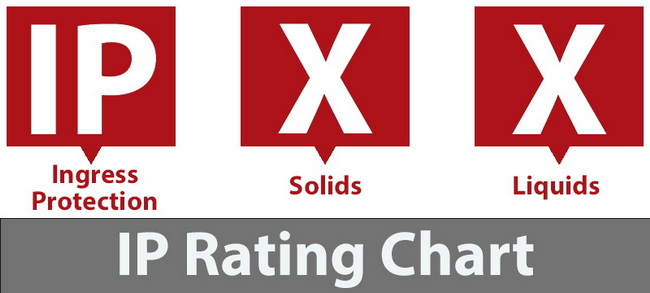
An IP rating (Ingress Protection rating) is a two‑digit code defined by IEC 60529 that classifies how effectively an electrical enclosure prevents the ingress of solid objects and water.
The IP code makes it possible to compare different enclosures using a common language, regardless of brand or material.
By specifying an appropriate IP rating, you protect people from accidental contact with live parts and ensure that dust or moisture cannot compromise the safe operation of your equipment.
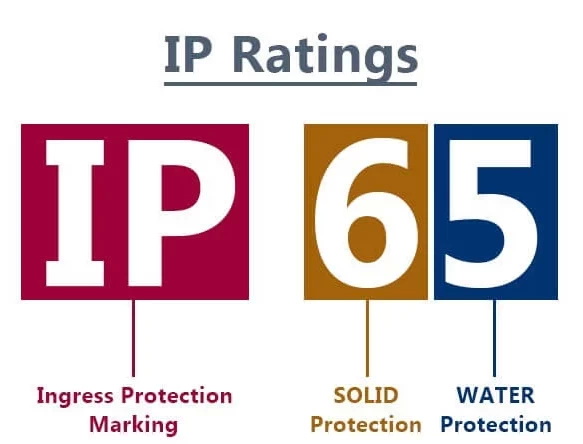
An IP rating is usually written as IPXY, where the first digit (X) indicates protection against solids and the second digit (Y) indicates protection against water.
- The first digit (0–6) defines protection against access to hazardous parts and ingress of solid foreign objects ranging from hands and tools down to fine dust.
- The second digit (0–9) defines protection against water, from vertical drips and splashes through jets and immersion.
- If one of the classes is not tested, it may be written as IPX4, where the “X” indicates “not specified” for that digit.
In some legacy documentation, a third digit can refer to protection against mechanical impact, but this is no longer part of the current IEC 60529 IP code and is now handled by a separate IK rating system.
The first digit describes both personnel protection (access to live or moving parts) and protection against solid objects such as tools, wires, or dust.
IP first‑digit levels:
- 0 – No protection: No specific protection against solids.
- 1 – >50 mm objects: Protected against large surfaces such as the back of a hand.
- 2 – >12.5 mm objects: Protected against fingers or similar objects.
- 3 – >2.5 mm objects: Protected against tools, thick wires, and similar objects.
- 4 – >1.0 mm objects: Protected against most wires, screws, and smaller tools.
- 5 – Dust protected: Some dust ingress is allowed but not enough to interfere with safe operation.
- 6 – Dust tight: Completely protected against dust; no ingress permitted.
For Levels 5 and 6, tests are normally performed in a dust chamber using fine powder, often with a partial vacuum drawn through the enclosure for several hours depending on the air volume and test setup.
The second digit describes protection against water exposure, from condensation to high‑pressure, high‑temperature jets.
IP second‑digit levels (commonly used):
- 0 – No protection.
- 1 – Dripping water: Vertically falling drops (for example, condensation) must not affect operation.
- 2 – Dripping water at 15° tilt: Protected when the enclosure is tilted up to 15° from vertical.
- 3 – Spraying water: Water sprayed at up to 60° from vertical using an oscillating tube or spray nozzle.
- 4 – Splashing water: Water splashing from any direction must not cause harmful effects.
- 5 – Water jets: Protected against low‑pressure water jets from any direction.
- 6 – Powerful water jets: Protected against higher‑pressure jets, often used in industrial wash‑down.
- 7 – Temporary immersion: Protected against temporary immersion, typically to 1 m depth for 30 minutes.
- 8 – Continuous immersion: Protected for long‑term immersion at depths greater than 1 m, with conditions agreed between manufacturer and user.
- 9/9K – High‑pressure, high‑temperature jets: Used in very demanding wash‑down environments such as food processing.
Understanding how to interpret common IP codes helps you quickly match an enclosure to its application.
- IP20: Protection against finger access and medium‑sized objects; no protection against water. Common in indoor, clean, dry environments.
- IP54: Dust protected and protected against splashing water or low‑pressure jets from any direction. Widely used in light industrial and commercial environments.
- IP65: Fully dust tight and protected against low‑pressure water jets. Suitable for many outdoor and wash‑down applications.
- IP66: Dust tight and protected against powerful water jets; used in harsh outdoor or marine environments.
- IP67: Dust tight and protected against temporary immersion up to around 1 m for 30 minutes. Often used where there is temporary flooding risk or short‑term submersion.
- IP68: Dust tight and suitable for continuous immersion at specified depths and times, defined by agreement between user and manufacturer.
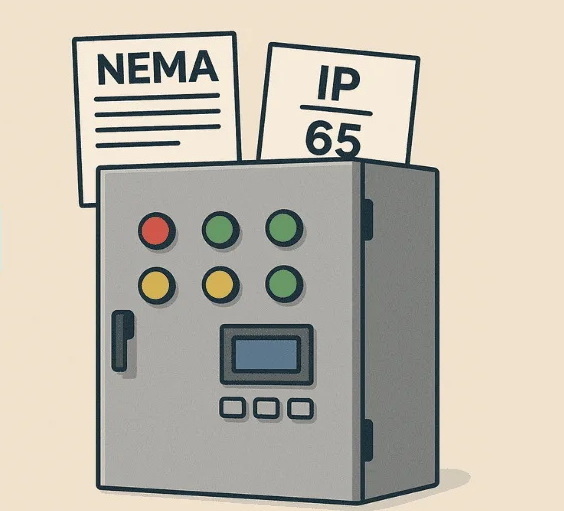
In North America, many engineers are more familiar with NEMA enclosure types than IP codes.
- NEMA ratings (for example, Type 1, 3R, 4, 4X, 12, 6, 6P) cover not only water and dust ingress but also additional factors such as corrosion resistance, gasket aging, and construction details.
- IP ratings focus strictly on protection against solid foreign objects and water; they do not address corrosion, icing, or other mechanical properties.
Because NEMA is broader in scope, an enclosure with a given NEMA rating may satisfy or exceed a certain IP rating, but the reverse mapping is not guaranteed.
The table below summarizes typical minimum NEMA types that meet or exceed certain IP ratings (one‑way mapping only).
IP Code | Typical minimum NEMA type | Notes |
IP20 | NEMA 1 | Basic indoor protection against large objects, no water protection. |
IP54 | NEMA 3 | Outdoor use with rain and dust protection, not for high-pressure wash-down. |
IP66 | NEMA 4, 4X | Indoor/outdoor, hose-down and heavy spray, 4X adds corrosion resistance. |
IP67 | NEMA 6 | Submersible for limited time and depth. |
IP68 | NEMA 6P | Long-term submersion with enhanced corrosion protection. |
This table should be used only to map from an IP requirement to a minimum NEMA type; you cannot reliably convert from NEMA type back to a specific IP code.
Different industries and environments demand different IP levels for safe and reliable operation.
Application scenario | Typical environment risk | Recommended minimum IP rating | Rationale |
Indoor control cabinets in clean rooms | Low dust, no water exposure | IP20–IP21 | Protection against accidental touch and basic objects. |
Commercial buildings, utility rooms | Light dust, occasional drips | IP44–IP54 | Protection against small solids and splashes. |
Outdoor power distribution | Rain, wind-blown dust | IP54–IP65 | Dust protection and rain or spray resistance. |
Telecom base stations | Outdoor, dust, rain, humidity | IP65–IP66 | Dust tight and robust protection against water jets. |
Industrial automation (wash-down areas) | Cleaning with hoses or jets | IP66–IP69 | Withstands high-pressure cleaning and aggressive detergents. |
EV charging and energy storage | Outdoor, possible flooding | IP55–IP67 | Combines jet protection with temporary immersion resistance. |
Submersible pumps and sensors | Continuous submersion | IP68 | Designed for long-term immersion at specified depth. |
Understanding the test methods helps you evaluate whether a particular IP rating genuinely fits your risk profile.
- Enclosures are placed in a dust chamber filled with fine powder that is recirculated by a blower.
- For some tests, a partial vacuum is applied to draw air through the enclosure, increasing the stress on gaskets and seals.
- Test durations typically range from 2 to 8 hours depending on whether vacuum is applied and the internal volume of the enclosure.
- Levels 3 and 4 use oscillating pipes or hand‑held spray nozzles to simulate rain and splashing from different angles.
- Levels 5 and 6 use hose nozzles at higher flow rates and pressures, hitting the enclosure from multiple directions and distances.
- IPX7 tests usually involve immersion to 1 m depth for about 30 minutes, with defined distances between the enclosure and the water surface and bottom.
- IPX8 conditions (depth and duration) are customized for each design, reflecting realistic deployment conditions such as reservoirs, pits, or underwater structures.
Some older documents and vendor literature mention a third digit in the IP code to describe protection against mechanical impacts, such as IP541.
Today, impact resistance is normally specified using a separate IK rating according to IEC 62262.
- IK levels are defined by impact energy values measured in joules.
- Higher IK levels indicate better resistance to vandalism, accidental knocks, or falling objects.
For critical outdoor, EV, or factory environments with risk of mechanical shock, you should request both IP and IK ratings when specifying enclosures.
To avoid over‑ or under‑specifying your enclosure, follow this simple process when defining IP requirements.
- Indoor or outdoor location, including exposure to UV, rain, snow, or marine atmospheres.
- Presence of dust, sand, fibers, oil mist, chemicals, or corrosive gases.
- Risk of water: condensation, occasional splashes, routine wash‑down, or temporary or permanent flooding.
- Determine whether operators, maintenance staff, or the public can touch the enclosure with fingers, tools, or cables.
- Higher first digits (3–6) improve protection against accidental access to hazardous parts.
- Clean indoor cabinet: IP2X–IP3X is often sufficient.
- Dusty factory, outdoor yard, or construction site: IP5X–IP6X is recommended to prevent harmful dust ingress.
- Occasional drips or condensation: IPX1–IPX2.
- Splashes and rain: IPX4–IPX5.
- Hose‑down or high‑pressure cleaning: IPX6–IPX9, depending on pressure and temperature.
- Temporary or permanent immersion: IPX7–IPX8, based on depth and time.
- For European and international markets, confirm compliance with IEC 60529 and any relevant product‑specific standards.
- For North American markets, align IP requirements with suitable NEMA types and any local code requirements.
- Consider cleaning procedures, likely contaminants, and the cost of failure over the expected service life.
- Factor in future upgrades, cable additions, and possible changes in operating environment.
Beyond the rating itself, design details strongly influence real‑world performance.
- Gasket design and materials: Correct gasket compression, material selection, and aging resistance are critical for maintaining water and dust seals over time.
- Door and cover interfaces: Hinges, latches, and door designs must ensure even pressure along the seal to avoid weak points.
- Cable glands and knockouts: Any opening for cables, conduits, or ventilation must preserve the overall IP rating using properly rated accessories.
- Mounting orientation: Some IP ratings assume a specific mounting position; incorrect orientation may reduce effective protection.
- Material selection: Stainless steel, coated steel, or engineered plastics should be chosen based on corrosion, UV exposure, temperature, and mechanical strength requirements.
Choosing the wrong IP rating can lead to unexpected failures in dust‑laden factories, outdoor EV charging stations, or energy storage sites, while over‑specifying can unnecessarily increase cost and lead times.
If you are designing or sourcing electrical enclosures for power distribution, telecom, industrial automation, water pumps, or new energy applications, work with a specialist enclosure manufacturer that understands real‑world environments and certification requirements.
Share your project's environment, regulatory constraints, and lifecycle expectations with an experienced enclosure engineering team so they can recommend an optimized IP rating (and matching NEMA or IK levels) and customize dimensions, materials, and mounting to your exact use case.
Contact us to get more information!
Not always. Higher ratings such as IP66 or IP68 usually cost more and may require more complex designs. If you are working in a clean, indoor environment, you may not need full dust‑tightness or immersion resistance, so a moderate rating can be more economical without compromising safety.
No. You can only reliably go from an IP requirement to a minimum NEMA type, because NEMA covers additional attributes like corrosion resistance, gasket aging, and construction details that IP does not. This makes direct conversion from NEMA to IP inaccurate in many cases.
IP67 means the enclosure is dust tight and protected against temporary immersion up to a specified depth and time, typically around 1 m for 30 minutes. It does not guarantee performance under continuous, deep immersion or high‑pressure jets, so it should not be treated as universally “waterproof” for all conditions.
The “X” means that particular class (solids or water) has not been specified or tested. In an IPX4 rating, only the water protection (4) is defined, while the solid protection is unknown, so you should not assume any particular solid protection level.
No. IP ratings only describe protection against solid objects and water. Corrosion resistance is handled by other standards and by enclosure design details such as material selection, coatings, and NEMA type. For harsh or coastal environments, you should always consider corrosion separately from the IP code.
1. https://www.nemaenclosures.com/blog/ingress-protection-ratings/
2. https://en.wikipedia.org/wiki/IP_code
3. https://www.gwp.co.uk/guides/ip-ratings-explained/
4. https://keystonecompliance.com/ip-code-chart/
5. https://blog.ansi.org/ansi/iec-60529-ip-code-rating-water-protection/
6. https://www.nemko.com/blog/ingress-protection-made-simple
7. https://www.budind.com/nema-vs-ip-protection-ratings/
8. https://www.nemaenclosures.com/blog/nema-ratings-buying-guide-for-type-1-3r-4-4x-12-differences/
9. https://www.interpower.com/ic/designers/designing-for-export/guides-and-charts/IP-Ingress-Protection-Codes.html
10. https://apx-enclosures.com/demystifying-ip-ratings-enclosures-keeping-your-electronics-safe-and-sound/

2026-07-26

2026-07-24


