


Views: 220 Author: Bohui Electric Publish Time: 2026-07-12 Origin: Site


Content Menu
● Understanding a 2 Lug Electrical Enclosure
● Safety First: Codes, PPE, and Lockout/Tagout
● Key Components Inside the Enclosure
● Step‑by‑Step: How to Wire a 2 Lug Electrical Enclosure
>> Step 1 – Plan Your Power Path and Load
>> Step 2 – Prepare the Enclosure and Entries
>> Step 3 – Grounding and Bonding the Metal Enclosure
>> Step 4 – Terminating Conductors on the Two Lugs
>> Step 5 – Organize Internal Wiring and Routing
>> Step 6 – Labeling, Documentation and Testing
● Expert Best Practices for Industrial Wiring
● Grounding, Shielding and EMI Control in Smart Manufacturing
● Common Mistakes to Avoid When Wiring 2 Lug Enclosures
● Where to Add Images, Diagrams and Videos
● Recommended Markdown Table: Wiring Checklist
● CTA: Partner With a Professional Industrial Enclosure Manufacturer
● FAQs About Wiring a 2 Lug Electrical Enclosure
>> Q1. Do I always need a neutral in a 2 lug enclosure?
>> Q2. Can I put two wires in one lug?
>> Q3. How do I keep signal cables from getting noisy inside power enclosures?
>> Q4. What's the best way to manage many wires in a small enclosure?
>> Q5. How often should I re‑torque or inspect lug connections?
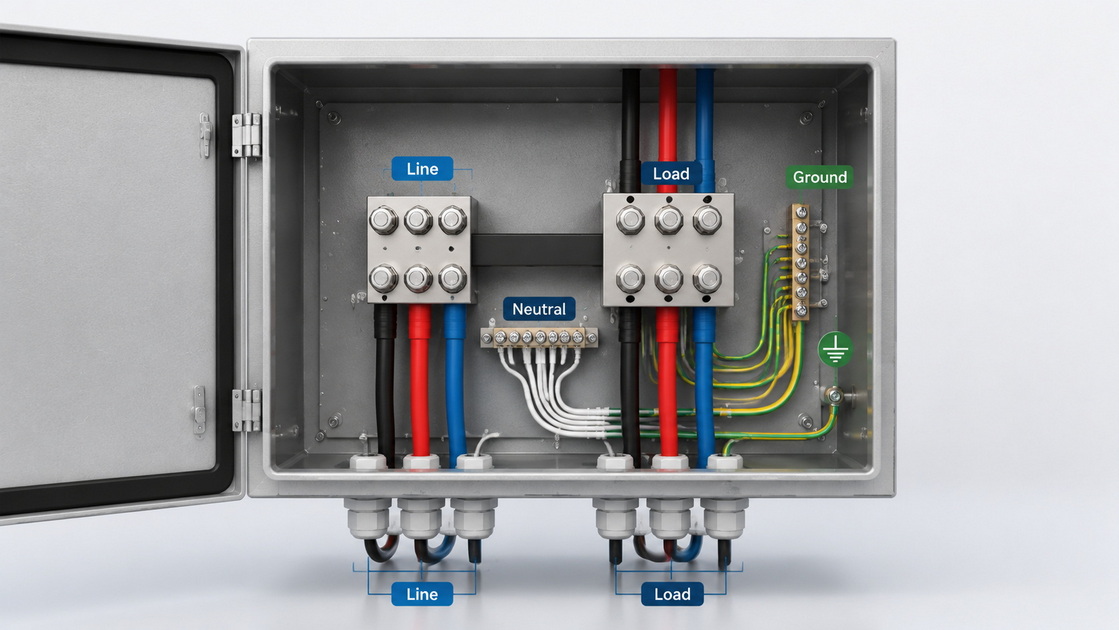
A 2 lug electrical enclosure typically refers to a metal box where two main lugs are used to terminate incoming and outgoing conductors—often for power feed‑through, sub‑feeds, or dedicated loads. [youtube]
In industrial applications, these lugs are mounted on a bus bar or terminal block inside the enclosure, allowing you to land line and load cables cleanly while maintaining code‑compliant clearances and insulation levels. [electricneutron]
Before you touch any conductor, safety and compliance must come first. [picamfg]
- De‑energize the circuit and verify with a calibrated tester.
- Apply lockout/tagout (LOTO) on upstream breakers or disconnects.
- Wear appropriate PPE (gloves, eye protection, arc‑rated clothing when required).
- Follow NEC/IEC rules for voltage, creepage and clearance distances inside enclosures. [electricneutron]
For industrial control panels and assemblies, many plants also follow internal wiring standards (such as BYU Capstone or corporate standards) that define wire colors, labeling and routing practices. [capstone.byu]
When wiring a 2 lug enclosure, you're usually dealing with these core elements. [capstone.byu]
- Line conductors (typically L1/L2 or L1/L2/L3 for three‑phase).
- Neutral conductor (where applicable).
- Equipment grounding conductor and bonding points.
- Main lugs or terminal strips for line/load terminations.
- Cable glands or bulkhead connectors for entry and exit. [meteorelectrical]
A well‑designed industrial enclosure will also include DIN rail terminals, wire ducts and labeling, making wiring more organized and serviceable. [industrialmonitordirect]
This section provides a practical, expert‑level sequence you can adapt to most low‑voltage industrial installations (e.g., motor feeders, pump controls, communication power supplies). [electricneutron]
Before stripping any wire, define the power flow:
incoming source → lugs → breakers/contactors → load devices → protective earth. [youtube]
- Identify source rating (voltage, current, short‑circuit rating).
- Decide if the 2 lugs are line‑only, line + load, or feed‑through.
- Check enclosure size; it should be larger than you think you need to avoid crowded wiring. [capstone.byu]
Proper entry planning prevents IP rating loss and cable damage. [meteorelectrical]
- Use certified cable glands matched to cable diameter and IP/NEMA rating.
- Avoid running bare cables through unprotected holes—use bulkhead connectors or glands instead. [meteorelectrical]
- Maintain separation between power and signal conductors to reduce EMI (e.g., 4–12 inches depending on voltage). [electricneutron]
Where possible, add wire ducts and DIN rail terminal blocks to keep wiring clean and traceable. [industrialmonitordirect]
In a metal industrial enclosure, bonding is non‑negotiable. [youtube]
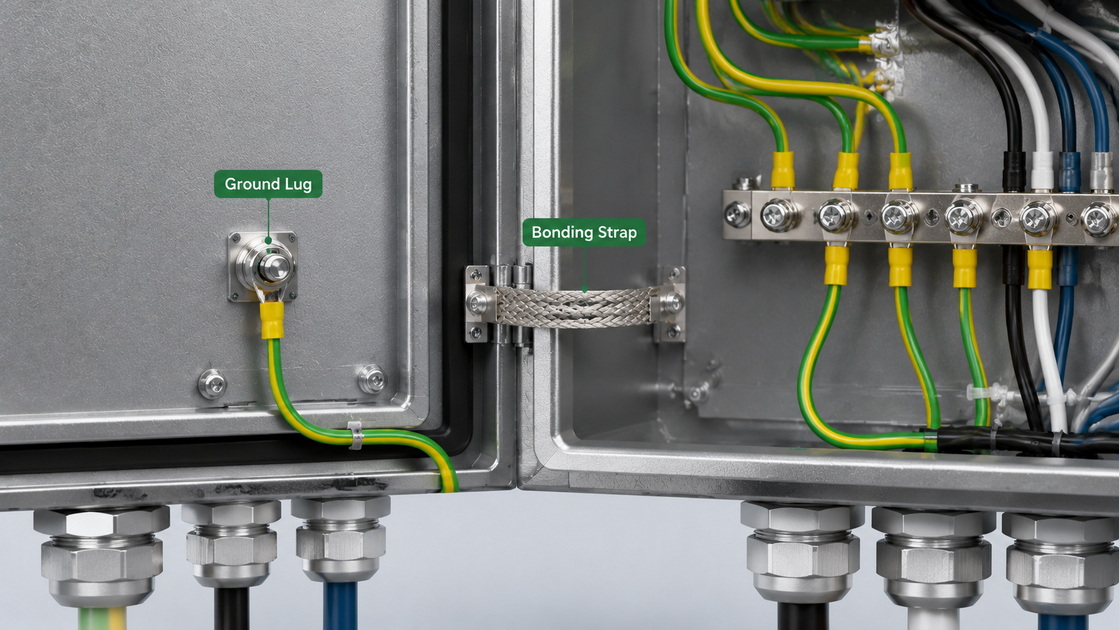
- Run a green or green/yellow equipment ground from the supply to a dedicated ground lug inside the enclosure.
- Bond the enclosure body, door and any removable panels to the same ground point for continuous electrical contact. [youtube]
- Use short, wide ground straps or conductors to reduce inductance and improve fault clearing. [picamfg]
For shielded cables, bond shields according to system EMC strategy—often at one end only to prevent ground loops. [picamfg]
Wiring the lugs is where most installers focus their attention, and accuracy here is critical. [youtube]
1. Strip the conductors using the manufacturer's recommended strip length.
2. Insert each conductor fully into the lug barrel or under the lug clamp.
3. Torque the lug screws to the manufacturer's specification to avoid loose or over‑tightened connections. [electricneutron]
4. Use one conductor per terminal unless the terminal is clearly rated for multiple wires. [electricneutron]
If the enclosure is used in a feed‑through configuration, ensure that upstream and downstream conductors are correctly grouped and labeled to avoid mis‑termination. [youtube]
Clean wiring is easier to maintain and troubleshoot. [industrialmonitordirect]
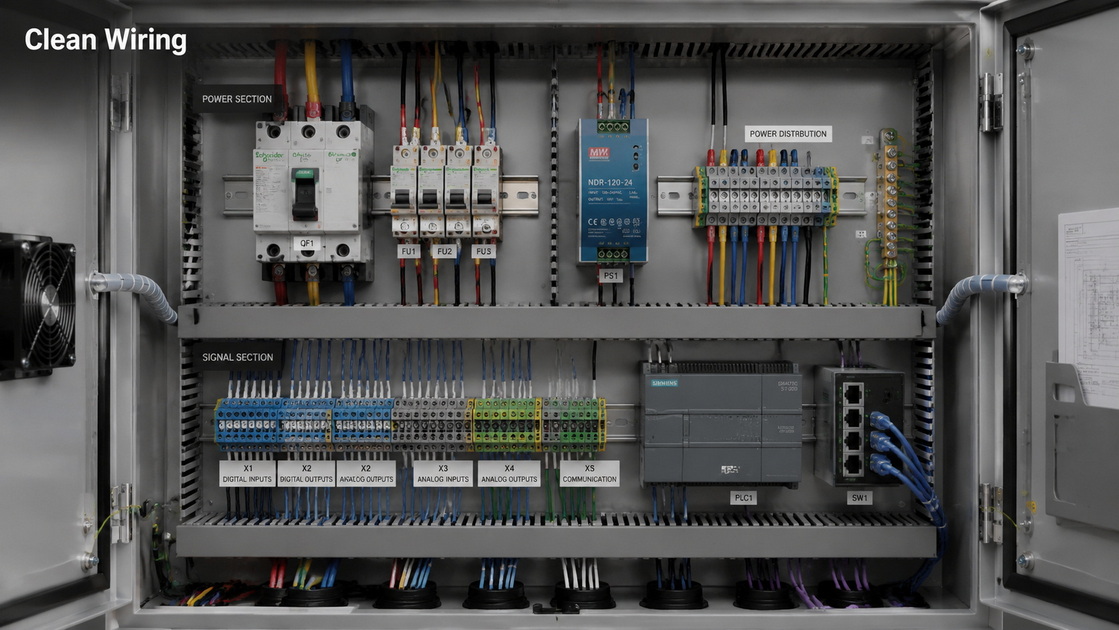
- Use different wire colors for different functions (e.g., black for hot, white for neutral, green for ground). [capstone.byu]
- Route power cables and signal cables in separate ducts or paths, crossing at right angles where they must intersect. [electricneutron]
- Maintain minimum bend radius of at least five times cable diameter to protect insulation. [electricneutron]
- Use wire looms, cable ties and stress‑relief points near connectors. [industrialmonitordirect]
Industrial best practice is to mount all boards and devices securely, with shock‑absorbing mounts if vibration is expected (e.g., pumps, compressors, vehicles). [capstone.byu]
Professional‑grade enclosures always include clear identification and documentation. [capstone.byu]
- Label terminal strips, lugs and individual wires with circuit numbers that match your schematic. [capstone.byu]
- Create or update wiring diagrams and panel layouts after installation.
- Perform continuity, insulation resistance and polarity tests before energizing.
- For outlets or control circuits, use a plug‑in tester or meter to verify correct hot/neutral/ground relationships. [youtube]
Beyond basic steps, industrial environments demand higher standards of reliability and EMC performance. [picamfg]
- Prefer stranded wire over solid in enclosures to avoid fatigue breakage. [capstone.byu]
- Use keyed and locking connectors for critical connections, especially in vibration‑prone environments like pumps and vehicles. [capstone.byu]
- Keep unused conductors safely bent back and taped, not floating inside the box. [electricneutron]
- Group terminal blocks logically by power, signal and safety circuits for faster troubleshooting. [electricneutron]
In steel mills, heavy manufacturing or smart‑factory environments, panel wiring cleanup often focuses on DIN rail terminals, wire ducts and proper documentation to transform messy panels into maintainable systems. [industrialmonitordirect]
With the rise of industrial intelligent manufacturing, IIoT and networked drives, enclosure wiring must also manage noise and shielding. [picamfg]
- Use single‑point or star grounding to avoid ground loops that interfere with sensors and PLCs. [picamfg]
- Keep enclosure seams and doors electrically continuous, using conductive gaskets or finger stock if necessary. [picamfg]
- Select twisted pair or shielded‑twisted‑pair cables for communication and low‑level signals; ground shields according to manufacturer guidance. [picamfg]
These practices are crucial for communication cabinets, network enclosures, and power‑electronics boxes used in new‑energy vehicles, storage systems and data centers. [regen-power.co]
Even experienced technicians can fall into patterns that reduce safety or reliability. [capstone.byu]
- Over‑crowding the enclosure, leaving no space for future expansion or service. [capstone.byu]
- Mixing high‑power and low‑signal cables in the same duct without separation. [electricneutron]
- Using improper connectors (e.g., audio connectors for high power). [capstone.byu]
- Failing to bond the enclosure or relying on incidental contact instead of a dedicated ground lug. [youtube]
Avoiding these pitfalls gives your enclosure a professional, code‑compliant finish and reduces long‑term maintenance risks. [industrialmonitordirect]
To improve user experience and SEO engagement, you can embed visuals at strategic points:
- Near the "Step‑by‑Step" section: a diagram of a 2 lug enclosure showing line, load, neutral and ground paths.
- In the grounding section: a photo or line drawing of proper bonding between enclosure, door and ground bus. [youtube]
- In the routing and organization section: a before/after panel wiring photo to illustrate wiring cleanup and DIN rail terminal use. [industrialmonitordirect]
- Near the testing section: a short video clip demonstrating the use of a plug‑in tester or meter on circuits after wiring. [youtube]
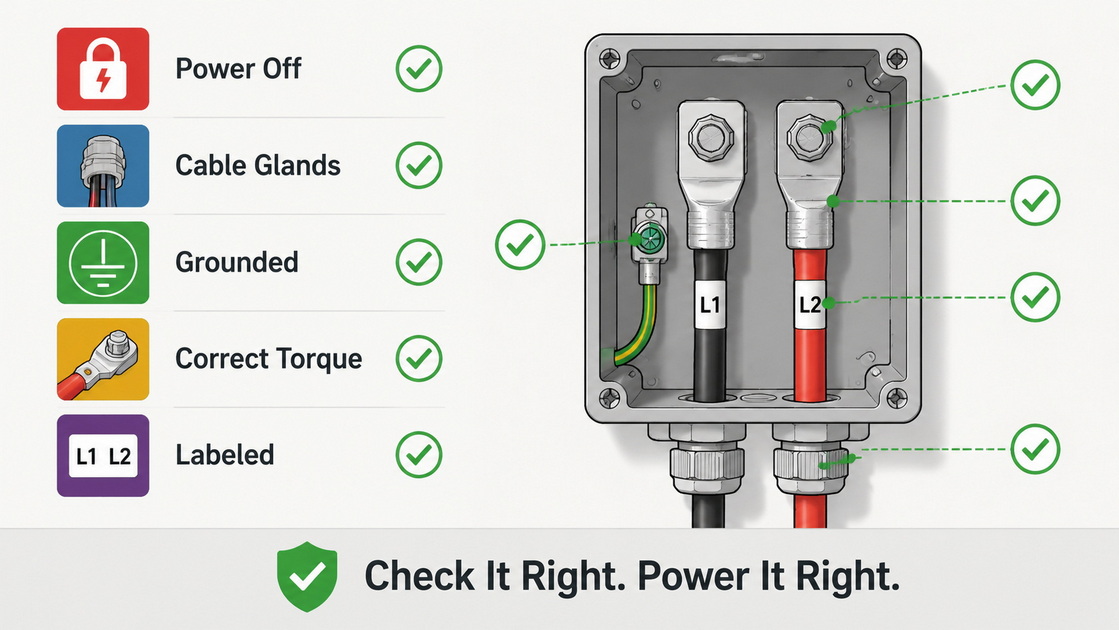
You can include a simple table that doubles as a practical checklist for technicians:
| Item | What to Check |
|---|---|
| Power isolation | Source de‑energized, LOTO applied, tester verified. electricneutron |
| Enclosure entry | Proper glands/bulkhead connectors, preserved IP rating. meteorelectrical |
| Grounding & bonding | Ground lug, enclosure bonded, doors grounded. youtube |
| Lug terminations | Correct conductor size, torque, one wire per terminal. electricneutron |
| Cable routing & labeling | Separated power/signal, bend radius, labels match drawings. capstone.byu |
If your facility is scaling electric power distribution, communication networks, smart manufacturing lines or new‑energy projects, working with a specialized industrial electrical enclosure manufacturer ensures your wiring lives in a robust, well‑engineered housing. [regen-power.co]
By choosing a partner experienced in OEM/ODM metal enclosures, precision sheet‑metal fabrication and multi‑industry compliance, you can standardize enclosure designs, simplify field wiring, and improve long‑term reliability across pumps, vehicles, buildings and energy‑storage systems. [regen-power.co]
A: Not necessarily. Many industrial feeders are line‑to‑line without a neutral, but control circuits and mixed loads may require neutrals; follow your design and local codes. [electricneutron]
A: Only if the manufacturer explicitly rates that lug for multiple conductors. Otherwise, use separate terminals or terminal blocks to remain compliant and safe. [electricneutron]
A: Maintain separation distances, cross at right angles, use twisted pairs or shielded cables, and adopt a proper grounding/shielding strategy to minimize EMI. [picamfg]
A: Choose a slightly larger enclosure, use wire ducts, DIN rail terminals, cable ties and systematic labeling; avoid cramped layouts whenever possible. [industrialmonitordirect]
A: During commissioning and routine maintenance intervals defined by your plant standards, especially in high‑vibration environments, check terminations for looseness or heat discoloration. [industrialmonitordirect]
1. BYU Capstone – *Wiring Tips*
<https://capstone.byu.edu/wiring-tips> [capstone.byu]
2. Electrical Engineering Center – *Standard Wiring Practices for Electrical Installation*
<https://www.electricneutron.com/standard-wiring-practices/> [electricneutron]
3. Industrial Monitor Direct – *Industrial Control Panel Wiring Cleanup & Best Practices*
<https://industrialmonitordirect.com/blogs/knowledgebase/control-panel-wiring-cleanup-industrial-electrical-organization-guide> [industrialmonitordirect]
4. PICA Manufacturing – *Best Practices for Grounding, Enclosure-Level Shielding and Cable Shielding*
<https://picamfg.com/best-practices-for-grounding-enclosure-level-shielding-and-cable-shielding/> [picamfg]
5. Meteorelectrical – *Installing Enclosures for Electrical Equipment: Entry Planning, Gland Selection, and Maintain IP Ratings*
<https://www.meteorelectrical.com/blog/installing-enclosures-for-electrical-equipment-entry-planning-gland-selection-and-maintaining-enclosure-ip-ratings> [meteorelectrical]
6. YouTube – *How To Wire A 2 Gang Outlet Box*
<https://www.youtube.com/watch?v=isU9sy-5qiU> [youtube]
7. YouTube – *Bonding a Metal Enclosure on a Telephone Pole*
<https://www.youtube.com/watch?v=tqGM-ZwSG_o> [youtube]
8. YouTube – *Feed Through Lugs vs Double Lugs Electrical Panel Wiring*
<https://www.youtube.com/watch?v=uTnFmd5yoPE> [youtube]
9. Regen Power – *Wiring Method for Industrial Assembly Electrical Boxes*
<https://www.regen-power.co.za/Mon-29-Jul-2024-13863.html> [regen-power.co]
10. UK Standards – *Wiring electrical components and equipment in enclosures*
<https://www.ukstandards.org.uk/en/nos-finder/SEMEEE332/wiring-electrical-components-and-equipment-in-enclosures> [ukstandards.org]

2026-07-26

2026-07-24


