


Views: 221 Author: Bohui Electric Publish Time: 2026-07-08 Origin: Site


Content Menu
● What Is Electrical Enclosure Sizing?
● Why Proper Enclosure Size Matters
● Key Factors When Sizing An Electrical Enclosure
>> 1. Number and Type of Internal Components
>> 2. Wiring Space and Cable Management
● Heat Management, Ventilation, And Cooling
● Standards And Environment: NEMA & IP Ratings
● Typical Industrial Electrical Enclosure Sizes
● Step‑By‑Step: How To Size An Electrical Enclosure
>> Practical Sizing Workflow For Engineers
>>> Step 1: Define Application And Environment
>>> Step 2: Map All Components
>>> Step 3: Add Wiring And Clearance Margins
>>> Step 4: Evaluate Heat Load And Cooling Options
>>> Step 5: Plan For Future Expansion
● Industry Case Insight: Smart Manufacturing And New Energy Systems
● Expert Tips From Manufacturing Practice
>> Practical Expert Recommendations
● CTA: Work With A Professional Enclosure Manufacturer
● FAQs
>> Q1. Are there universal standard sizes for electrical enclosures?
>> Q2. How much extra space should I leave for wiring?
>> Q3. Does enclosure size affect cooling system selection?
>> Q4. What is the impact of environment on enclosure size?
>> Q5. Can I modify enclosure size later if my system expands?
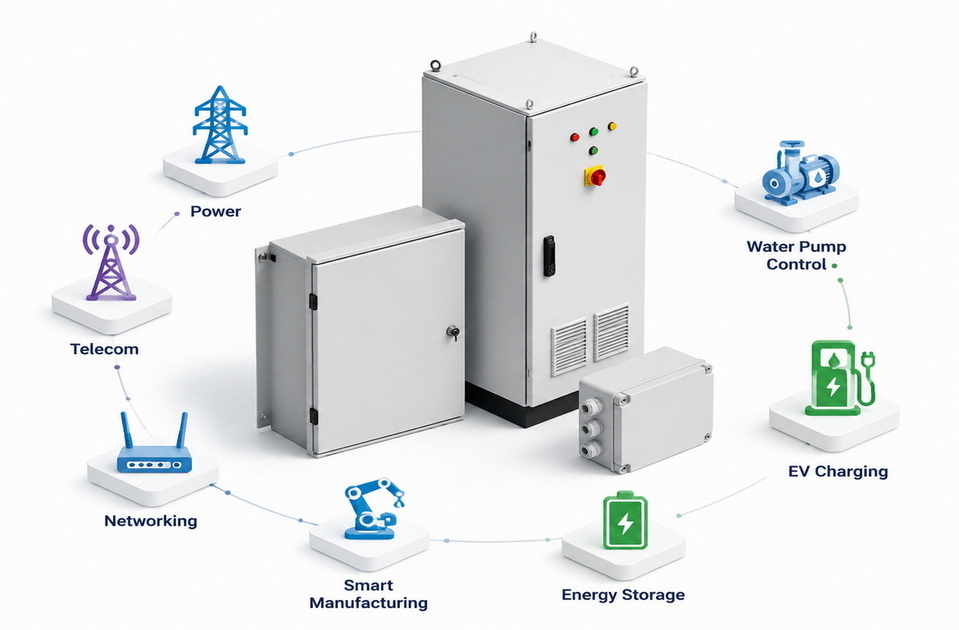
Electrical enclosure sizing is the process of determining the optimal height, width, depth, and internal layout of a housing that protects electrical or electronic components. It ensures that components are safely mounted, cables are properly routed, and heat can dissipate without exceeding allowable temperature limits. [carsai-precisionparts]
From an industry perspective, manufacturers like Ningbo Bohui Electric Co., Ltd. design industrial electrical enclosures that serve power distribution, telecommunications, networking, smart manufacturing, construction, new energy storage, EV charging, and water pump control systems, where correct sizing directly affects system reliability and lifetime. [vanpee]
Proper enclosure sizing is not only a mechanical decision; it is a safety and reliability decision. [kdmfab]
- It reduces the risk of electrical hazards such as arcing, overheating, and short circuits by ensuring adequate clearances and creepage distances. [instrumentationtools]
- It improves equipment lifetime by providing enough space for ventilation, heat dissipation, and optional cooling systems like fans or heat exchangers. [kdmsteel]
- It supports maintainability, allowing technicians to access terminals, breakers, and controllers without disturbing adjacent wiring or components. [carsai-precisionparts]
A well-sized industrial electrical enclosure also helps meet applicable standards like NEMA 250 and IP rating schemes, which define the degree of protection for electrical equipment against dust, water, and accidental contact. [blog.ansi]
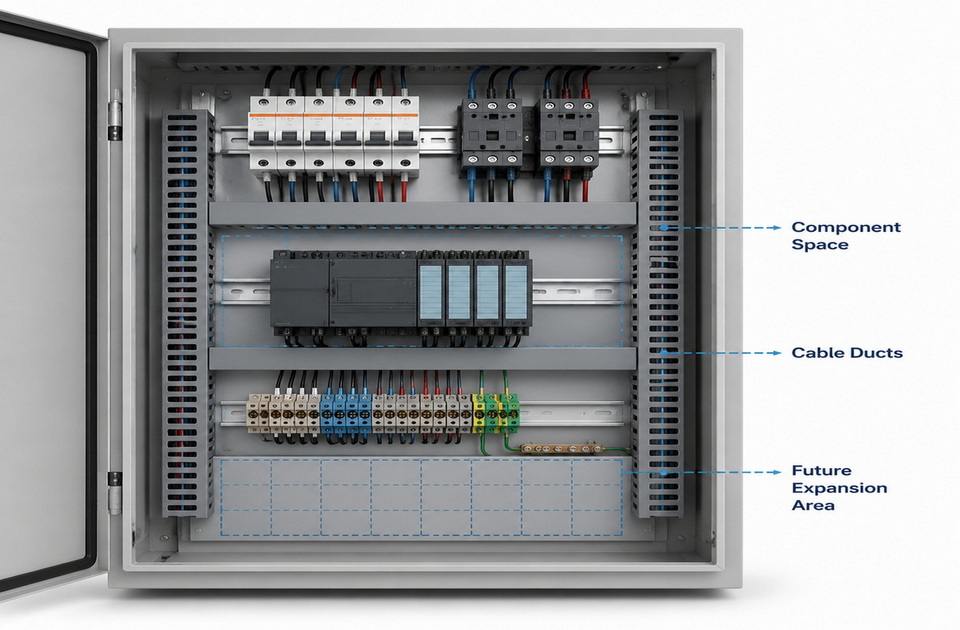
You should start sizing by listing all components to be installed: circuit breakers, contactors, relays, PLCs, drives, power supplies, terminals, and busbars. Each item has a footprint, depth, required clearance, and mounting method, all of which contribute to the minimum internal dimensions. [kdmsteel]
- Dense control panels or drive cabinets require larger width and depth to accommodate wiring ducts and power devices. [kdmfab]
- Telecom and networking enclosures must consider patch panels, switches, and fiber trays with specific front-access requirements. [vanpee]
Cable routing can easily consume more space than the devices themselves, so your enclosure should allow for proper cable bending radius, trunking or ducting, and service loops. [instrumentationtools]
- Leave vertical and horizontal clearance for wiring ducts and terminal strips.
- Consider top/bottom entry glands, side cable knockouts, or rear access depending on installation. [carsai-precisionparts]
Effective cable management not only improves airflow but also makes troubleshooting and upgrades significantly easier. [instrumentationtools]
Heat load is one of the most overlooked aspects of enclosure sizing, yet it strongly influences depth, height, and surface area. [kdmfab]
- The enclosure's surface area and material determine how well it can dissipate heat generated by internal components. [kdmsteel]
- Overcrowding increases internal temperature, which can lead to premature failure of drives, PLCs, and power supplies. [kdmfab]
A practical approach is:
1. Estimate internal heat load from equipment datasheets.
2. Ensure the enclosure size provides enough surface area for passive cooling, or space for active cooling (fans, filters, heat exchangers) if required. [kdmsteel]
3. Keep airflow paths unobstructed by avoiding heavy cable congestion directly in front of heat-sensitive components. [kdmfab]
Sizing decisions must align with the installation environment and protection requirements. [blog.ansi]
- Indoor, clean environments often use NEMA Types 1, 2, 12, or 13, where dust protection and incidental contact are key considerations. [blog.ansi]
- Outdoor or harsh environments require NEMA Types 3, 4, 4X, 6, or 6P, which address rain, hose-down, corrosion, or temporary submersion. [blog.ansi]
- IP ratings follow a numerical scheme (e.g., IP65, IP66), indicating dust-tightness and water resistance levels. [blog.ansi]
Environmental factors (corrosive vapors, splash zones, UV exposure, or wash-down areas) may require larger or deeper enclosures to accommodate seals, double doors, or thermal management solutions. [kdmsteel]
Industrial electrical enclosures are available in a wide range of standard sizes, though there is no single global "size standard"; dimensions are shaped by typical application needs. [carsai-precisionparts]
Below is an example of commonly used ranges for wall-mounted and floor-standing enclosures in industrial and commercial settings: [lianjer]
| Common Size (H × W × D) | Typical Application |
|---|---|
| 200 × 200 × 150 mm | Small junction boxes for sensors or IO. carsai-precisionparts |
| 300 × 300 × 200 mm | Compact control panels or pump starters. carsai-precisionparts |
| 400 × 400 × 200 mm | Distribution boxes, small machine controls. carsai-precisionparts |
| 600 × 600 × 300 mm | Industrial control enclosures for machinery. carsai-precisionparts |
| 800 × 600 × 300 mm | Large control systems or power panels. lianjer |
Manufacturers may offer sizes as small as 75 × 125 × 35 mm for miniature boxes up to more than 800 × 600 × 300 mm for large industrial cabinets, with custom dimensions available for OEM/ODM projects. [lianjer]
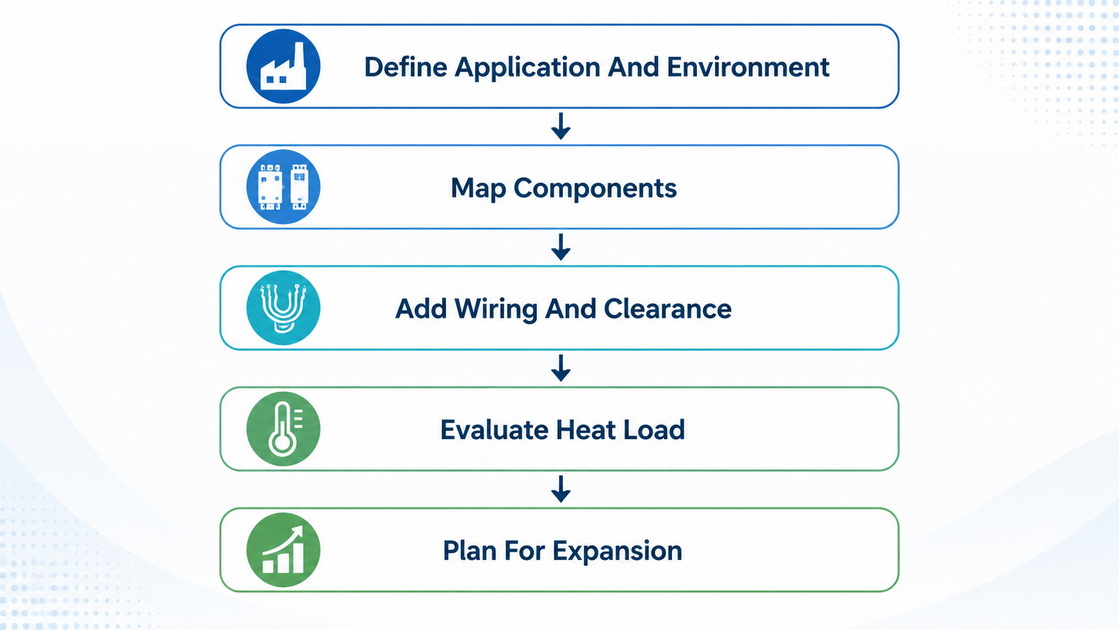
A structured workflow helps avoid under‑sizing and costly redesigns. [carsai-precisionparts]
- Identify whether the enclosure is for power distribution, telecommunications, networking, industrial automation, building services, new energy storage, EV charging, or pump control. [kunlonghardware]
- Determine installation type: wall‑mount, floor‑standing, pole‑mount, or integrated into machinery. [kunlonghardware]
- Select appropriate NEMA/IP rating based on indoor/outdoor location, dust level, moisture, and wash‑down requirements. [blog.ansi]
Create a component layout plan before selecting the enclosure size. [carsai-precisionparts]
1. List all devices with their dimensions and mounting requirements.
2. Group components by function (power section, control section, communication section).
3. Consider front‑panel devices (HMIs, meters) and their cutout requirements. [kdmsteel]
This mapping helps determine minimum panel width and height.
Once the bare component layout fits, add extra space for wiring and accessibility. [instrumentationtools]
- Reserve space along the edges for cable ducts and terminal strips.
- Keep sufficient clearance in front of breakers and contactors for safe operation and replacement. [instrumentationtools]
- Allow for cable entry zones (top, bottom, or side) with appropriate gland or conduit arrangements. [carsai-precisionparts]
A common rule in industry practice is to add 20–30% additional internal space beyond the calculated component footprint to accommodate wiring and service access, although the exact margin depends on application complexity. [kdmfab]
Calculate or estimate the heat load and verify that the chosen enclosure can manage it. [kdmfab]
- Use component power loss data and simple thermal models or manufacturer calculators.
- For high‑power drives or dense PLC racks, consider ventilated enclosures, filtered fans, or heat exchangers, which may require greater depth or height. [kdmsteel]
- Ensure that thermal devices and airflow paths are not blocked by wiring or accessories. [kdmfab]
Industrial systems often grow over time; sizing an enclosure with no spare space is a common mistake. [instrumentationtools]
- Reserve locations for additional terminals, communication modules, or drives.
- Keep extra DIN‑rail sections or mounting plates available for upgrades.
- Maintain clear documentation of layout so future engineers can reconfigure without replacing the entire enclosure. [instrumentationtools]
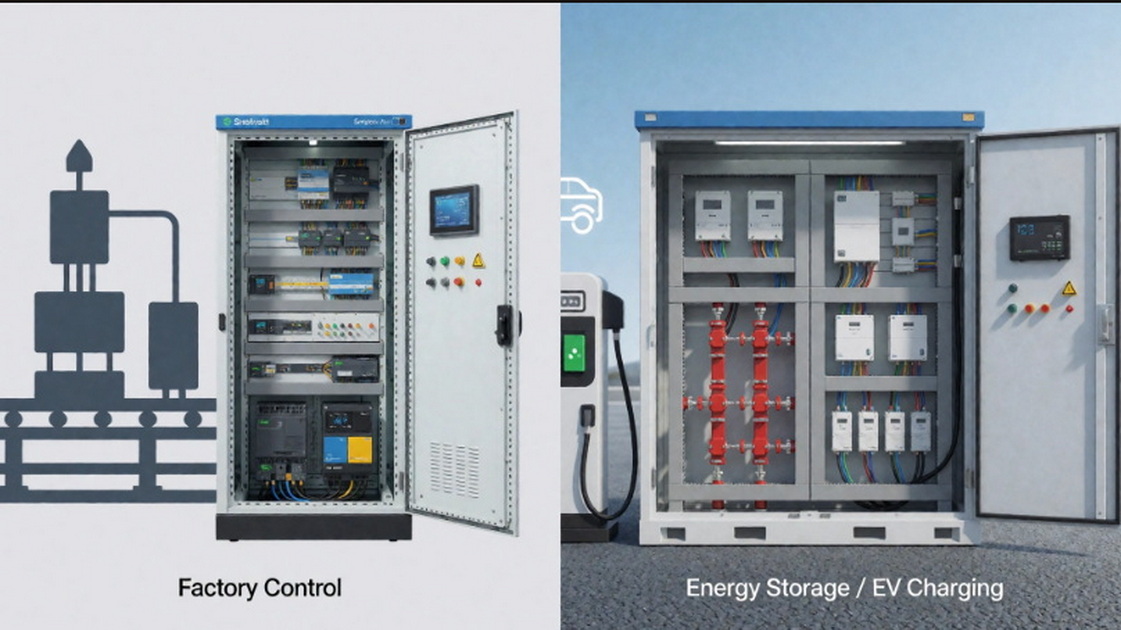
In modern smart manufacturing lines, electrical enclosures must accommodate traditional power components alongside Ethernet switches, IIoT gateways, and edge computing nodes. This combination increases both the space and cooling requirements, especially in compact machine‑mounted cabinets. [vanpee]
For new energy storage and EV charging infrastructure, enclosures often need to integrate high‑current busbars, metering devices, communication units, and protective relays. These systems typically demand: [vanpee]
- Larger floor‑standing cabinets with segregated compartments for power and control.
- Enhanced ventilation or active cooling to manage continuous load and ambient temperature variations. [kdmsteel]
- Higher protection ratings (e.g., NEMA 3R, 4, or IP65+) for outdoor exposure. [blog.ansi]
Experienced OEM/ODM manufacturers design such enclosures with extra depth and height, ensuring safe creepage distances, robust busbar support, and adequate wiring channels for field connections. [vanpee]
Industry and field experience suggest several practical tips that go beyond basic sizing formulas. [carsai-precisionparts]
- Avoid over‑dense layouts; if you are debating between two sizes, the larger enclosure often yields better long‑term reliability and easier maintenance. [kdmfab]
- Optimize depth for devices with large terminal blocks or rear‑mounted accessories; shallow enclosures can cause cable stress and difficulty in tightening connections. [carsai-precisionparts]
- Check door swing and operator access; wide or double‑door designs may be necessary in large enclosures to ensure safe operation and inspection. [vanpee]
- Align enclosure materials and coatings with environmental conditions (e.g., stainless steel or coated steel for corrosive environments, aluminum for weight‑sensitive applications). [kunlonghardware]
OEM/ODM suppliers with sheet‑metal design expertise can help translate conceptual layouts into optimized enclosure dimensions, including reinforcement, mounting, and thermal considerations. [vanpee]
Choosing the right electrical enclosure size is easier and more reliable when you collaborate with an experienced industrial enclosure manufacturer. If you need custom dimensions for power, telecom, networking, smart manufacturing, construction projects, new energy storage, EV charging, or pump systems, a specialized OEM/ODM partner can: [vanpee]
- Review your component list and environment requirements.
- Provide 2D/3D layout proposals with optimized dimensions, clearances, and thermal design.
- Manufacture high‑quality sheet‑metal enclosures that meet NEMA/IP ratings and your local code requirements. [kdmsteel]
A: No single global standard defines enclosure sizes; instead, manufacturers offer common ranges tailored to typical applications, and standards focus on protection ratings rather than dimensions. [blog.ansi]
A: Many industrial projects allocate roughly 20–30% more internal space than the calculated component footprint to allow for wiring ducts, bending radius, and service access. [carsai-precisionparts]
A: Yes. The enclosure's surface area and internal volume directly impact heat dissipation and the effectiveness of passive or active cooling; larger enclosures can support better airflow and more cooling options. [kdmfab]
A: Harsh or outdoor environments often require thicker walls, robust seals, and possibly larger or deeper enclosures to integrate protective features while maintaining internal clearances. [blog.ansi]
A: Physical resizing is not practical; instead, plan for expansion during the initial design by reserving extra mounting space and considering modular or multi‑cabinet solutions. [instrumentationtools]
1. KDM Steel – "Electrical Enclosure Sizes: The Ultimate FAQ Guide."
https://www.kdmsteel.com/electrical-enclosure-sizes/ [kdmsteel]
2. Carsai Precision Parts – "Electrical Enclosure Sizes Guide: Standard Dimensions & Selection Tips."
https://carsai-precisionparts.com/electrical-enclosure-sizes-guide/ [carsai-precisionparts]
3. Lianjer – "Standard Electrical Enclosure Sizes: Chart, Dimensions & Applications."
https://www.lianjer.com/standard-electrical-enclosure-sizes-guide/ [lianjer]
4. ANSI Blog – "Enclosures for Electrical Equipment, ANSI/NEMA 250‑2020."
https://blog.ansi.org/ansi/electrical-enclosures-ansi-nema-250-2020/ [blog.ansi]
5. Kunlong Hardware – "Mastering Electrical Enclosure Design: A Step‑by‑Step Guide."
https://www.kunlonghardware.com/electrical-enclosure-design-guide/ [kunlonghardware]
6. KDMFAB – "What is Electrical Enclosure Size?"
https://kdmfab.com/electrical-enclosure-sizes/ [kdmfab]
7. Vanpee – "Industrial Enclosures for Individual Customisation."
https://www.vanpee.dk/media/li4bak4e/industrial_enclosures1.pdf [vanpee]
8. Practical Guide to Electrical Enclosures for Industrial Applications.
https://instrumentationtools.com/wp-content/uploads/PDF/Books/Electrical%20Enclosures%20Guide.pdf [instrumentationtools]

2026-07-26

2026-07-24


