


Views: 212 Author: Bohui Electric Publish Time: 2026-07-06 Origin: Site


Content Menu
● Introduction: Why Frost in Electrical Enclosures Is a Hidden Threat
● Understanding Frost Buildup Inside Electrical Enclosures
● Core SEO Concepts – Frost vs. Condensation in Electrical Enclosures
● Why Frost Is So Dangerous for Industrial Electrical Equipment
● Root Causes of Frost Buildup in Electrical Enclosures
>> Temperature Fluctuations and Dew Point
>> High Humidity and Moisture Ingress
>> Inadequate IP/NEMA Ratings or Material Choice
● Proven Methods to Prevent Frost Buildup in Electrical Enclosures
>> Maintain Internal Temperature Above Ambient
>> Control Humidity with Dehumidification and Desiccants
>> Optimize Location and Installation
● Choosing the Right Enclosure: IP/NEMA Ratings, Materials, and Thermal Protection
>> IP and NEMA Ratings for Moisture Protection
>> Material Choice and Insulation
● Ventilation vs. Sealing: Balancing Heat, Moisture, and Airflow
>> When Tight Sealing Is Essential
>> When Controlled Ventilation Helps
● Field‑Proven Frost Prevention Techniques from Technicians and Operators
● Step‑by‑Step Checklist to Prevent Frost in Electrical Enclosures
>> Design and Specification Stage
>> Operation and Maintenance Stage
● Industry Use Cases: Frost Prevention in New Energy, EV, and Water Pump Systems
● Clear Action Steps and When to Seek Expert Support
● FAQ: Frost Buildup in Electrical Enclosures
>> Q1. Is sealing an enclosure completely enough to prevent frost?
>> Q2. What is the most cost‑effective way to prevent frost in outdoor panels?
>> Q3. How often should desiccant packs be replaced?
>> Q4. Can non‑metallic enclosures eliminate condensation and frost?
>> Q5. What measurements help verify frost‑prevention effectiveness?
If you work with outdoor industrial electrical enclosures in power, communications, networking, intelligent manufacturing, construction, or new energy, you already know that condensation and frost are more than a nuisance—they're a reliability and safety risk. When moisture inside an enclosure freezes, it can crack components, corrode terminals, trigger nuisance trips, and in worst cases cause catastrophic equipment failures. As a manufacturer of industrial electrical enclosures, my perspective is shaped by years of seeing how small details in design, installation, and micro‑climate control make the difference between a dry, dependable cabinet and a frost‑damaged one. [pbsionthenet]
In this guide, we'll walk through how frost forms, why traditional "sealed box" thinking is no longer enough, and the practical strategies that work in real installations—from enclosure heaters and insulation to IP/NEMA ratings, smart ventilation, and dehumidification. The focus is on industrial electrical enclosures in harsh or variable climates, especially in sectors like new energy storage, EV infrastructure, water pumps and process control, where uptime is critical and failure costs are high. [fiboxusa]
Frost inside an enclosure is simply frozen condensation: moisture in the air reaches the dew point, condenses on cold surfaces, and then freezes when temperature drops below 0 °C. This is most common in outdoor cabinets exposed to rapid temperature swings, night‑time cooling, and high humidity—conditions found in substation yards, pump stations, rooftops, and coastal or river areas. [micro-dehumidifier]
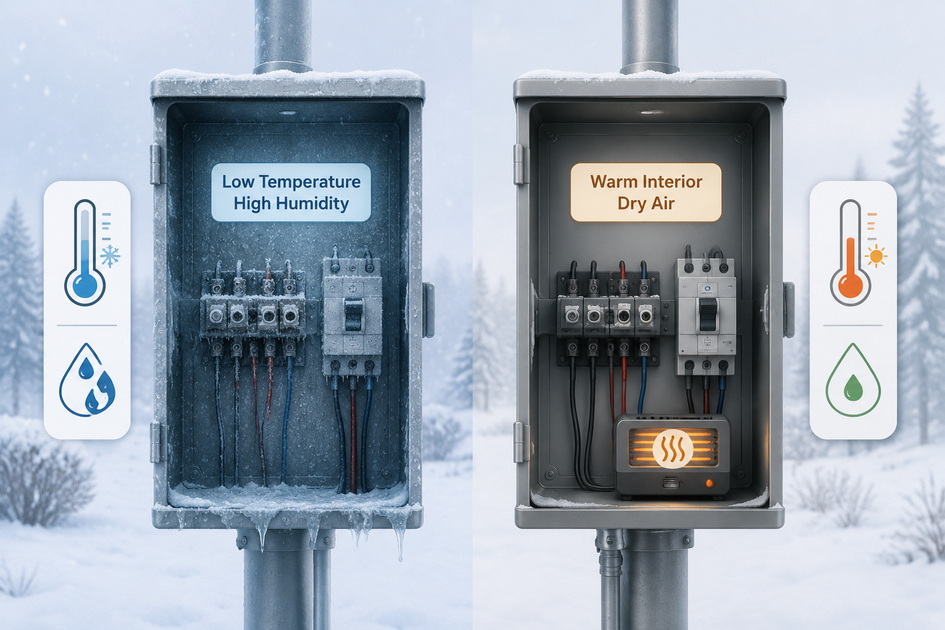
Key factors driving frost buildup include:
- Temperature cycling: Warm days and cold nights repeatedly push surfaces below the dew point.
- High relative humidity: Once RH stays above about 65 %, corrosion and moisture issues rise sharply. [king-electric]
- Poor sealing and cable/conduit entry: Moist air infiltrates through unsealed glands, doors, and conduits. [alliedmoulded]
- Inadequate thermal management: Enclosures without heaters or insulation cool quickly and stay cold. [terrapin-industrial]
For industrial operators, the takeaway is clear: controlling temperature and moisture, not just sealing the box, is the foundation of frost prevention. [pfannenbergusa]
From a technical and SEO standpoint, "frost buildup in electrical enclosures" is a specific case of "condensation in electrical enclosures," and solutions largely overlap. If you are searching for practical advice, you will often find content under phrases like "prevent condensation in electrical enclosures," "enclosure heaters," "industrial enclosure insulation," and "IP/NEMA rated outdoor cabinets." [topcabinet]
Using these related terms helps align with how engineers and specifiers actually search while keeping the focus on the frost issue: preventing the internal temperature and humidity combination that allows water to condense and then freeze. In practice, if you design to avoid condensation, you are already 90 % of the way to preventing frost buildup. [king-electric]
Frost and ice inside industrial electrical enclosures directly impact performance, safety, and lifecycle cost. Real‑world issues include: [pbsionthenet]
- Corroded terminals and busbars leading to hot spots and eventual failure. [micro-dehumidifier]
- Cracked housings or PCB coatings when ice expands in confined spaces. [pbsionthenet]
- Nuisance trips of breakers and protective relays due to surface tracking or mechanical sticking. [king-electric]
- Drift in sensor accuracy and premature failure of electronics in process and instrumentation enclosures. [terrapin-industrial]
Industry experience shows that keeping enclosure temperature roughly 5 °C (about 9 °F) above ambient and relative humidity below 60 % dramatically reduces condensation, corrosion, and frost risk. For critical applications—such as battery energy storage systems and EV charging control gear—this level of environmental control is now seen as standard practice, not a luxury. [terrapin-industrial]
Condensation and frost form when enclosure surfaces drop below the dew point for the air inside. In many outdoor cabinets, metals rapidly radiate heat at night, cooling faster than the ambient air, especially in clear, still conditions. If moisture is present, water condenses and then freezes as temperatures fall further. [alliedmoulded]
Even a well‑sealed enclosure can accumulate moisture if opened frequently or if humid air infiltrates through micro‑gaps. Common ingress points include: [micro-dehumidifier]
- Unsealed cable and conduit entries.
- Poorly compressed door gaskets.
- Unfiltered vents, louvers, or fan cutouts.
Without dehumidification or heaters, this moisture remains trapped and eventually condenses and freezes on cold surfaces. [pfannenbergusa]
IP ratings (e.g., IP65, IP67) and NEMA enclosure classifications help define resistance to dust and water ingress. When enclosures with insufficient ratings are deployed outdoors, wind‑driven rain, fog, or spray can enter, raising internal humidity and frost risk. Non‑metallic enclosures also exchange heat more slowly and naturally resist condensation compared with thin metal cabinets, which heat and cool rapidly. Choosing the wrong enclosure type for the environment compounds frost problems. [essentracomponents]
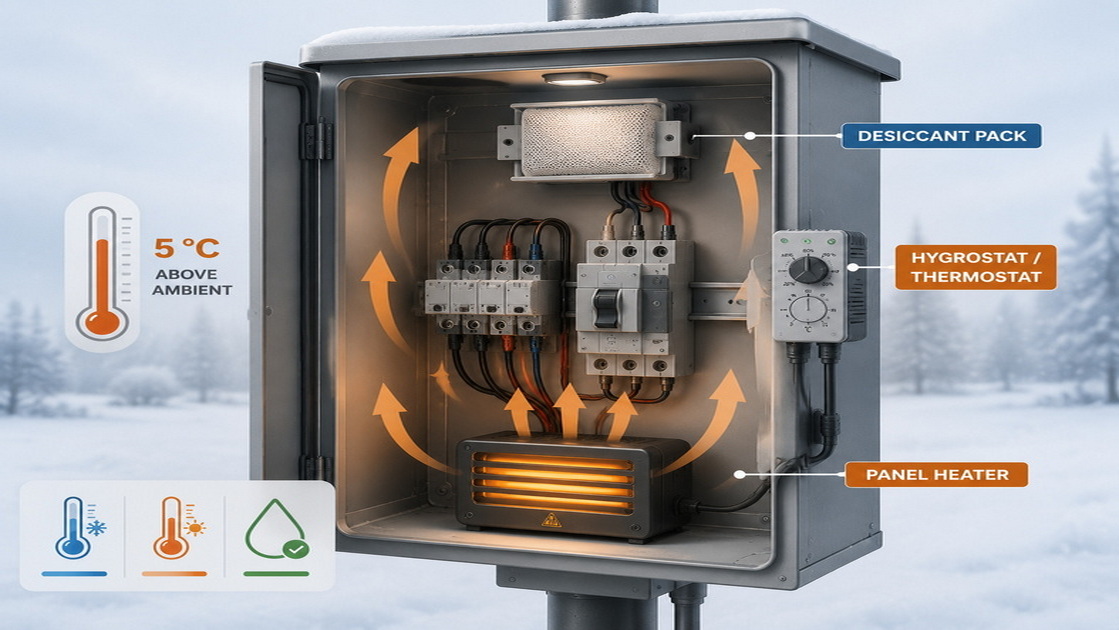
One of the most effective strategies is to keep the interior of the enclosure slightly warmer than the surrounding air. Industry guidance shows that maintaining the enclosure about 5 °C (9 °F) above ambient significantly reduces condensation. You can achieve this with: [pfannenbergusa]
- Panel or enclosure heaters sized to the internal volume.
- Self‑regulating PTC heaters or strip heaters controlled by thermostats or hygrostats. [micro-dehumidifier]
- Integrated thermal management systems for critical instrumentation enclosures. [terrapin-industrial]
In practice, many utilities and industrial sites run enclosure heaters continuously—24/7—to maintain stability and avoid repeated condensation‑frost cycles. [reddit]
If humidity is high or sealing is imperfect, adding moisture control is essential. Common solutions include: [pfannenbergusa]
- Desiccant packs (silica gel) inside enclosures, replaced or regenerated periodically. [micro-dehumidifier]
- Small dehumidifiers or dry‑air exchange units for larger cabinets. [pfannenbergusa]
- Ionic membrane dehumidifiers for sensitive electronics, lasers, and measurement systems in compact enclosures. [micro-dehumidifier]
Keeping relative humidity below about 50 % indoors, and even lower outdoors where temperature swings are greater, goes a long way to eliminating condensation and frost. [king-electric]
You may not always control where an enclosure is placed, but best‑practice location and installation decisions can sharply reduce frost risk. Consider: [fiboxusa]
- Avoiding low‑lying, damp areas or locations near standing water when possible. [fiboxusa]
- Using overhangs, shelters, or pump houses to limit direct exposure and dripping water. [alliedmoulded]
- Positioning enclosures away from strong heat sources that cause rapid cycles. [fiboxusa]
Good installation practices also include sealing conduits and cable glands with suitable foam or grommets and ensuring gaskets are properly compressed along the full door perimeter. [alliedmoulded]
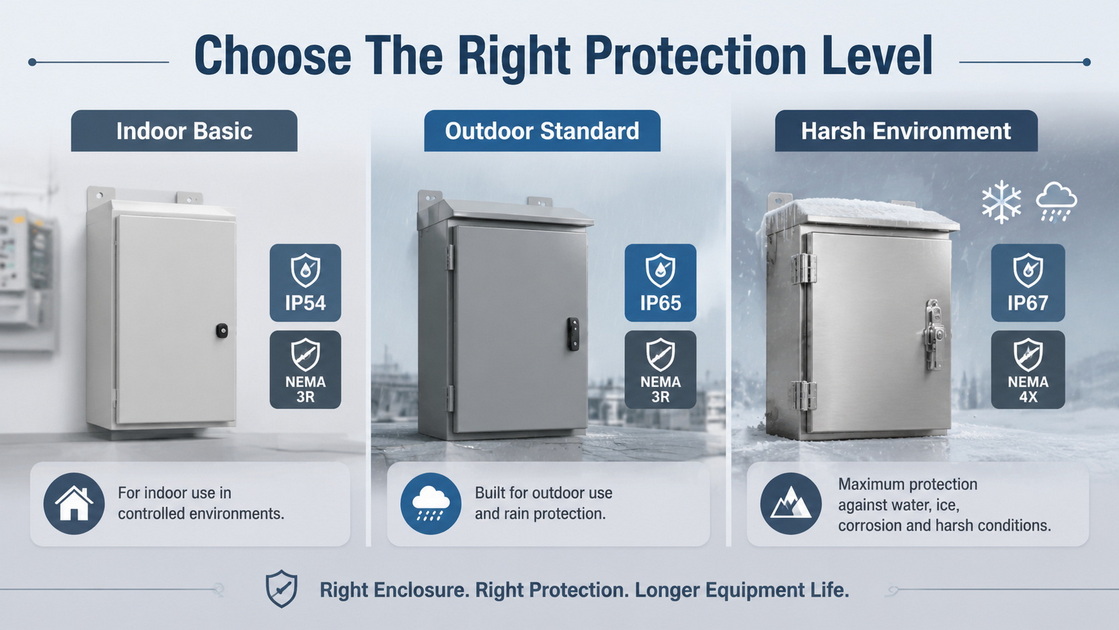
Selecting the right enclosure is a foundational frost‑prevention decision. [terrapin-industrial]
For outdoor use, look for NEMA or IP rated enclosures that minimize water and vapor ingress. [essentracomponents]
- NEMA ratings define protection against environmental factors including rain, snow, and ice.
- IP ratings like IP65, IP66, or IP67 specify dust and water resistance. [terrapin-industrial]
An IP67 enclosure, which is dust‑tight and protected against immersion, significantly reduces water vapor entering the enclosure and thus lowers condensation and frost risk. [alliedmoulded]
Non‑metallic enclosures exchange heat more slowly than metal ones, making them naturally more resistant to condensation. For process industries, specialist insulation systems—such as instrument enclosure liners and heated insulation packs—are used to keep internal temperatures stable and provide efficient freeze protection. [terrapin-industrial]
Modern thermal protection systems can be rated for hazardous areas (e.g., T6), support high short‑term temperatures, and integrate long‑life heater cables to reduce maintenance. Combining appropriate material, insulation, and ratings helps build a robust "thermal envelope" around your equipment. [terrapin-industrial]
A common mistake is to treat sealing and ventilation as opposites, rather than tools that must be balanced for the application. [alliedmoulded]
For many outdoor enclosures, especially in corrosive or marine environments, tight sealing with high IP ratings and robust gaskets is the right starting point. This reduces direct ingress of rain, spray, and fog and keeps humidity more controllable with heaters and desiccants. [essentracomponents]
In applications where internal heat loads are high or cooling is needed, you cannot completely seal the enclosure. In these cases: [pfannenbergusa]
- Use filtered vents or louvered panels designed to promote continuous low‑speed airflow.
- Favor passive ventilation that never turns off over high‑powered fans that cycle. [alliedmoulded]
- Ensure cooling units and air conditioners are managed so that opening doors does not expose cold components to warm, humid air which then condenses. [pfannenbergusa]
Consistent, gentle airflow reduces the chance that moisture can accumulate on surfaces long enough to condense and freeze. [alliedmoulded]
Beyond theory, technicians in utilities and industrial plants use simple, reliable techniques to keep frost out of their panels. [reddit]
- Installing small enclosure heaters (often 100 W+) in outdoor control boxes, running continuously. [reddit]
- Powering heaters from upstream of lockout devices so they can stay on even during routine shutdowns where safe. [reddit]
- Adding drainage paths or small sump areas to collect and remove water before it can freeze. [micro-dehumidifier]
- Using foam sealants in conduits and cable entries to prevent moisture gaining access through hidden routes. [micro-dehumidifier]
These practical measures reflect a simple truth: it's cheaper to prevent frost with low‑power heaters, sealing, and moisture control than to replace equipment or face downtime after a failure. [pbsionthenet]
If you are designing or maintaining industrial electrical enclosures, this structured checklist helps turn concepts into action. [fiboxusa]
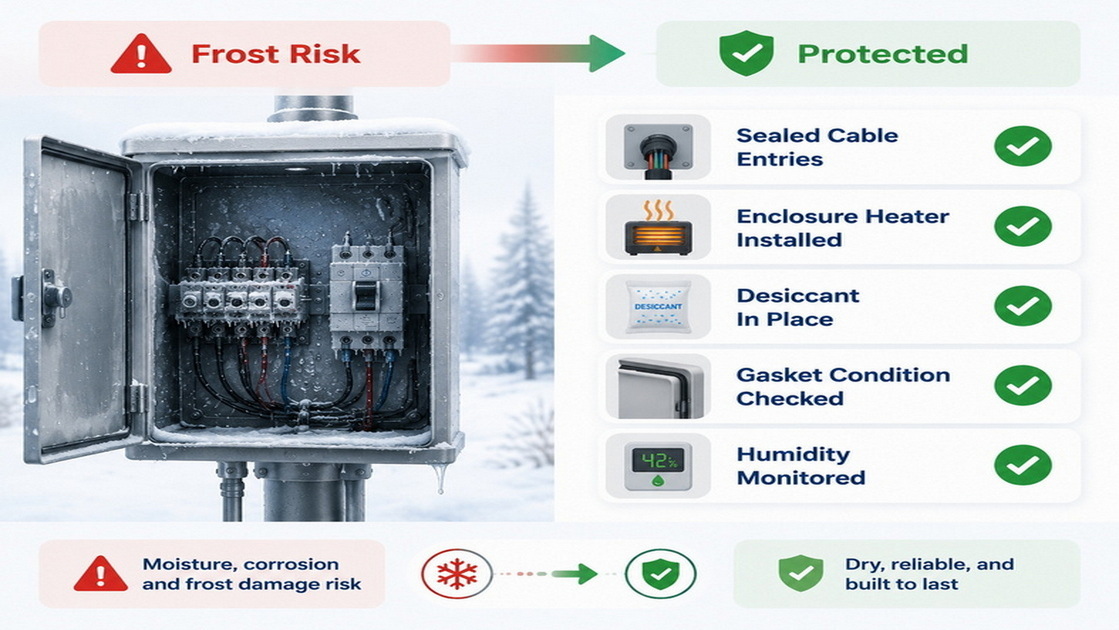
1. Define environment (outdoor/indoor, humidity, temperature range, presence of spray or standing water).
2. Select appropriate NEMA/IP rated enclosure for moisture and dust protection. [essentracomponents]
3. Choose enclosure materials (metal vs non‑metallic) and insulation/thermal protection to suit the environment. [terrapin-industrial]
4. Add enclosure heaters sized to maintain internal temperature at least 5 °C above ambient. [king-electric]
5. Specify moisture‑control devices (desiccants, dehumidifiers, ionic membrane units) for high‑humidity or critical electronic applications. [pfannenbergusa]
1. Avoid very damp locations where possible; use shelters or overhangs. [fiboxusa]
2. Seal cable glands, conduits, and knockouts with appropriate grommets and foam sealants. [micro-dehumidifier]
3. Verify uniform gasket compression and door alignment.
4. Install heaters, thermostats, and hygrostats according to manufacturer guidance. [king-electric]
5. Ensure any ventilation or cooling devices maintain continuous or well‑controlled airflow. [alliedmoulded]
1. Monitor internal temperature and humidity at representative points. [king-electric]
2. Replace or regenerate desiccants before saturation. [micro-dehumidifier]
3. Periodically inspect seals, gaskets, and cable entries for damage or gaps. [alliedmoulded]
4. Confirm heater operation, especially before cold seasons or during major shutdowns. [reddit]
5. Review field failures for signs of moisture or frost damage and feed lessons back into design standards. [pbsionthenet]
In new energy storage and EV charging systems, electrical enclosures typically house control electronics, relays, communications hardware, and safety devices exposed to outdoor conditions. Frost buildup can cause mis‑trips, incorrect readings, or downtime at times of peak demand. Integrating enclosure heaters, insulation, and high IP/NEMA ratings is now considered part of a robust energy‑storage design standard. [terrapin-industrial]
Water pump and irrigation installations often rely on outdoor control panels that experience large daily temperature swings and moisture from nearby water surfaces. Here, frost prevention focuses on strategic location, shelters, sealing of conduits, and continuous low‑power heating to maintain a dry, stable micro‑climate around starters, contactors, and VFDs. [king-electric]
If you already see condensation or frost inside your enclosures, the priority is to stop moisture and restore temperature control:
- Inspect and improve sealing at doors, cable entries, and conduits.
- Install or verify operation of enclosure heaters sized to maintain internal temperature above ambient. [terrapin-industrial]
- Add desiccant or dehumidification where humidity remains high. [pfannenbergusa]
- Review enclosure ratings and material; upgrade if unsuitable for the environment. [terrapin-industrial]
For complex or hazardous‑area applications, work with enclosure manufacturers and thermal‑management specialists who can help specify insulation, heaters, and climate systems that meet code requirements and long‑term reliability goals. [terrapin-industrial]
If you manage fleets of enclosures across a plant or network, the most impactful step is to standardize frost‑prevention guidelines and checklists in your design and maintenance procedures so that every cabinet benefits from consistent good practice. [cdn.automationdirect]
Not always. Even sealed enclosures can accumulate moisture from initial trapped humidity, door openings, and material outgassing, so you still need temperature and humidity control to prevent condensation and frost. [fiboxusa](https.//www.fiboxusa.com/Customer-Content/www/CMS/files/How-to-prevent-condensation-inside-electrical-enclosures-1.pdf)
For many sites, small enclosure heaters combined with good sealing and occasional desiccant replacement offer the best balance of low cost and high reliability against frost buildup. [reddit](https.//www.reddit.com/r/electricians/comments/16n7bz8/how_can_i_stop_condensation_in_electrical/)
Replacement frequency depends on humidity and enclosure volume, but you should inspect desiccants during routine maintenance and replace them whenever they approach saturation or show discoloration and caking. [pfannenbergusa](https.//www.pfannenbergusa.com/preventing-condensation-in-electrical-enclosures/)
Non‑metallic enclosures reduce heat exchange and make condensation less likely, but they do not eliminate the need for moisture management and, in cold climates, enclosure heating for frost prevention. [terrapin-industrial](https.//terrapin-industrial.com/feeds/category/instrument-enclosure-insulation)
Monitoring internal temperature, relative humidity, and visual inspection for corrosion or water marks gives a practical indication of whether your frost‑prevention measures are working or need adjustment. [king-electric](https.//king-electric.com/blog/prevent-freezing-and-condensation-in-electrical-and-mechanical-enclosures/)
1. Essentra Components – "How to prevent condensation in enclosures." [essentracomponents]
2. King Electric – "Prevent Freezing and Condensation In Electrical and Mechanical Enclosures." [king-electric]
3. Allied Moulded – "Best Practices to Manage Condensation in Electrical Enclosures." [alliedmoulded]
4. Micro Dehumidifier – "How to prevent condensation in electrical enclosures and cabinets." [micro-dehumidifier]
5. Fibox – "How to prevent condensation inside electrical enclosures?" (PDF). [fiboxusa]
6. Pfannenberg USA – "Preventing Condensation in Electrical Enclosures." [pfannenbergusa]
7. Terrapin Industrial – "Instrument Enclosure Insulation – Thermal & Protection Solutions." [terrapin-industrial]
8. Rittal – "Condensation: an electrical enclosure's nightmare." [pbsionthenet]
9. Reddit r/electricians – "How can I stop condensation in electrical boxes/panels." [reddit]
10. Terrapin Industrial – "Electrical Enclosures for Challenging Field Applications." [terrapin-industrial]
11. AutomationDirect – "Practical Guide to Electrical Enclosures for Industrial Applications." [cdn.automationdirect]

2026-07-26

2026-07-24


