


Views: 221 Author: Bohui Electric Publish Time: 2026-07-16 Origin: Site


Content Menu
● What Is An Exterior Junction Box?
● Step 1 – Plan The Installation Safely
● Step 2 – Choose The Right Exterior Junction Box
● Step 3 – Select Location And Mounting Surface
● Step 4 – Prepare Tools, Cables, And Accessories
● Step 5 – Mount The Exterior Junction Box
● Step 6 – Install Cable Glands And Entry Points
● Step 7 – Connect Wires Inside The Box
● Step 8 – Close, Seal, And Test The Installation
● Expert Tips From Real‑World Installations
● Exterior Junction Box Types And Typical Uses
● FAQs About Installing An Exterior Junction Box
>> 1. Do I need a special box for outdoor installations?
>> 2. How high should I mount an exterior junction box?
>> 3. Can I install an exterior junction box myself?
>> 4. Why are cable glands important on outdoor boxes?
>> 5. What should I check after installation?
>> References
An exterior junction box is a protective enclosure that houses wire connections in outdoor environments such as building facades, pump stations, gardens, EV charging points, and industrial yards. It shields terminations from rain, dust, UV, and mechanical impact while providing a structured space for splicing, branching, or transitioning circuits. [jkoffset]

In my work with electrical contractors and industrial maintenance teams, the most reliable outdoor installations always start with choosing the right enclosure and planning cable entry before anyone opens a panel or runs a cable. [youtube]
Before touching any wiring, professional installers follow a clear planning and safety routine. [youtube]
- Switch off the power at the main panel or upstream breaker and lock it out if possible. [youtube]
- Use a voltage tester on the conductors you'll be working on to confirm the circuit is truly de‑energized. [youtube]
- Identify the load and supply paths so you know exactly which cables enter and exit the junction box. [youtube]
- Check local electrical codes and site standards, especially for outdoor receptacles, lighting, and three‑phase circuits in industrial or garden applications. [youtube]
In outdoor garden and industrial applications, experienced technicians often schedule exterior junction box work during dry weather and daylight to reduce risk and improve visibility. [youtube]
Selecting the correct box matters more than many DIY guides suggest, because enclosure performance directly affects the lifespan of your wiring and devices. [quicksheetmetal]
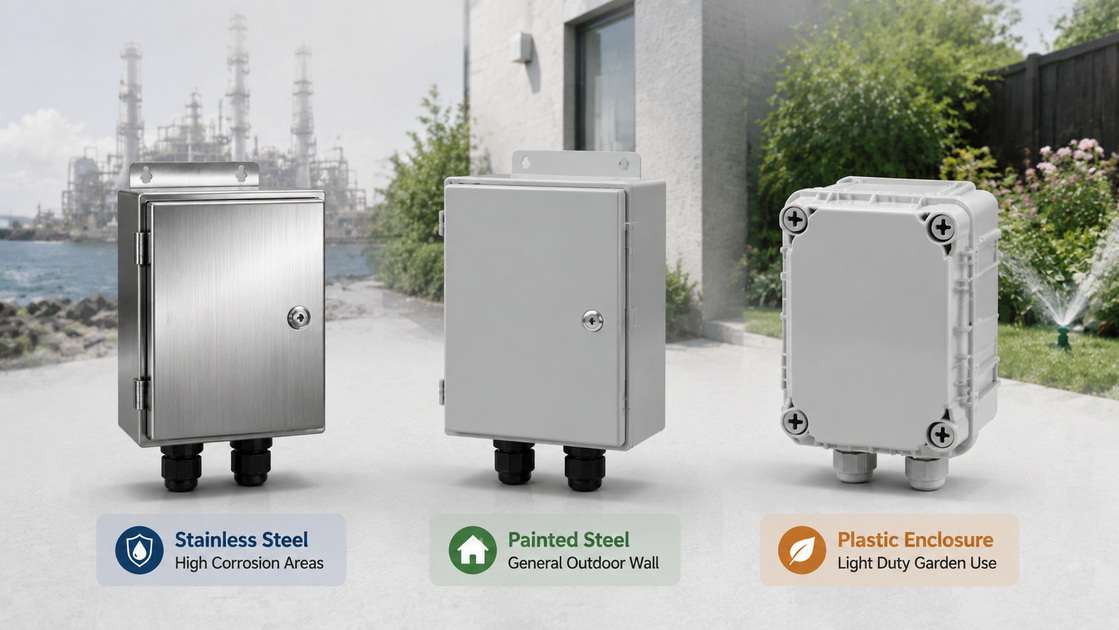
- For general outdoor walls, building facades, and residential exteriors, weatherproof metal or engineered plastic boxes designed for outdoor use are recommended. [quicksheetmetal]
- In open‑air environments with rain exposure, enclosures in the IP66 or NEMA 4X range provide robust protection against water jets and dust. [quicksheetmetal]
- For marine, chemical, or highly corrosive environments, installers prefer 304 or 316 stainless steel junction boxes. [quicksheetmetal]
- When mounting near pumps, EV chargers, or industrial controls, rugged sheet‑metal housings resist impact from tools, gravel, or debris. [youtube]
Manufacturers such as Polycase point out that a properly rated box must match both the environment and the cable types you plan to use. That insight aligns with what I see in the field: over‑specifying the enclosure is cheaper than troubleshooting water‑damaged wiring later. [polycase]
Choosing where to mount an exterior junction box affects both safety and long‑term reliability. [youtube]
- Place the box accessible, but away from direct water streams, heavy splashing, and areas where snow, leaves, or water may accumulate. [youtube]
- Avoid low points on walls or ground where water can pool around the enclosure. [quicksheetmetal]
- On brick, concrete, or siding, use suitable anchors or brackets that can handle both box weight and cable strain. [youtube]
- Keep the box close to the power or control source to minimize unnecessary cable runs and voltage drop. [quicksheetmetal]
For industrial installations, technicians often reserve additional wall space around the junction box so future upgrades—such as extra glands or terminal blocks—can be added without relocating the enclosure. [quicksheetmetal]
A smooth installation depends on bringing the right tools and accessories to the job. [youtube]
Typical tools and materials include: [jkoffset]
- Drill and hole saws for mounting holes and cable entries
- Screwdrivers, linesman pliers, and wire strippers
- Waterproof cable glands sized for the cable diameter
- Stainless steel mounting brackets or expansion bolts for masonry
- Wire connectors (wire nuts or terminal blocks)
- Sealant, gaskets, and plugs for unused holes
- Personal protective equipment such as gloves and safety glasses
Outdoor junction box replacement videos clearly show the need for corrosion‑resistant hardware and appropriately sized holes for glands, especially in gardens and three‑phase installations. [youtube]
Once you have the correct enclosure and location, you can mount the exterior junction box on the chosen surface. [youtube]
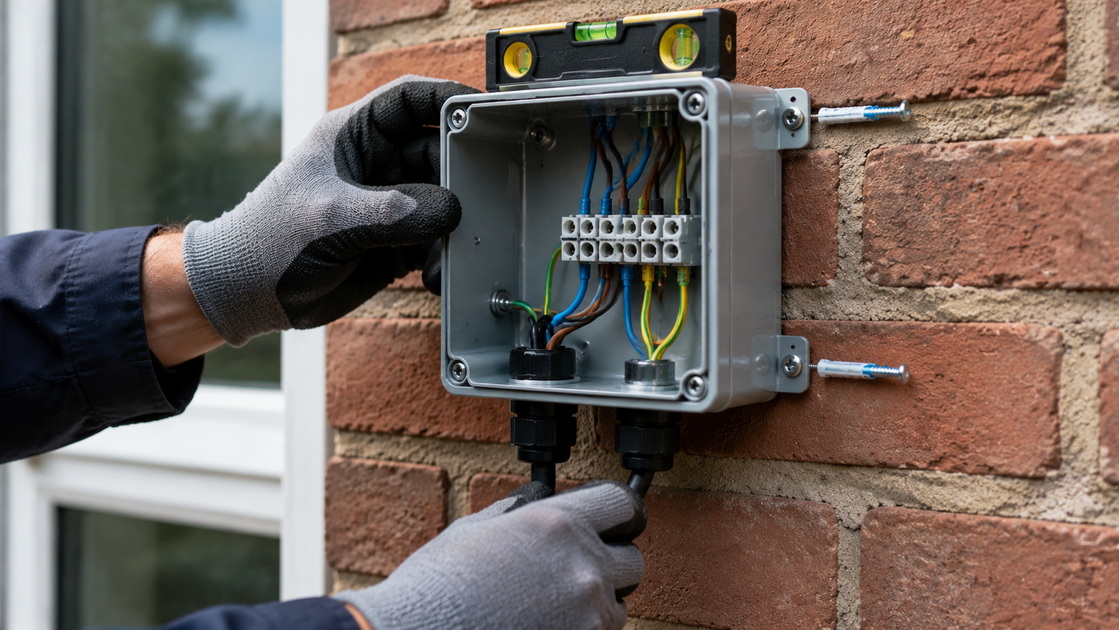
1. Mark the mounting hole positions on the wall or structure using the box or its bracket as a template. [youtube]
2. Drill fixing holes and insert expansion bolts or wall plugs as required for the material (brick, concrete, siding, or steel). [youtube]
3. Position the box, align it level, and fasten it using stainless steel screws or anchor bolts to avoid rust. [youtube]
4. Confirm that the enclosure is secure and does not flex when cables are pulled or when a cover is opened and closed. [youtube]
On vinyl siding or thin exterior panels, professionals often add a backing plate or use a pancake‑style box to bring the mounting point closer to solid sheathing behind the siding. This reduces movement and improves the seal—a practical detail that many installers learn through experience. [youtube]
Cable entry is a critical part of exterior junction box installation, especially in wet or dusty environments. [quicksheetmetal]
- Use a hole saw or punch to create cable entry holes sized for your glands, following the manufacturer's dimensions. [youtube]
- Fit waterproof glands into the holes and tighten the nuts so the gaskets compress evenly and form a watertight seal. [quicksheetmetal]
- Route cables through the glands before securing the box fully, to avoid sharp bends or twisting. [youtube]
- Seal unused holes with threaded plugs or silicone to prevent moisture ingress. [jkoffset]
In a documented outdoor three‑phase garden installation, the installer replaced a broken junction box by cutting new holes, adding a cable gland with an O‑ring, and carefully tightening the nut to secure the gland and maintain enclosure integrity. That real‑world case illustrates how attention to glands and seals directly affects the durability of the installation. [quicksheetmetal]
Inside the box, the goal is to create safe, organized, and clearly identifiable connections. [polycase]
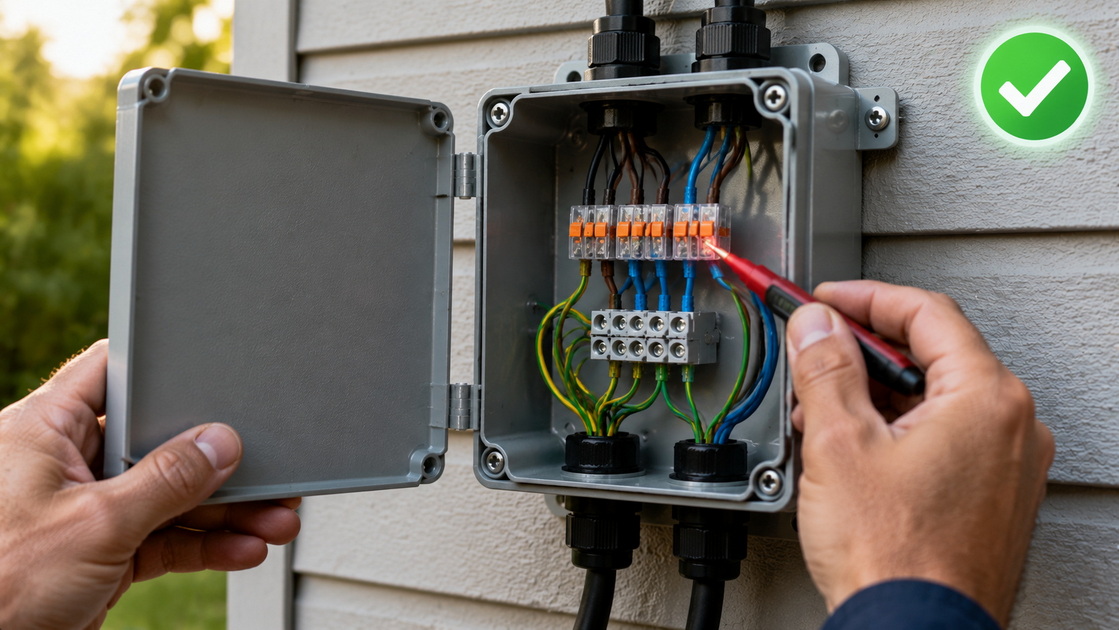
- Strip the cable jackets and conductor insulation only as much as needed to reach connectors or terminals. [youtube]
- Follow color codes and wiring diagrams: match live to live, neutral to neutral, and ground to ground according to regional standards. [youtube]
- Use wire nuts, terminal blocks, or outdoor‑rated connectors designed to withstand temperature changes and prevent brittleness. [youtube]
- Arrange conductors neatly, avoiding sharp bends and keeping grounds and neutrals clearly separated. [polycase]
- Secure cables with clips or internal supports so their weight does not pull directly on the terminations. [quicksheetmetal]
Experienced technicians often label circuits inside the box or on the cover, especially on multi‑circuit or three‑phase installations, so future maintenance teams quickly understand the layout. [youtube]
After wiring, the box must be closed and tested so that the outdoor connection remains safe over time. [youtube]
- Inspect gaskets, glands, and cover interfaces for gaps or misalignment. [quicksheetmetal]
- Close the cover firmly, engaging all screws or latches to maintain the enclosure's protection rating. [youtube]
- Restore power at the panel and test the circuit—lighting, receptacles, or pumps—for correct operation. [youtube]
- Check for grounding continuity and verify there are no short circuits or nuisance tripping. [quicksheetmetal]
- In wet environments, some installers perform a visual check after rain to confirm there is no water ingress around glands or covers. [quicksheetmetal]
An outdoor junction box guide from CountyOffice emphasizes the importance of testing connections after closing the box and consulting a licensed electrician if issues arise, which aligns with best practices across residential and industrial projects. [youtube]
Practical experience from outdoor projects—residential, commercial, and industrial—reveals patterns that significantly improve long‑term performance. [youtube]
- Over‑protect exposed connections: use higher protection ratings (such as IP66 or NEMA 4X) when in doubt, especially on open walls or near landscaping. [quicksheetmetal]
- Keep enclosures away from areas where lawn equipment, gravel, or vehicles can impact the cover; damaged covers are a common failure mode in gardens. [youtube]
- On masonry, pre‑drilling for mounting screws and using stainless hardware reduces rust and simplifies future replacement. [youtube]
- On siding, cutting back mounting blocks to seat pancake or shallow boxes closer to the sheathing improves both aesthetics and sealing. [youtube]
- For future expansion—additional lights, outlets, or controls—professionals choose boxes with extra internal space and plan cable routes accordingly. [youtube]
These field‑tested habits are why well‑installed exterior junction boxes can remain reliable for years, even in demanding environments. [youtube]
Different outdoor scenarios call for different exterior junction box configurations. [jkoffset]
| Box type | Typical use case | Key characteristics |
|---|---|---|
| Weatherproof wall box | Outdoor outlets and small loads | Surface‑mounted, sealed cover, weather‑rated housing youtube |
| Metal junction box with glands | Pumps, garden lights, control circuits | Robust sheet‑metal construction, cable glands, corrosion‑resistant hardware youtube |
| Pancake box | Slim exterior lighting on siding | Shallow depth, flush to mounting block, ideal for tight spaces youtube |
| Stainless steel enclosure | Marine, chemical, or industrial plants | High corrosion resistance, IP66 or NEMA 4X protection range quicksheetmetal |
| Multi‑gang outdoor box | Multiple receptacles or complex branching | Extra space for connectors, often paired with in‑use covers youtube |
When planning a project, professionals map loads to box types during design so that each exterior junction box matches the mechanical, environmental, and electrical demands of its location. [jkoffset]
Yes, exterior installations require weatherproof junction boxes designed for outdoor use, with appropriate protection ratings such as IP66 or NEMA 4X depending on exposure and environment. [youtube]
Height depends on application and local rules, but installers typically mount boxes high enough to avoid standing water and mechanical damage, while keeping them reachable for inspection and maintenance. [youtube]
Many homeowners complete simple outdoor junction box projects if they can safely isolate power, follow color codes, and respect local regulations, but complex or high‑load circuits should involve a qualified electrician. [polycase]
Cable glands grip and seal cables where they enter the enclosure, preventing moisture, dust, and mechanical stress from damaging conductors or weakening terminations. [youtube]
After closing the cover and restoring power, check that loads operate correctly, verify grounding and absence of short circuits, and inspect seals around glands and covers for signs of gaps or water ingress. [quicksheetmetal]
1. Polycase – "How to Install a Junction Box: 8 Steps." – <https://www.polycase.com/techtalk/how-to-guides/how-to-install-a-junction-box.html> [polycase]
2. Quick Precision Sheet Metal – "How to Install a Junction Box Outside? Outdoor Waterproof Enclosures Guide." – <https://www.quicksheetmetal.com/How-to-Install-a-Junction-Box-Outside-Outdoor/87.html> [quicksheetmetal]
3. JK Offset – "How To Install A Outdoor Junction Box." – <https://www.jkoffset.com/how-to-install-a-outdoor-junction-box/> [jkoffset]
4. CountyOffice.org – "How To Install A Junction Box Outside?" video and description. – <https://www.youtube.com/watch?v=rDQT-DPhYY4> [youtube]
5. Outdoor garden three‑phase junction box replacement video transcript. – <https://www.youtube.com/watch?v=TB8L15kzWIQ> [youtube]
6. Pancake junction box installation on exterior light fixture. – <https://www.youtube.com/watch?v=c5yRK1-5wf4> [youtube]
7. Exterior receptacle installation with weatherproof box and cover. – <https://www.youtube.com/watch?v=0-HQOYY_M08> [youtube]
8. Weatherproof junction box installation tips for outdoor connections. – <https://storageshedsoutlet.com/blog/keep-your-outdoor-connections-safe-expert-tips-for-weatherproof-junction-box-installation/> [storageshedsoutlet]

2026-07-26

2026-07-24


