


Views: 222 Author: Bohui Electric Publish Time: 2026-06-12 Origin: Site


Content Menu
● Understanding Condensation in Electrical Enclosures
● Why Condensation Is So Dangerous
● Root Causes: Where Condensation Really Comes From
● Step‑by‑Step Strategy: How to Stop Condensation
>> 1. Choose the Right Enclosure from Day One
>> 2. Control Temperature: Heaters and Cooling
>> 3. Manage Airflow and Pressure
>> 4. Get Sealing, Cable Glands, and Conduits Right
>> 5. Use Desiccants and Moisture-Removal Technologies
>> 6. Choose Smart Installation Locations
● Industry Case Insight: From Failure to Reliable Operation
● Practical Checklist for Engineers and Installers
● When to Consider Custom, High‑Quality Metal Enclosures
● FAQs: Condensation in Electrical Enclosures
>> 1. Why is my electrical enclosure sweating inside?
>> 2. Do I really need a heater in my enclosure?
>> 3. Can I rely only on a high IP rating to stop condensation?
>> 4. Are desiccant packs enough on their own?
>> 5. How often should I inspect an enclosure for condensation issues?
If you want to stop condensation in an electrical enclosure, you must control temperature swings, moisture ingress, and internal humidity at the same time—through smart enclosure selection, sealing, ventilation, heating, and ongoing maintenance. From a manufacturer's and field engineer's perspective, condensation control is not a single product; it's a system-level design decision that starts at enclosure specification and continues through installation and lifecycle management. [alliedmoulded]
Condensation happens when warm, moist air inside or around the enclosure cools down and reaches its dew point, forming tiny water droplets on panels, terminals, and PCBs. In real projects—from outdoor power distribution boxes to factory automation cabinets—this typically occurs during night–day cycles, washdown operations, coastal climates, or when equipment is intermittently powered. [electronicspecifier]

From an industrial risk perspective, even a thin film of moisture can accelerate corrosion, cause tracking and arcing, trigger false signals, and drastically shorten the life of sensitive electronics. As a manufacturer of industrial electrical enclosures, we see condensation failures most often in outdoor power systems, telecom cabinets, EV charging infrastructure, and new energy storage units where humidity and temperature shifts are unavoidable. [bohuitechnology]
> Key takeaway: You don't "fix" condensation once; you design the enclosure system so condensation has nowhere to form and nowhere to stay.
Condensation is not just an aesthetic issue—it is a direct reliability and safety threat. In critical applications like power distribution or communication networks, a single moisture-related fault can lead to unplanned downtime, safety incidents, and expensive emergency maintenance. [fiboxusa]
Typical failure modes caused by condensation include:
- Corrosion of terminals and busbars: Accelerated rusting, increased contact resistance, and overheating. [iscsales]
- Insulation breakdown: Water films reduce creepage and clearance distances, increasing risk of arcing. [hofengfab]
- Signal instability: Intermittent faults in control wiring, PLC I/O, and sensor lines. [iscsales]
- Mechanical degradation: Rusted hinges, locks, and mounting hardware, compromising enclosure sealing performance over time. [alliedmoulded]
In customer feedback we review, a common pattern emerges: the enclosure itself often meets the IP/NEMA rating on paper, but poor installation location, cable entry practices, and lack of internal climate control substantially increase condensation risk. [electronicspecifier]
As both an enclosure manufacturer and a content strategist, I always recommend starting with a root-cause checklist before proposing any hardware. [bohuitechnology]
The main drivers of condensation are:
- Temperature cycles: Day/night, on/off cycles, and nearby heat sources that create rapid temperature changes inside the cabinet. [fiboxusa]
- High ambient humidity: Coastal installations, water treatment plants, pump rooms, or production lines with frequent washdown. [hofengfab]
- Trapped moist air: Sealed boxes installed in humid conditions that never exchange or condition internal air. [blog.okw]
- Poor sealing and cable management: Unsealed glands and conduits acting as moisture "chimneys." [reddit]
Field electricians (for example, substation technicians on professional forums) frequently point out that panels without heaters and with poorly sealed conduits are far more likely to show condensation, especially in outdoor switchgear and control boxes. [reddit]
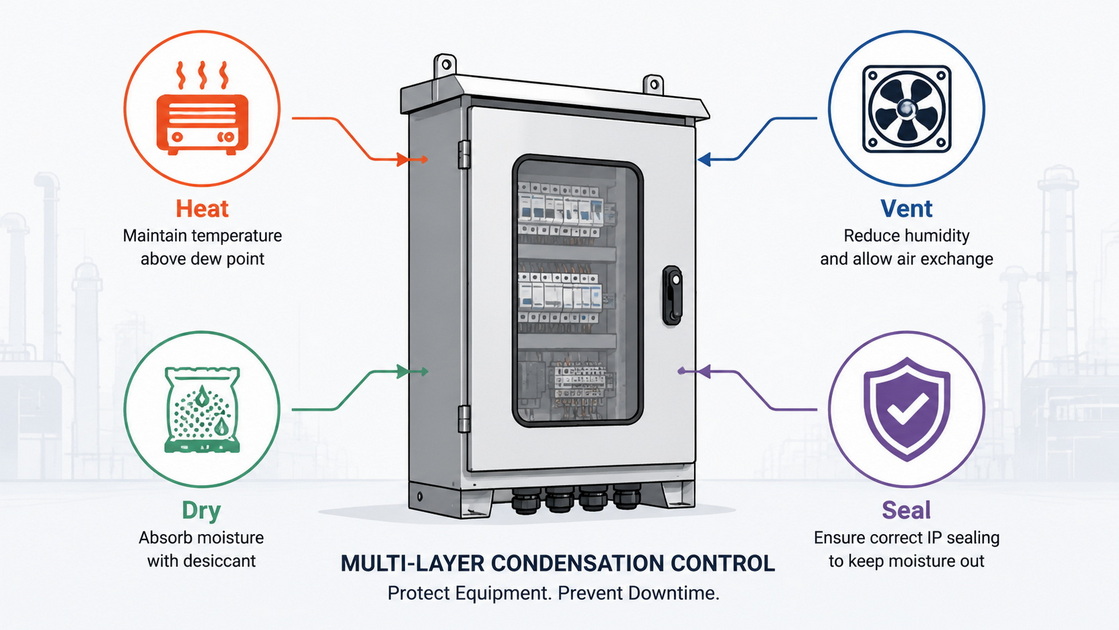
From a practical engineering standpoint, stopping condensation is about stacking several complementary controls instead of relying on one "silver bullet." [blog.okw]
When you're at the design or RFQ stage, your first decision is enclosure selection—material, protection level, and form factor. [yg-enclosure]
Key design choices:
- IP / NEMA rating:
- For harsh, wet environments, choose at least IP66–IP67 or equivalent NEMA 4/4X to limit moisture ingress. [yg-enclosure]
- Avoid overspecifying beyond application needs to keep cost and complexity under control. [electronicspecifier]
- Material:
- Stainless steel or coated steel offers mechanical strength and protection for industrial and outdoor use. [iceqube]
- Materials with lower thermal conductivity (or combined design features that reduce rapid temperature swings) help limit condensation. [blog.okw]
- Mechanical design:
- Robust doors, hinges, and compression latches maintain gasket compression over the product's life. [alliedmoulded]
As a manufacturer with over 20 years in sheet metal distribution boxes, our own enclosure portfolios are designed to provide high IP performance and customization options for power, automation, new energy, and communication projects, which is often the foundation for effective condensation control. [bohuitechnology]
Condensation occurs when the enclosure's internal temperature falls to the dew point, so one of the most effective strategies is to keep the internal temperature slightly above that dew point. [fiboxusa]
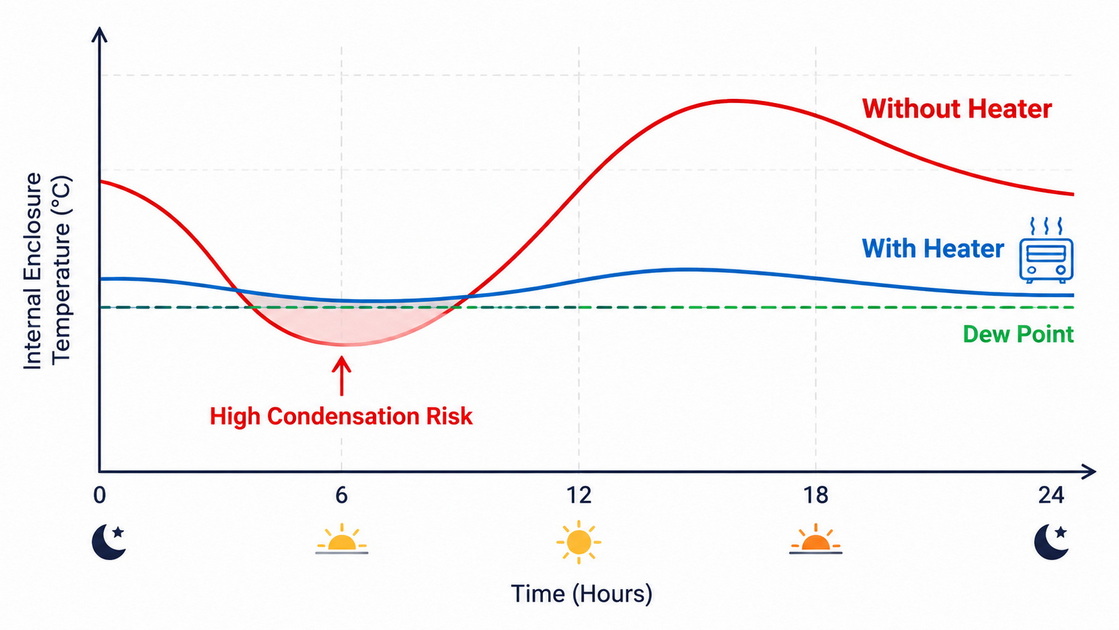
Common temperature-control solutions:
- Enclosure heaters
- Small, thermostatically controlled heaters keep internal temperature stable and above dew point. [iscsales]
- Field technicians share that 24/7 low‑wattage heaters are standard in outdoor breaker control boxes purely to prevent condensation. [reddit]
- Ventilation and fans
- For moderate environments, filtered vents and internal fans promote air exchange and help equalize temperature and humidity. [hofengfab]
- Active enclosure coolers
- In high‑heat, high‑humidity installations, thermoelectric or refrigerant-based coolers can both cool and dehumidify by condensing moisture on coils and draining it out. [parker]
> Pro tip: In many industrial projects, a combination of heater + controlled ventilation offers the most robust, cost-effective balance between condensation control and energy use. [alliedmoulded]
Even sealed enclosures benefit from controlled air movement and pressure equalization to prevent moist air from being trapped. [blog.okw]
Best practices for air and pressure management:
- Passive ventilation
- Strategically placed vents allow constant, low‑velocity airflow, which limits moisture accumulation on internal surfaces. [alliedmoulded]
- Pressure equalization devices
- Modern membrane-based vents allow air to pass while blocking water and dust, balancing internal and external pressure. [blog.okw]
- Balanced design
- Combining sealing with controlled equalization prevents vacuum "breathing" effects that draw in moist air whenever pressure changes (for example, during cooling at night). [hofengfab]
Industrial enclosure vendors emphasize that condensation control is most reliable when sealing and ventilation are treated as part of a single system design rather than independent add‑ons. [hofengfab]
Even a high‑IP enclosure will fail to prevent condensation if entry points—such as cable glands and conduits—are poorly handled. [yg-enclosure]
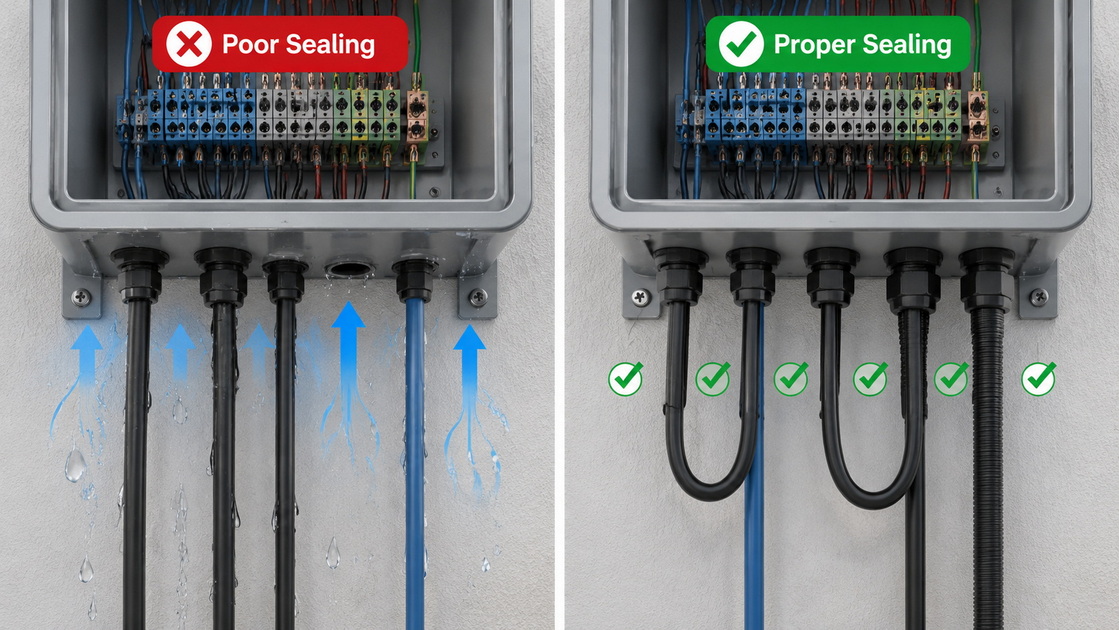
Implementation checklist:
- Use high‑quality gaskets and ensure they are evenly compressed when the door is closed. [alliedmoulded]
- Install proper cable glands rated for the same IP/NEMA class as the enclosure. [yg-enclosure]
- Seal conduits to prevent them from acting as moisture channels; practitioners often combine sealing with drip loops on downward‑entering cables. [reddit]
- Periodically inspect seals for aging, mechanical damage, and chemical attack in harsh environments. [electronicspecifier]
From an OEM's perspective, we see that many "condensation problems" are actually installation discipline problems, especially in retrofit or multi‑contractor projects where cable entries are changed over time without re‑sealing. [bohuitechnology]
For applications where environmental control is inherently difficult—such as remote pump stations or outdoor telecom cabinets—desiccants and moisture-removal systems add another layer of insurance. [parker]
Common solutions:
- Desiccant packs or cartridges
- Silica gel or similar media absorb moisture from trapped internal air. [hofengfab]
- They require scheduled replacement or regeneration; this must be built into maintenance routines. [hofengfab]
- Drying/air treatment systems
- Membrane-based cabinet dryers can reduce internal relative humidity to very low levels (for example, around 10%), dramatically reducing condensation risk. [parker]
- Condensate management
- In large control cabinets, condensate evaporators can collect and evaporate accumulated water, further lowering dew point. [youtube]
Specialized industrial suppliers highlight that these systems are particularly valuable in mission-critical cabinets where field visits are infrequent and any downtime is costly. [youtube]
Even the best enclosure can't fully compensate for a poor installation environment. Thoughtful positioning is one of the cheapest and most effective mitigation strategies. [fiboxusa]
Location best practices:
- Avoid direct sunlight or nearby heat sources that cause rapid temperature swings. [electronicspecifier]
- Stay away from very damp areas such as near open water, coastal spray, or heavy steam zones whenever possible. [fiboxusa]
- Ensure enough clearance around the enclosure for air circulation; use standoffs or spacers when wall-mounting to create an air gap. [electronicspecifier]
Industry guidance consistently stresses that simple layout changes—shade, distance from steam, slight repositioning—significantly reduce condensation without additional hardware. [fiboxusa]
In one documented best-practice scenario, electrical enclosure manufacturers and integrators recommend a three‑step approach for outdoor industrial cabinets: relocate if possible, add controlled ventilation or heating, and optimize sealing and cable entries. [iscsales]
Across case discussions and field reports, the most successful combinations often include:
- An appropriately rated IP66/IP67 or NEMA 4X metal enclosure
- A low‑wattage heater running continuously or thermostatically controlled
- Filtered vents or pressure equalization devices to avoid trapped moist air
- Desiccant packs for initially humid installations and during seasonal peaks
For Ningbo Bohui's typical customer—whether in power distribution, industrial automation, or new energy systems—this kind of integrated approach delivers both reliability and total lifecycle cost reduction, because fewer moisture-related failures means fewer emergency service calls and component replacements. [bohuitechnology]
To make this actionable, here is a concise checklist you can run through on every project:
1. Define environment and risk
- Indoor vs outdoor, humidity levels, washdown, coastal or inland. [fiboxusa]
2. Select enclosure and rating
- Choose material and IP/NEMA rating appropriate for the environment. [yg-enclosure]
3. Plan temperature control
- Specify heaters, fans, or coolers based on expected temperature cycles and load. [parker]
4. Design sealing and ventilation together
- Combine robust gaskets with controlled vents or pressure equalization elements. [blog.okw]
5. Engineer cable entry carefully
- Use rated glands, seal conduits, and design drip loops where needed. [reddit]
6. Add moisture buffers where needed
- Use desiccants or cabinet dryers in high-risk or remote locations. [parker]
7. Plan inspection and maintenance
- Schedule periodic checks for gasket wear, corrosion, heater function, and humidity indicators. [alliedmoulded]
Standard catalog boxes are not always enough—especially for complex industrial, energy, or communication projects that span multiple climates and compliance regimes. [enclosuremanufacturers]
Situations where custom or semi‑custom metal enclosures add clear value include:
- Multi‑climate deployments (for example, nationwide utility networks) that require harmonized IP/NEMA performance and accessory compatibility. [iceqube]
- High‑density control panels where internal heat load and humidity interactions need careful mechanical and thermal design. [iceqube]
- New energy and EV charging infrastructure where exposure to rain, temperature swings, and user interaction is high. [iceqube]
Manufacturers like Ningbo Bohui, with long experience in sheet metal electrical distribution boxes, can integrate structural design, thermal management, and protection features into a single enclosure solution that forms the backbone of your condensation-control strategy. [iceqube]
If you are planning a new installation—or troubleshooting condensation in an existing panel—this is the ideal time to rethink your enclosure strategy.
- Review your environment, risk profile, and current failure patterns.
- Specify high‑quality, properly rated sheet metal enclosures with integrated condensation-control design.
- Partner with a manufacturer that understands power, communication, industrial automation, new energy storage, EV infrastructure, and water pump systems, and can customize enclosure solutions for each. [bohuitechnology]
To explore tailored industrial electrical enclosure options that align with your condensation-control requirements, contact Ningbo Bohui's engineering team for design support, sample drawings, and project-specific recommendations. [bohuitechnology]
Condensation forms when warm, moist air inside or around the enclosure cools to its dew point, creating water droplets on internal surfaces, especially during night–day or load-change cycles. [iscsales]
In many outdoor or high-humidity environments, a small enclosure heater is one of the most effective ways to keep internal temperature above the dew point, significantly reducing condensation risk. [iscsales]
No. While IP66–IP67 or NEMA 4/4X enclosures limit moisture ingress, condensation can still form from trapped humid air inside; you still need temperature and humidity management. [yg-enclosure]
Desiccant packs help absorb residual moisture but work best as part of a broader strategy that includes sealing, ventilation, and temperature control; they also require periodic replacement. [parker]
Inspection frequency depends on environment and criticality, but many industrial users align checks with routine maintenance cycles, focusing on gasket condition, corrosion signs, and heater or vent performance. [electronicspecifier]
1. Allied Moulded. "Best Practices to Manage Condensation in Electrical Enclosures."
https://alliedmoulded.com/best-practices-to-manage-condensation-in-electrical-enclosures/ [alliedmoulded]
2. OKW Enclosures. "Say Goodbye to Moisture: How to prevent condensation in sealed enclosures."
https://blog.okw.com/en/blog/how-to-prevent-condensation-in-sealed-enclosures [blog.okw]
3. Ningbo Bohui Technology Co., Ltd. "Metal box enclosures and sheet metal distribution boxes."
https://www.bohuitechnology.com [bohuitechnology]
4. Electronics Specifier. "Tackling the condensation in enclosure installations."
https://www.electronicspecifier.com/products/cabinets-and-enclosures/tackling-the-condensation-in-enclosure-installations [electronicspecifier]
5. Fibox. "How to prevent condensation inside electrical enclosures."
PDF: https://www.fiboxusa.com/Customer-Content/www/CMS/files/How-to-prevent-condensation-inside-electrical-enclosures-1.pdf [fiboxusa]
6. Control Moisture in Electrical Enclosures (video).
https://www.youtube.com/watch?v=J-L212RY6SQ [youtube]
7. Ice Qube, Inc. "Enclosures for Electrical Equipment."
https://iceqube.com/electrical-enclosures/ [iceqube]
8. Yongu. "How to Prevent Condensation in Electrical Enclosures."
https://www.yg-enclosure.com/article/how-prevent-condensation-electrical-enclosures.html [yg-enclosure]
9. ISC Sales. "How to Prevent Condensation in Electrical Enclosures."
https://iscsales.com/blog/how-to-prevent-condensation-in-electrical-enclosures/ [iscsales]
10. Fibox USA. "How to Prevent Condensation Inside Your Electrical Enclosures."
https://www.fiboxusa.com/how-to-prevent-condensation-inside-your-electrical-enclosures/ [fiboxusa]
11. EnclosureManufacturers.com. "Leading Electrical Enclosure Manufacturers."
https://enclosuremanufacturers.com/electrical-enclosures/ [enclosuremanufacturers]
12. Hofengfab. "How to Prevent Condensation in Electrical Enclosures."
https://www.hofengfab.com/how-to-prevent-condensation-in-electrical-enclosures/ [hofengfab]
13. Reddit – r/electricians. "How can I stop condensation in electrical boxes/panels."
https://www.reddit.com/r/electricians/comments/16n7bz8/how_can_i_stop_condensation_in_electrical/ [reddit]
14. Parker Hannifin. "Eliminating Moisture in Electrical Cabinets."
https://www.parker.com/content/dam/Parker-com/Literature/IGFG/PDF-Files/Eliminating-Moisture-in-Electrical-Cabinets.pdf [parker]

2026-07-26

2026-07-24


