


Views: 222 Author: Bohui Electric Publish Time: 2026-05-08 Origin: Site


Content Menu
● What Is an IP69 Rating, Really?
● IP69 vs IP69K: Are They the Same?
● How IP69 Testing Works (From a Lab and Factory View)
>> High‑Pressure Water Jet Test (IPX9)
● IP69 vs IP67 vs IP68: Which Do You Actually Need?
● Where IP69 Wall Mount Enclosures Are Essential
>> Key Industries Using IP69 Enclosures
● Advantages and Trade‑Offs of IP69 Enclosures
● How to Choose the Right IP Rating for Your Project
>> Step‑by‑Step Decision Criteria
● Standards, Compliance, and Certification: What Buyers Must Check
>> Compliance Checklist Before Purchasing
● Expert Tips to Avoid Common IP69 Selection Mistakes
● How to Work With Your Enclosure Manufacturer
>> 1. What is the difference between IP69 and IP69K?
>> 2. Can an IP69 enclosure be used underwater?
>> 3. Is IP69 always better than IP68?
>> 4. Why are IP69 enclosures more expensive?
>> 5. How often should gaskets and seals be inspected on an IP69 enclosure?
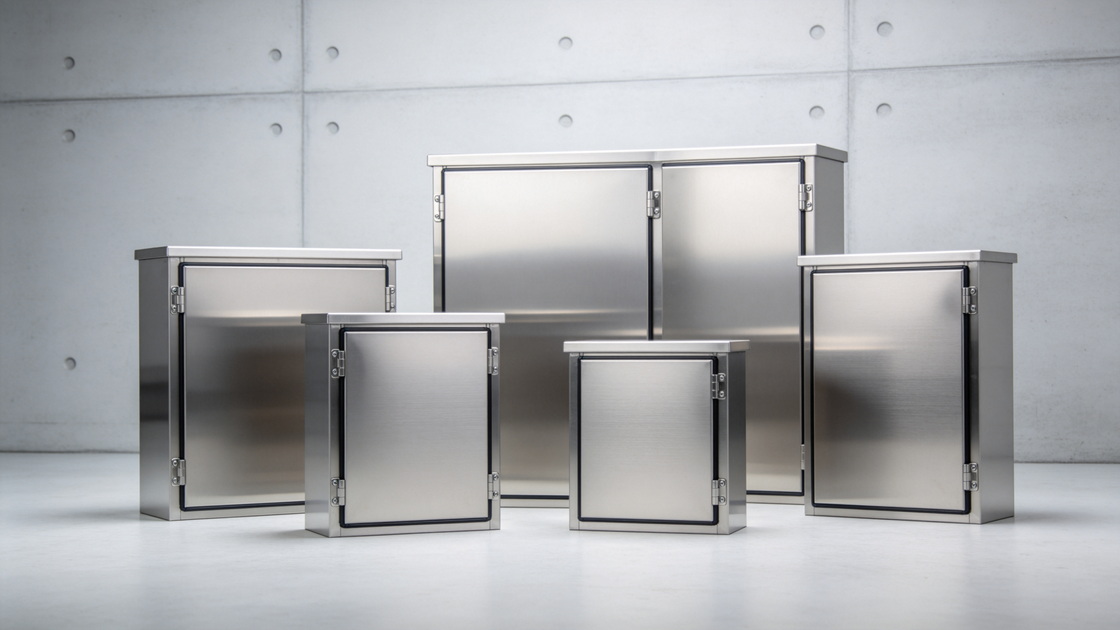
An IP69 rating is the highest level of ingress protection for dust and high‑pressure, high‑temperature water jets, and it has become a critical requirement for wall mount enclosures in hygiene‑sensitive and harsh industrial environments. From my experience working with electrical enclosure buyers in food, automotive, water, and new energy projects, choosing IP69 correctly often determines whether a project runs reliably for 10 years—or starts failing after the first aggressive wash‑down. [nopio]
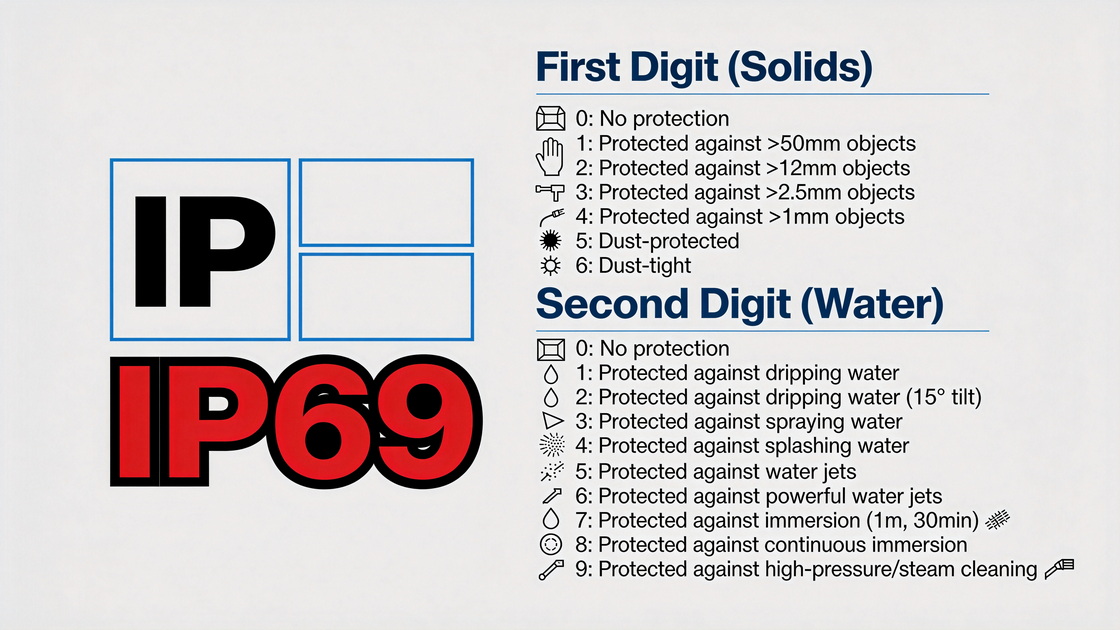
When engineers talk about IP69, they are referring to one of the toughest standardized tests for how well an enclosure keeps out dust and water. Under IEC 60529, the code has two digits: the first digit (0–6) is for solids like dust, and the second (0–9) is for water.
- 6 = completely dust‑tight, even under vacuum.
- 9 = withstands high‑pressure, high‑temperature water jets from multiple angles.
In practical terms, an IP69 wall mount enclosure can be hit by hot, high‑pressure cleaning water from all directions without letting water or dust reach the internal components. This makes it ideal for aggressive wash‑down environments such as food plants, pharmaceutical lines, and automatic car washes.
> From an enclosure manufacturer's perspective, you never design "just to pass a lab test". You design for the worst real‑world cleaning routine your customer will actually use—often harsher than the standard assumes. [nopio]
Many buyers ask whether IP69 and IP69K mean the same thing, especially when they compare European and global product datasheets. The short answer: they are closely related but come from different standards and test setups.
- IP69: Defined in IEC 60529, widely used across electrical and industrial equipment.
- IP69K: Comes from DIN 40050‑9, originally developed for automotive and machinery applications.
IP69K adds more detailed requirements for:
- Water jet pressure of about 80–100 bar (1160–1450 psi)
- Water temperature up to 80 °C (176 °F)
- Fixed spray angles (0°, 30°, 60°, 90°) and 10–15 cm nozzle distance
In many catalogs, IP69 and IP69K are used interchangeably because they both indicate extreme resistance to hot, high‑pressure cleaning jets. For regulated environments (like food, beverage, and automotive), it's safer to confirm which exact test standard the enclosure has passed, rather than relying on the label alone.
From a lab standpoint, earning an IP69 rating means the enclosure survives two sets of demanding tests. From a factory standpoint, it means your enclosure design, gasket, and mounting must all work together—because one weak link can void the rating.
For the first digit "6", the enclosure is placed in a sealed dust chamber and exposed to fine dust (like talc) for up to 8 hours. Partial vacuum can be applied to encourage dust ingress. The enclosure must show no dust penetration at the end of the test.
For the second digit "9", the enclosure faces high‑pressure, high‑temperature water. Typical conditions include:
- Water pressure: 80–100 bar (1160–1450 psi)
- Water temperature: up to 80 °C (176 °F)
- Spray angles: 0°, 30°, 60°, 90°
- Nozzle distance: 10–15 cm
- Duration: at least 30 seconds per angle (minimum 2 minutes total)
The enclosure can be mounted on a rotating table so jets hit from all directions. After testing, there must be no water ingress that could affect safe operation.
From our own manufacturing practice with wall mount enclosures, the design details that usually decide pass or fail are:
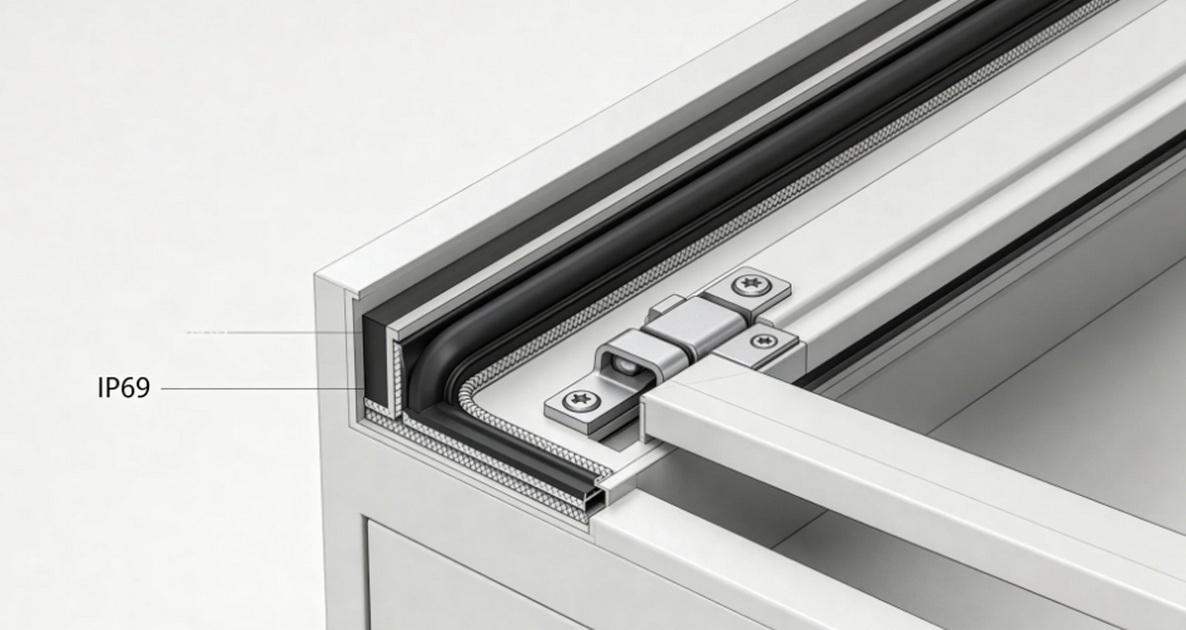
- Consistent gasket compression along the entire door perimeter
- Robust door hardware that prevents twisting under jet force
- Avoiding unnecessary cutouts or poorly sealed cable entries
When IP69 failures occur in the field, they rarely come from the metal box itself. They come from improper cable glands, incorrectly drilled knockouts, or poor mounting orientation—all things that must be considered at the design and installation stage.
A frequent mistake we see in RFQs is treating IP67, IP68, and IP69 as a simple "good, better, best" ladder. In reality, they protect against different kinds of water exposure.
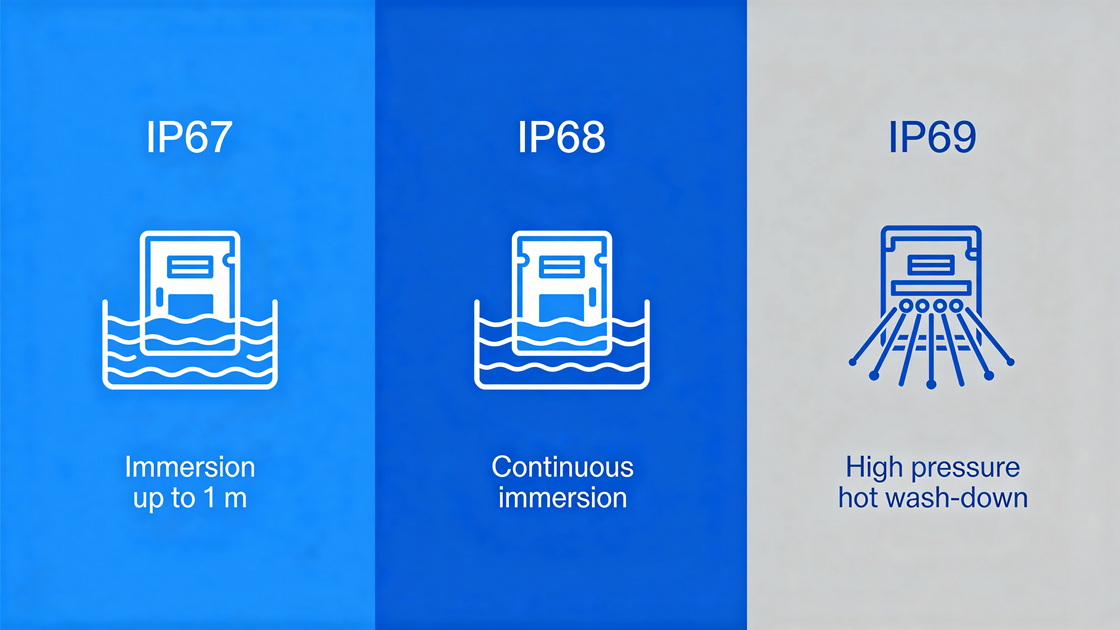
| Rating | Type of water exposure | Typical use case | Wash‑down ready? | Immersion proof? |
|---|---|---|---|---|
| IP67 | Immersion up to 1 m | Outdoor boxes, temporary flooding | No | Temporary only |
| IP68 | Continuous immersion >1 m | Submersible sensors, tank devices | Limited | Long duration |
| IP69 | High‑pressure, hot water jets | Food/pharma, sanitary machinery | Yes | No |
If your enclosure is installed in an area with regular high‑pressure cleaning, IP69 is a better choice than IP67/68, even though IP68 appears "higher" in terms of immersion depth. For sealed junction boxes in underground pits or tanks, IP68 can be more appropriate than IP69.
> As a rule of thumb: wash‑down → IP69; immersion → IP67/IP68; general outdoor → IP65–IP67.
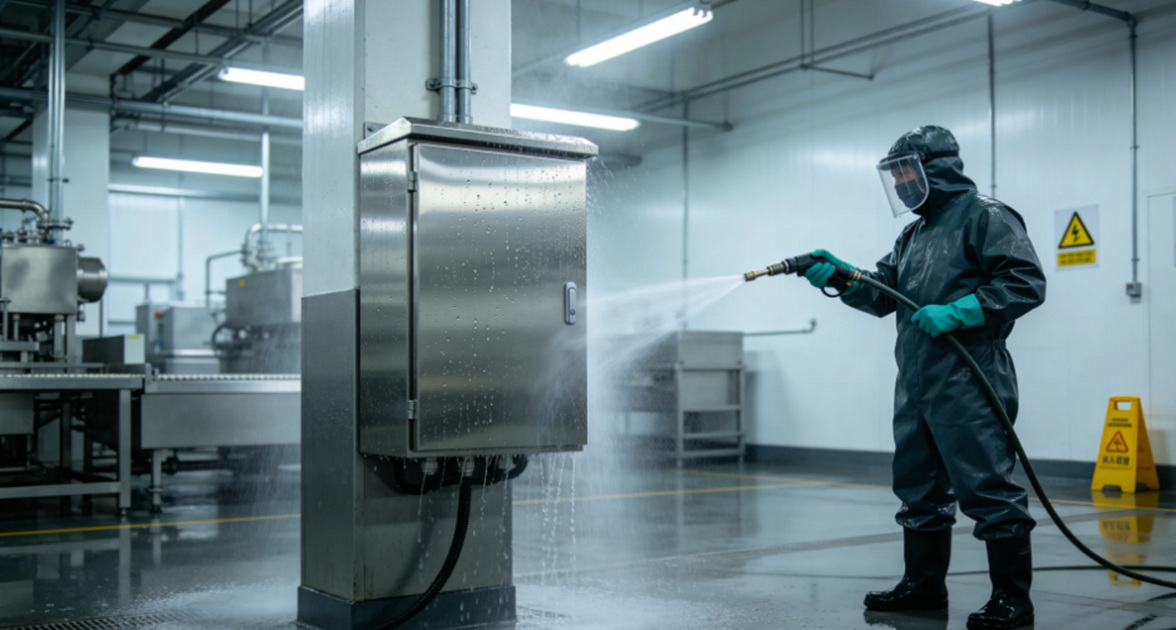
IP69 wall mount enclosures are engineered specifically for demanding, hygiene‑critical and outdoor conditions. In our day‑to‑day work with OEMs and system integrators, we see recurring patterns in where IP69 is requested.
1. Food & Beverage Processing
Daily high‑pressure sanitization is mandatory to meet hygiene regulations. IP69 enclosures protect I/O modules, PLCs, and control buttons installed directly on lines such as meat processing, dairy, and beverage filling.
2. Pharmaceutical & Biotech Plants
Cleanrooms and sterile zones rely on enclosures that withstand steam jets and chemical disinfectants. IP69 helps prevent micro‑leaks where bacteria or moisture could accumulate.
3. Automotive & Car Wash Systems
Automated car wash tunnels expose sensors and control boxes to continuous high‑pressure, heated water and detergents. IP69 reduces corrosion risk and nuisance failures.
4. Agriculture, Water & Pump Systems
Mobile machinery, irrigation, and pump stations operate in muddy, wet, and dusty conditions. IP69 is valuable where enclosures are frequently cleaned or exposed to spray and splashes.
5. Transportation & Rail Infrastructure
Outdoor junction boxes and signal control enclosures face pressure washing during maintenance. IP69 ensures that aggressive cleaning does not compromise safety.
- Wall‑mounted wash‑down control panels in poultry and dairy lines
- Outdoor junction boxes fixed along automatic car wash tracks
- Control boxes for mobile generators and lighting on construction or military sites
In these locations, a failure doesn't just mean a single device replacement. It can trigger unplanned downtime, product contamination risk, and expensive restart procedures, which is why many engineering teams standardize on IP69 once they see the total cost impact.
- Maximum protection against dust and spray: 100% dust‑tight and resistant to hot, high‑pressure water from all directions.
- Supports hygiene and sanitation standards: Commonly used in FDA‑regulated and other strict hygiene environments where frequent wash‑downs are mandatory.
- High reliability in harsh environments: Properly designed IP69 enclosures resist moisture, corrosion, and debris, extending equipment life and reducing maintenance interventions.
- Not a deep‑immersion rating: IP69 is not designed for prolonged underwater use; for submerged installations, IP67 or IP68 is more appropriate.
- Higher cost and engineering complexity: Thicker gaskets, precision sealing, and robust construction increase unit cost and demand more careful engineering.
- Possible over‑specification: In dry indoor areas or simple sheltered outdoor locations, IP69 may offer more protection than necessary, increasing cost without clear benefit.
From an engineering‑buyer perspective, the question is not "Can we get the highest IP rating?" but "Which rating gives the best lifecycle value for the specific environment?"
Choosing between IP66, IP67, IP68, and IP69 should follow a simple decision framework, not just intuition.
1. Define the environment type
- Dry indoor, light dust
- Wet, occasional splashes
- Heavy dust, outdoor exposure
- Frequent high‑pressure wash‑down
2. Map cleaning methods
- No pressure washing → IP54–IP66 often sufficient
- Regular pressure washing (cold water) → IP66–IP69
- Hot, high‑pressure wash‑downs → IP69 is usually recommended
3. Assess water pressure, temperature, and direction
When you expect jets from multiple angles, especially at elevated temperature, IP69 gives a clear safety margin over IP66/67.
4. Consider chemical exposure
IP ratings do not cover chemical resistance. You must also ensure gasket and housing materials (e.g., stainless steel vs coated steel vs plastic) are compatible with the cleaning chemicals used.
5. Confirm documentation
- Request IP test reports according to IEC 60529 or DIN 40050‑9
- Check labeling and certification marks (UL, TÜV, Intertek, etc.)
A structured review like this prevents both under‑specifying (leading to failures) and over‑specifying (wasting budget).
IP69 is not just a marketing label—it is tied to formal international standards and third‑party testing. Before approving a supplier or enclosure series, engineering teams should verify the following.
- IEC 60529 (International): The primary standard defining IP codes and the test methods for dust and water ingress.
- ISO 20653 (Automotive/Transportation): Extends IP definitions for road vehicles and mobile equipment.
- DIN 40050‑9 (German/European): Defines IP69K for high‑pressure, high‑temperature wash‑down, especially in food and transportation industries.
- Third‑party lab certification: Confirm that products are tested by accredited labs (UL, TÜV, Intertek) rather than only self‑declared ratings.
- Test reports and product markings: Request documentation that links the specific enclosure series and size to exact test reports.
- Material and seal suitability: Ensure the IP69 rating is supported by suitable gasket design, screw fittings, and enclosure material (e.g., stainless steel, fiberglass reinforced plastic).
- Installation guidance: IP ratings can be voided by incorrect installation, drilling, or cable entry methods—manufacturer instructions must be followed closely.
For global sourcing teams, this diligence is especially important when comparing offers from different countries, where testing practices and documentation quality can vary widely.
Drawing on repeated conversations with engineers and purchasers across power, communication, industrial automation, and new energy projects, three mistakes show up again and again:
1. Treating IP69 as a guarantee, regardless of installation
- Field modifications like on‑site drilling or poor cable gland selection can completely compromise an IP69 enclosure.
- Always coordinate with your enclosure supplier about factory‑made cutouts, gland plates, and recommended accessories.
2. Ignoring thermal management
- Higher sealing levels also mean reduced natural ventilation.
- For power and drive cabinets, evaluate whether you need breather valves, heat exchangers, or sealed cooling solutions that preserve the IP rating.
3. Overlooking lifecycle inspection
- Even with IP69, gaskets, seals, and hinges face mechanical fatigue, chemical attack, and temperature cycling.
- A simple inspection schedule (every 6–12 months in harsh environments) significantly extends enclosure life and reliability.
These insights may not appear in the standards, but they are what separate successful long‑term installations from expensive trial‑and‑error.
For projects in power distribution, communication networks, industrial automation, building control, energy storage, EV charging, and pump systems, partnering closely with your enclosure manufacturer makes IP69 implementation far more reliable.
When you approach a supplier, prepare to discuss:
- Exact installation environment (indoor/outdoor, wash‑down zones, altitude, temperature range)
- Cleaning procedures (pressure, temperature, chemicals, frequency)
- Cable entry strategy (top/bottom entry, gland types, pre‑punched plates)
- Material preferences (stainless steel grades, coated steel, aluminum, engineering plastics)
- Future maintenance access (how often the door will be opened, and by whom)
An experienced manufacturer can then help you balance IP rating, material selection, mechanical design, and total cost of ownership, rather than simply offering a standard catalog item.
Both offer top‑level protection against dust and high‑pressure water, but IP69K refers specifically to high‑pressure, high‑temperature cleaning jets according to DIN 40050‑9, while IP69 usually refers to IEC 60529 testing. In many industrial applications they overlap, but critical projects should confirm the exact standard used.
No, IP69 focuses on water jets, not long‑term submersion. For underwater use, choose IP67 or IP68, which are tested at defined depths and durations.
Not necessarily. IP69 is better for aggressive wash‑down, while IP68 is better for continuous immersion. "Best" depends entirely on whether your risk is pressure washing or submersion.
IP69 enclosures require precise sealing, robust construction, and certified testing, which add material and engineering costs. However, in hygiene‑critical or harsh environments, they usually reduce downtime and maintenance, improving overall ROI.
Even with IP69 protection, seals and gaskets should be visually checked every 6–12 months in demanding environments, particularly where heat, chemicals, or vibration are present. Early detection of wear prevents unexpected failures.
1. IEC 60529 – Degrees of protection provided by enclosures (IP Code).
2. DIN 40050‑9 – Road vehicles; degrees of protection (IP code); protection against high‑pressure/steam jet cleaning.
3. ISO 20653 – Road vehicles – Degrees of protection (IP-code) – Protection of electrical equipment against foreign objects, water and access.
4. Lianjie. "What Is an IP69 Rating?" (accessed 2026). [https://www.lianjer.com/what-is-an-ip69-rating/]
5. Boostability. "Google E‑E‑A‑T (2024 Ultimate Guide)." 2025. [boostability]
6. Wildcat Digital. "How Do You Write E‑E‑A‑T Content?" 2023. [wildcatdigital.co]
7. Nopio. "Industrial SEO: Ranking Strategies for Manufacturing." 2026. [nopio]

2026-07-26

2026-07-24


