


Views: 222 Author: Amanda Publish Time: 2026-02-03 Origin: Site


Content Menu
● What Is a DIN Rail in Electrical Enclosures?
● Why DIN Rails Matter for Power, Telecom, and Industrial Projects
● Brief History and Standards Behind DIN Rails
● Main Types of DIN Rails and Their Applications
>> TS35 “Top Hat” DIN Rails (Standard 35 mm)
>> TS15 Mini Top Hat Rails (15 mm)
>> TS32 G-Rails (G-Profile Rail)
● Key Technical Considerations When Selecting a DIN Rail
● Practical Installation Tips for Reliable DIN Rail Systems
● Where DIN Rails Are Used Across Industries
● Example: DIN Rail Energy Meters for Smart Power Management
>> Three-Phase DIN Rail Meter (DTSU666 Example)
>> Single-Phase DIN Rail Meter (DDSU666 Example)
● Common DIN Rail Types at a Glance
● How to Choose DIN Rails and Enclosures for Your Projects
● FAQs About DIN Rails and Electrical Enclosures
>> 1. What is the main purpose of a DIN rail in an electrical panel?
>> 2. Can I mix different manufacturers' devices on the same DIN rail?
>> 3. When should I choose TS35 rails instead of TS15 mini rails?
>> 4. Are C-rails and G-rails still necessary in modern installations?
>> 5. What enclosure features are important for DIN-rail-based designs?
A DIN rail is a standardized metal mounting rail used to fix and organize electrical and electronic devices inside control panels and enclosures. It provides a consistent mechanical interface so that components from different manufacturers can be mounted side by side without custom drilling or brackets. In modern power, communication, industrial automation, and new energy systems, DIN rails are the backbone that keeps devices aligned, accessible, and safe.
Because DIN rails follow international standards, panel builders can design enclosures that are easy to expand, maintain, and upgrade over the entire lifecycle of an installation. This makes them especially valuable in sectors like power distribution, telecom, industrial automation, and energy storage where scalability and reliability are critical.
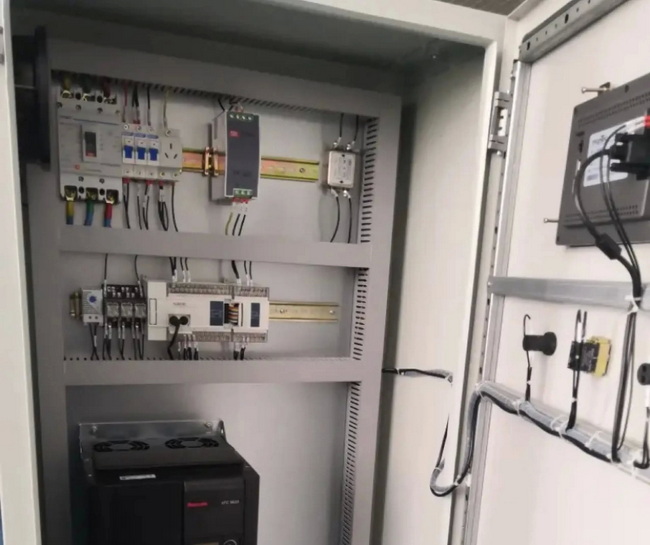
DIN rails are more than just a piece of bent metal; they are a standardized platform that underpins efficient, scalable electrical design.
Key benefits of using DIN rails in professional enclosures include:
- Standardization across brands and projects: You can mix devices from multiple manufacturers on the same rail as long as they follow the same profiles and dimensions.
- Fast, clean installation: Devices clip or snap onto the rail, reducing drilling, cutting, and custom brackets.
- Space optimization in compact panels: Vertical and horizontal device alignment allows dense but serviceable layouts.
- Lower lifecycle cost: Less assembly time, easier upgrades, and reduced downtime mean lower total cost of ownership.
- Organized, safe layouts: Clear separation between control, power, and communication devices supports safer wiring and easier troubleshooting.
These advantages are particularly important in applications such as power distribution boards, telecom and network cabinets, industrial intelligent manufacturing lines, building automation panels, EV charging infrastructure, and water pump control systems.
The term DIN originates from Deutsches Institut für Normung, the German Institute for Standardization. DIN rail technology began to emerge in Germany in the late 1920s and was formalized as electrical panels grew more complex.
A key milestone came in 1928 when Rheinisch-Westfälisches Elektrizitätswerk (RWE) developed early rail concepts to bring order to non-standard electrical panels. Early rails were made of porcelain with a central busbar, but porcelain proved too fragile, and metal profiles quickly became the norm.
In the 1950s, DIN acquired and refined RWE's designs, turning them into standardized rail formats widely adopted in Europe and beyond. In the United States, the National Electrical Manufacturers Association (NEMA) aligned with these principles, and today most control and protection devices intended for panel mounting are available in DIN-compatible versions.
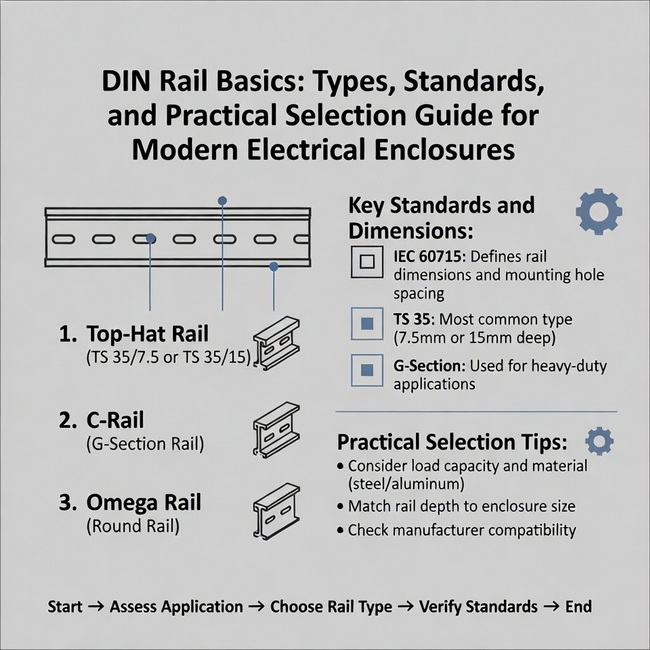
The TS35 top hat rail is the most widely used DIN rail profile in modern control panels. Its cross-section looks like a small hat or channel, and it is 35 mm wide.
Common variants include:
- TS35 x 7.5 mm: Standard depth for general-purpose applications.
- TS35 x 15 mm: Deeper profile for heavier or taller devices where extra stability is needed.
Typical applications include:
- Meters and energy analyzers
- Miniature circuit breakers (MCB) and RCBOs
- Terminal blocks
- Relays and contactors
- Power supplies and I/O modules
- Programmable logic controllers (PLC) and communication modules
Because of its versatility, TS35 is the default choice in low-voltage distribution, industrial automation, building controls, and communication cabinets.
The TS15 mini top hat rail is a compact version of the TS35, with an overall width of 15 mm and a typical channel depth of 5.5 mm. It is ideal when panel space is extremely limited or when only small, lightweight components need to be mounted.
Common use cases include:
- Compact relays and interface modules
- Small junction boxes
- Signal-level devices in narrow enclosures
- Space-constrained control boxes in machinery and OEM equipment
In dense network, communication, or IoT control boxes, TS15 rails help you fit essential components without compromising accessibility.
C-rails were widely used before TS35 became the dominant standard and are still popular for heavy-duty applications. They have a 32 mm edge-to-edge width and a C-shaped cross-section that offers robust wall support.
They are typically chosen when:
- Mounting heavier components such as transformers
- Installing larger power supplies
- Building panels where mechanical robustness is a priority
In industrial power, water pumping stations, and large machinery, C-rails remain a proven solution for high-mass devices.
G-rails, also referred to as TS32, have a 32 mm width with a deeper cavity on one side that forms a “G” shape in cross-section. The deeper channel is usually placed at the lower edge of the panel to provide added support and prevent devices from being mounted backward.
They are commonly used where:
- Heavy-duty components need strong, reliable support
- Mechanical shock or vibration may occur
- Traditional designs or regional standards still favor G-profile rails
For industrial intelligent manufacturing, heavy pump controls, or large power systems, G-rails offer a robust mechanical foundation.
When designing or upgrading an electrical enclosure, choosing the right DIN rail type and material is critical for long-term reliability and safety.
Important selection factors include:
- Mechanical load capacity: Consider the total weight of devices, including transformers, power supplies, and contactors. Heavier devices often benefit from C-rails or G-rails, or from thicker-gauge TS35 rails.
- Available panel depth and width: Shallow enclosures may favor TS15 or TS35 x 7.5 mm rails, while deeper panels can use TS35 x 15 mm to accommodate taller devices.
- Corrosion resistance: In humid or aggressive environments, such as coastal telecom sites or water treatment facilities, galvanized or stainless steel rails can improve durability.
- Thermal performance: Dense layouts and high current devices generate heat; maintaining spacing and using perforated or ventilated enclosures helps avoid hotspots.
- Standard compliance: Ensuring compatibility with DIN and, where applicable, NEMA guidelines supports global interchangeability and simplifies future expansion.
To get the best performance from your DIN rail and enclosure system, follow these practical guidelines:
1. Plan layout by function
Group devices by function, such as power distribution, control, and communication, along the rail to simplify wiring and maintenance.
2. Use correct cutting and deburring tools
Cut rails to length with appropriate tools, then deburr edges to avoid damaging insulation or cable sheaths.
3. Follow manufacturer mounting instructions
Some devices require specific orientations or clearances for cooling and proper operation; always follow product data sheets.
4. Allow maintenance space
Leave enough space at the top and bottom of the rail, and between key devices, so technicians can insert screwdrivers and test probes safely.
5. Secure anchoring to the enclosure
Fix the DIN rail firmly to the backplate or enclosure body, using the recommended number and type of fasteners for the expected load.
6. Label devices and sections clearly
Use marking strips and device labels so technicians can quickly identify circuits during inspection or fault finding.
These steps help ensure that panels in power, telecom, networking, industrial automation, and new energy storage applications remain safe, serviceable, and future-ready.
DIN rails are now standard in a wide range of application scenarios:
- Power and distribution: LV switchboards, distribution boards, energy metering cabinets, and submetering systems.
- Telecom and network: Rack-mounted enclosures for routers, switches, media converters, and power conditioning units.
- Industrial intelligent manufacturing: PLC panels, remote I/O stations, motor control centers, and sensor hubs.
- Building automation: HVAC controllers, lighting control modules, access control, and safety systems.
- New energy and energy storage: Battery management systems, inverter panels, and DC distribution.
- New energy vehicles and charging: Charging station controllers, protection devices, and monitoring equipment.
- Water and pump systems: Pump control panels, level monitoring systems, and protection relays.
In all these fields, DIN rails provide a stable, standardized mounting platform that supports safe, scalable electrical infrastructure.
Energy meters designed for DIN-rail mounting make it easy to add accurate metering to new or existing panels without redesigning the enclosure.
A three-phase DIN rail meter such as the DTSU666 is designed for industrial and commercial applications where three-phase loads are common. Typical features include:
- Lightweight and compact dimensions around 98 × 65 × 72 mm for easy mounting on standard TS35 rails.
- Measurement of frequency, power factor, total kWh and kVarh, and instantaneous values such as kW, kVar, Irms, and Vrms.
- Low internal power consumption, typically less than 1 W / 5 VA, to minimize its own energy use.
- Wide operating temperature range, for example from -40 °C to +75 °C, suitable for harsh environments.
- IP54 protection rating, offering limited dust ingress protection and resistance to low-pressure water jets.
Such meters are ideal for industrial factories, ports, large office complexes, and multi-tenant buildings requiring precise three-phase energy monitoring.
A single-phase DIN rail meter such as the DDSU666 provides similar functionality in a more compact form factor for single-phase loads.
Key characteristics include:
- Very compact size around 98 × 65 × 36 mm and lower weight of about 200 g for narrow enclosures.
- Measurement of power factor, frequency, total kWh, and instantaneous kW, Irms, and Vrms.
- Low power consumption comparable to the three-phase model, usually less than 1 W / 5 VA.
- Similar operating temperature range and IP54 degree of protection.
These meters are suitable for residential buildings, small offices, storage rooms, and smaller commercial loads where single-phase connections dominate. When combined with well-designed DIN rails and enclosures, both single-phase and three-phase meters help operators gain detailed insight into energy use and improve efficiency across facilities.
DIN rail type | Width (mm) | Typical depth (mm) | Profile shape | Typical applications |
TS35 top hat | 35 | 7.5 or 15 | Hat/channel | Standard control panels, MCBs, relays, PLCs, meters, power supplies, I/O. |
TS15 mini top hat | 15 | 5.5 | Narrow hat | Compact enclosures, small relays, signal modules, narrow control boxes. |
C-rail | 32 | Varies | C-shaped | Heavier devices, transformers, larger power supplies, robust industrial panels. |
TS32 G-rail | 32 | Deep G cavity | G-shaped | Heavy-duty components, vibration-prone environments, legacy or robust designs. |
When selecting DIN rails and matching enclosures for sectors like power, communication, industrial IoT, or new energy, consider the following checklist:
- Define environment and protection level: Indoor versus outdoor, humidity, dust, and water exposure determine enclosure rating, such as IP54 or higher.
- Match rail type to device mix: Choose TS35 for general control and protection devices; use C-rail or G-rail for larger or heavier components.
- Plan for expansion: Leave space for future devices, additional meters, or communication modules, especially in fast-growing sectors like EV charging and energy storage.
- Coordinate with system integrators and OEMs: Ensure enclosure size, cutouts, and rail layout align with upstream and downstream equipment requirements.
- Check international compliance: For projects spanning multiple regions, verify compatibility with DIN, IEC, and local standards to simplify global deployment.
A well-chosen combination of rails and enclosures reduces integration risk and supports long-term scalability in smart grids, industrial automation, and digital infrastructure.
If you are designing or upgrading panels for power systems, telecom networks, industrial intelligent manufacturing, building automation, energy storage, EV infrastructure, or water pump control, choosing reliable DIN rails and enclosures is critical for performance and safety.
Contact our team at Ningbo Bohui Electric Co., Ltd. today to discuss customized electrical enclosure solutions optimized for DIN rail mounting, harsh environments, and your specific industry standards. Our engineers can help you select rail types, enclosure sizes, and layouts that shorten installation time, support future expansion, and enhance the reliability of your entire system.
Contact us to get more information!
The main purpose of a DIN rail is to provide a standardized mechanical mounting platform for devices such as breakers, meters, relays, and terminal blocks, making panel assembly faster, cleaner, and more modular.
Yes, you can mix devices from different manufacturers on the same DIN rail as long as the devices are designed for the same profile, such as TS35, and follow relevant standards for mounting and clearances.
You should use TS35 rails for most standard control panels and when mounting larger or heavier devices. TS15 rails are better suited for compact enclosures and light, small-form-factor components where space is at a premium.
C-rails and G-rails remain valuable for heavy-duty applications where mechanical strength and secure support are essential, such as large transformers, industrial power supplies, and panels exposed to vibration or shock.
Important enclosure features include adequate depth for mounted devices, a suitable IP rating for the environment, a robust backplate for rail mounting, and enough space for cable management, labeling, and future expansion.
1. https://www.chintglobal.com/global/en/about-us/news-center/blog/din-rail-basics-and-types.html
2. https://www.chintglobal.com [chintglobal](https://www.chintglobal.com)

2026-07-26

2026-07-24


