


Views: 211 Author: Bohui Electric Publish Time: 2026-06-24 Origin: Site


Content Menu
● Understanding Electrical Enclosures and Hole Cutting
● Types of Holes Commonly Needed
>> Circular Holes (Push Buttons, Cable Glands)
>> Rectangular and Square Cutouts (HMI, Meters, Fans)
● Essential Tools for Cutting Holes in Enclosures
>> For Circular Holes in Metal Enclosures
>> For Rectangular/Square Holes
>> For Plastics and Composite Enclosures
● Safety and Preparation Before Cutting
● Step‑by‑Step: How to Cut Circular Holes
>> Step 1: Plan Hole Position and Size
● Step‑by‑Step: Cutting Rectangular or Square Holes
>> Step 1: Mark and Protect the Surface
>> Step 2: Drill Corner Starter Holes
>> Step 3: Cut Along the Lines
>> Step 4: File, Deburr and Fit
● Manufacturer Insight: When to Use CNC or Laser Cutting
● Best Practices to Protect IP Rating and Coating
● User Tips and Community Feedback
● Simple Tool and Method Selection Table
● Call to Action: Partner with a Professional Enclosure Manufacturer
● FAQ: Cutting Holes in Electrical Enclosures
>> 1. Can I cut holes in an IP65 or IP66 enclosure without losing the rating?
>> 2. What is the safest method for a beginner to cut push button holes?
>> 3. Should I cut holes before or after mounting internal components?
>> 4. How do I avoid chipping paint or coating around the hole?
>> 5. When should I outsource hole cutting to a manufacturer?
Cutting clean, safe holes in an electrical enclosure is all about planning, choosing the right tools for the enclosure material, and following professional safety practices step by step. In this guide, I'll walk you through how we approach hole cutting in industrial enclosures from a manufacturer and field-engineer perspective, and how you can apply the same standards in your own projects. [bohuielectric]
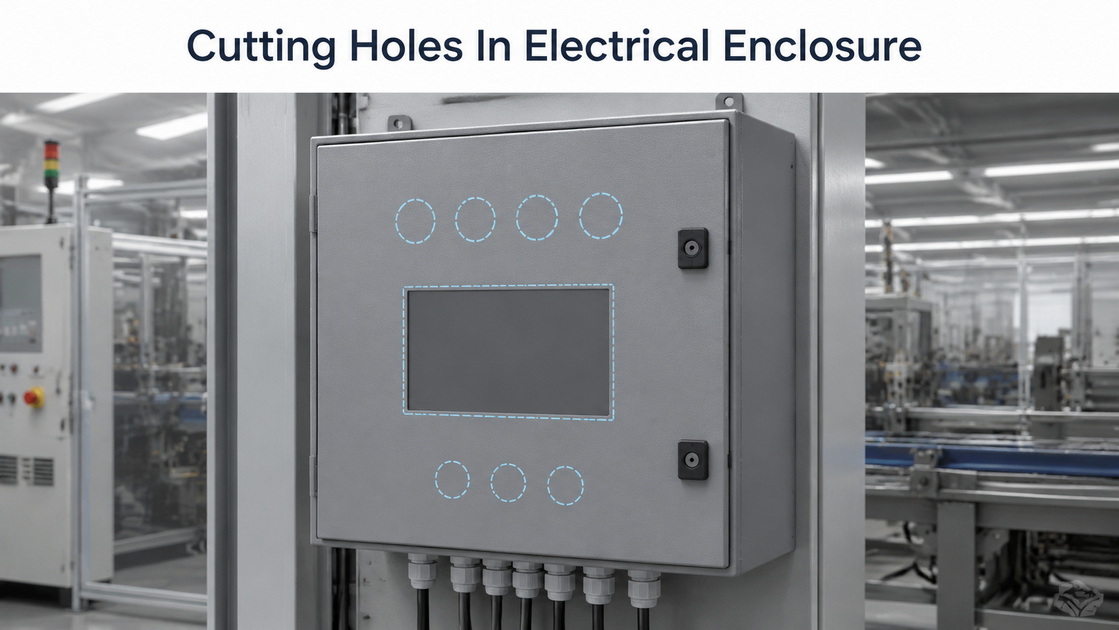
Electrical enclosures protect sensitive components from dust, moisture, mechanical impact and accidental contact, so any modification—especially cutting holes—directly affects safety, IP rating and long‑term reliability. As an enclosure manufacturer, we see that most problems in the field come from poorly planned cutouts and improper deburring, which lead to water ingress, corrosion and even injuries. [twcontrols]
Before you cut anything, clearly define:
- What you're mounting (push buttons, cable glands, HMIs, fans, sensors). [youtube]
- Enclosure material and thickness (mild steel, stainless steel, aluminum, coated steel, plastic). [chinametalworking]
- Required certification/IP rating (UL 508A panels, IP65/IP66 enclosures, NEMA rating). [bohuielectric]
Different accessories require different hole types and tolerances, and that dictates the best cutting method. [hobby-machinist]
Circular holes are used for:
- Push buttons and indicator lights (commonly 22 mm or 30.5 mm). [twcontrols]
- Cable glands and fittings (various diameters). [forum.core-electronics.com]
- Ventilation or fan cutouts with circular openings. [youtube]
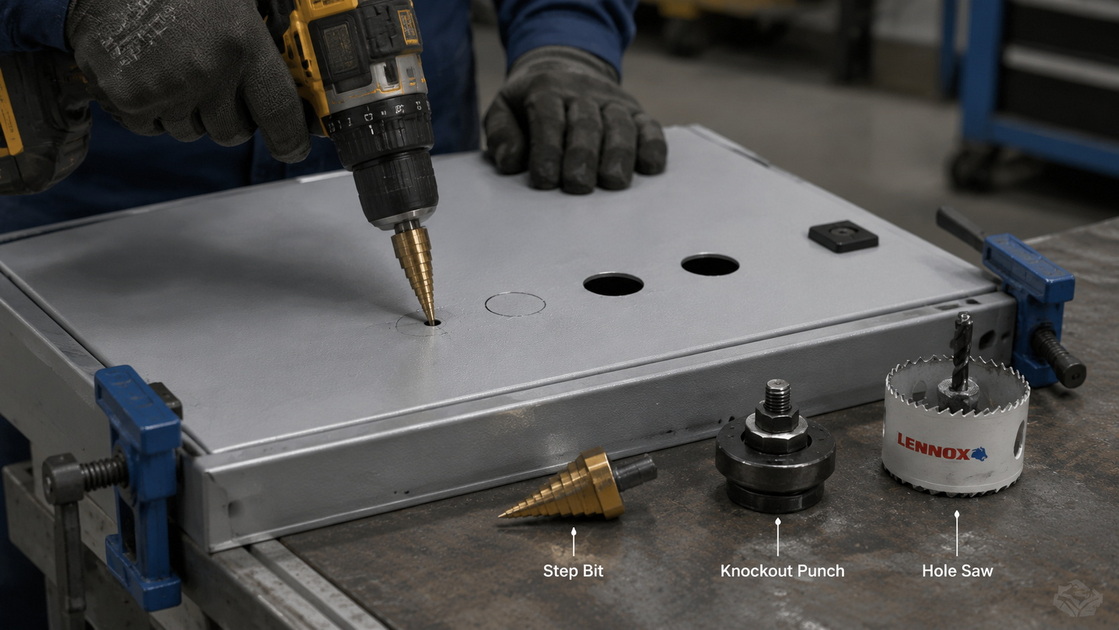
Preferred methods include step bits, hole saws and knockout punches, which give consistent diameters and clean edges when used properly. [hobby-machinist]
Rectangular cutouts are needed for:
- Human‑Machine Interface (HMI) screens and touch panels. [youtube]
- Meters, displays and larger switches. [forum.core-electronics.com]
- Rectangular fan or filter units.
These typically require drill + jigsaw, nibbler tools, or CNC/laser cutting for best accuracy, especially on thicker metal enclosures. [bohuielectric]
Choosing the right tool reduces heat, vibration and edge damage while improving accuracy. Below are common tools used by industrial panel builders and enclosure manufacturers. [twcontrols]
- Step bit (double‑fluted or spiral): Excellent for progressively enlarging holes and achieving common button/gland sizes in sheet metal. [reddit]
- Knockout punches (e.g., Greenlee style): Ideal for large, precise round or special‑shape holes; require a pilot hole and work best in mild steel or aluminum. [hobby-machinist]
- Hole saws: Use with a pilot drill for larger circular openings, especially on thinner sheet metal or plastic. [forum.core-electronics.com]
- Drill + jigsaw with sheet‑metal blade: Drill corner holes, then carefully cut along marked lines for HMI or fan openings. [youtube]
- Nibbler tool: Removes small bites of metal, allowing controlled rectangular openings with minimal distortion. [reddit]
- Rotary tool with cutting disc: Useful for small custom openings; requires steady hands and careful deburring afterward. [forum.core-electronics.com]
- Bench drill with step bits for clean circular holes. [reddit]
- Laser cutting (where available) for precise cutouts on suitable plastics. [reddit]
Across all methods, deburring tools, files, and abrasives are non‑negotiable: every professional panel shop emphasizes removing sharp edges inside and outside the enclosure. [youtube]
From a manufacturer's standpoint, the most serious mistakes are made before the first hole is cut: poor layout, ignoring enclosure ratings, and skipping PPE. [chinametalworking]
Key safety practices include:
- Disconnect power and remove or protect internal components before cutting. [twcontrols]
- Wear gloves, safety glasses, hearing protection, and avoid loose clothing or jewelry around rotating tools. [youtube]
- Secure the enclosure with clamps or in a vise to prevent movement. [reddit]
- Protect painted or coated surfaces with tape under the tool's footplate to avoid scratches. [hobby-machinist]
In our production lines, we also control heat buildup during cutting because excessive heat can damage coatings and accelerate corrosion. Keeping speeds moderate and stopping periodically to cool the area extends tool life and protects the enclosure finish. [bohuitechnology]
This section shows a practical method that closely mirrors what UL 508A panel builders and experienced hobbyists do in real projects. [youtube]
1. Identify the accessory and confirm the exact required hole diameter from its datasheet. [twcontrols]
2. Use a drawing or CAD program to layout the front panel with center marks for each hole. [reddit]
3. Print the layout 1:1 scale, tape it to the enclosure, and transfer centers using a center punch. [reddit]
This approach dramatically reduces misalignment and is widely recommended by professionals in both industrial and hobby communities. [forum.core-electronics.com]
1. Place the enclosure on a stable surface and clamp it firmly. [twcontrols]
2. Use a small drill bit (e.g., 3–4 mm) to make precise pilot holes at each marked center. [reddit]
3. Keep the drill perpendicular to the surface and apply steady, moderate pressure to avoid sliding or oversized pilot holes. [twcontrols]
Pilot holes guide step bits, hole saws or knockout punches, minimizing walking and producing clean, centered openings. [hobby-machinist]
Depending on your chosen method:
- With a step bit:
- Run the drill at moderate speed and enlarge the pilot hole step by step until you reach the target diameter. [twcontrols]
- Avoid running too fast; high speed generates heat and dulls the bit quickly. [twcontrols]
- With a knockout punch:
- Drill the recommended pilot hole size, assemble the punch and die, then tighten the draw bolt until the slug pops out. [hobby-machinist]
- Verify the finished hole against the accessory before removing the punch. [hobby-machinist]
- With a hole saw:
- Ensure the pilot drill is centered and start at low speed to prevent chatter. [twcontrols]
- Once the saw is engaged, maintain steady feed pressure and periodically clear chips. [twcontrols]
In professional panel shops, these methods are chosen based on hole size, material thickness and production volume; step bits and punches dominate for repeatable industrial work. [hobby-machinist]
1. Use a deburring tool, file or Dyna file to smooth the inside and outside edges thoroughly. [youtube]
2. Run a finger around the entire circumference—no sharp edges should remain, inside or out. [youtube]
3. Remove tape, clean markings, and check that accessories fit snugly without forcing. [youtube]
Experienced panel builders emphasize that well‑deburred holes reduce injury risk during maintenance and prevent cable jackets from being cut or compromised over time. [youtube]
Square and rectangular cutouts need more careful layout because they are highly visible and often used for HMI or display units. [youtube]
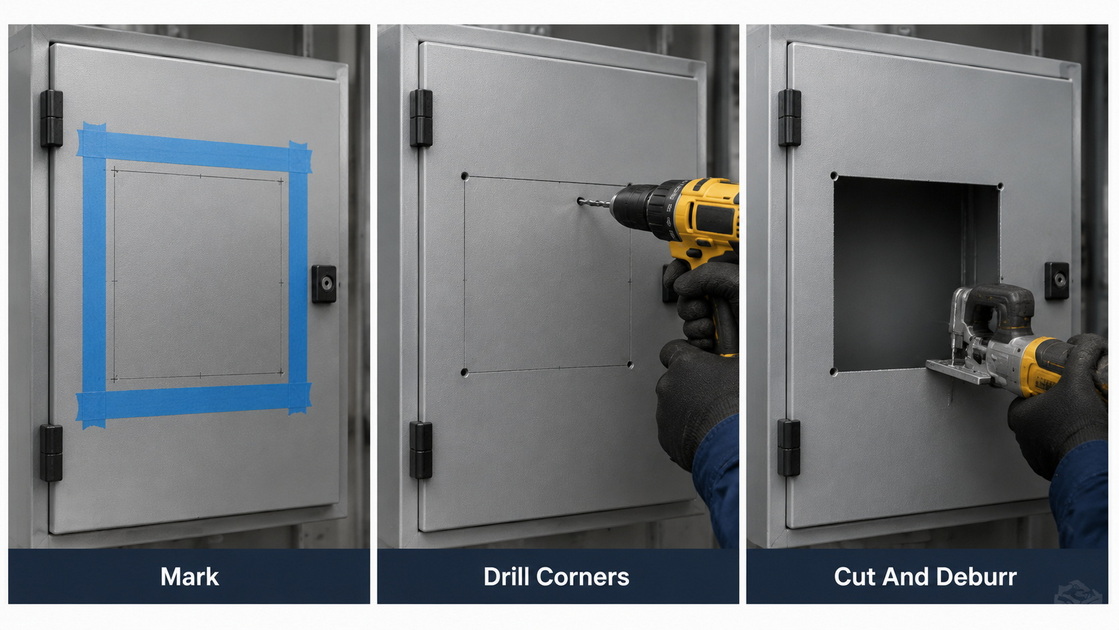
1. Use a square or straightedge to mark the exact boundaries of the cutout on the enclosure. [youtube]
2. Apply thick tape over the area to protect paint and provide a smooth surface for the saw's shoe. [youtube]
3. Double‑check dimensions against the manufacturer's cutout drawing before proceeding. [youtube]
Maintaining accurate marking is critical; even a few millimeters of error can cause fit issues with panel‑mount devices. [forum.core-electronics.com]
1. Drill pilot holes in each corner of the planned cutout, large enough to accept the jigsaw blade. [youtube]
2. Aim for about 3/8 inch (≈10 mm) diameter, as commonly used in workshop practice. [youtube]
3. Ensure the holes stay fully inside the cutout area to avoid visible over‑cut corners. [forum.core-electronics.com]
These corner holes are your entry points for the jigsaw or nibbler, allowing you to cut along straight lines rather than forcing curves. [forum.core-electronics.com]
1. Insert a sheet‑metal jigsaw blade and start from one corner hole, following your marked line steadily. [hobby-machinist]
2. Keep the shoe flat and move slowly to maintain a straight edge and avoid chatter. [youtube]
3. Alternatively, use a nibbler tool to gradually remove material along the outline, especially on thinner metal. [reddit]
Professionals often prefer jigsaws with fine‑tooth blades for mild steel enclosures and nibblers for tight spaces or complex shapes. [forum.core-electronics.com]
1. Use flat and half‑round files to straighten edges and fine‑tune corner radius. [forum.core-electronics.com]
2. Deburr inside and outside to remove all sharp lips and splinters. [youtube]
3. Test‑fit the HMI or fan housing; adjust only minimally and avoid over‑enlarging the opening. [forum.core-electronics.com]
In UL 508A panel practice, a neat, well‑filed opening is viewed as a sign of workmanship and reduces rework during panel assembly and inspection. [youtube]
From an industrial manufacturer's point of view, manual cutting is ideal for small projects and field modifications, but large‑volume or high‑precision work is better handled with automated processes. [bohuitechnology]
At Ningbo Bohui Electric Co., Ltd., we use CNC stamping, laser cutting, bending and welding to produce standard and custom electrical enclosures with high repeatability and tight tolerances. These processes: [bohuitechnology]
- Ensure precise cutouts for HMIs, busbars and multi‑hole patterns even on thick steel. [bohuielectric]
- Protect enclosure integrity and IP rating through controlled heat input and edge quality. [chinametalworking]
- Shorten development cycles for OEM customers needing fully customized hole layouts. [bohuitechnology]
For complex projects or when you need many identical panels, it is often more cost‑effective to have holes pre‑cut at the factory rather than manually modifying each enclosure on site. [chinametalworking]

Every hole you cut is a potential path for moisture or dust, so it must be integrated properly with seals and fittings. Based on field experience and industry guidance, we recommend: [chinametalworking]
- Use IP‑rated cable glands and gaskets that match your enclosure's target protection level. [chinametalworking]
- Avoid scratching or burning powder coating around the hole; damaged coating invites rust. [hobby-machinist]
- Seal unused or oversized openings with appropriate plugs or blanking plates. [chinametalworking]
In our own production, quality control checks each enclosure for coating damage, sharp edges and hole accuracy to maintain performance across power, telecom, EV charging and industrial automation projects. [bohuielectric]
Real‑world users—makers, technicians and integrators—have shared practical tips that align closely with professional practice: [reddit]
- Measure twice; misaligned holes are the top frustration in DIY enclosures. [reddit]
- Use templates printed at 1:1 scale and tape them directly to panels for accurate drilling. [reddit]
- For plastics, consider laser cutting or slower drill speeds to avoid cracking. [forum.core-electronics.com]
- A bench drill with clamping improves accuracy and safety compared to handheld drills. [twcontrols]
Combining these user insights with manufacturer‑level standards gives you a robust, repeatable workflow for enclosure modification.
You can add a table like the one below to help readers quickly choose the right method:
| Hole type | Material | Recommended method |
|---|---|---|
| 22 mm push button | Mild steel | Step bit + deburring file twcontrols |
| Large cable gland | Mild steel | Knockout punch + pilot hole hobby-machinist |
| HMI rectangular cut | Steel panel | Corner drilling + jigsaw + filing youtube |
| Small sensor opening | Plastic box | Step bit on drill press + clamps reddit |
| Ventilation cutout | Metal panel | Hole saw or CNC/laser pre‑cut youtube |
If you regularly need complex cutouts, multi‑hole patterns or certified enclosures for power, telecom, industrial automation, EV charging, building systems or water pumps, manual cutting quickly becomes a bottleneck and risk. [bohuielectric]
By working with an experienced enclosure manufacturer like Ningbo Bohui Electric Co., Ltd., you can:
- Get OEM‑configured enclosures with all required holes cut by CNC or laser before installation. [bohuitechnology]
- Ensure conformity to IP and UL requirements while reducing on‑site rework and tool costs. [bohuielectric]
- Scale projects faster with consistent quality across global deployments. [bohuielectric]
Contact our team to discuss your drawings or specifications, and we'll help you turn them into production‑ready enclosure designs with professional cutout solutions.
Yes, but only if you use properly rated cable glands, gaskets and accessories and avoid damaging the seal area or coating around the hole. Always follow the accessory manufacturer's cutout and torque instructions. [chinametalworking]
A step bit used on a bench drill with the enclosure clamped in place is one of the safest and most forgiving methods for beginners. It offers good control and reduces the risk of bit walking. [reddit]
Cut holes before installing components whenever possible. This keeps metal chips away from contactors, PLCs and wiring, and reduces the risk of accidental damage. [twcontrols]
Use tape under the tool's foot, moderate speed to limit heat, and sharp bits or blades. Avoid dragging tools across the coating and clean chips frequently. [hobby-machinist]
If you need many identical panels, complex cutout patterns or certified enclosures for critical applications, it's often more cost‑effective and reliable to have holes pre‑cut by a professional enclosure manufacturer. [bohuitechnology]
1. Robinson Engineering Inc., "Cutting a Square Hole in an Electrical Enclosure." https://www.youtube.com/watch?v=Qko4-OF8gyg [youtube]
2. TW Controls, "Cutting Holes in UL 508A Control Panel Enclosures." https://www.youtube.com/watch?v=shHFETQYDLc [youtube]
3. Ningbo Bohui Electric Co., Ltd., "China Wall Mounted Enclosure, Modular Electrical Enclosure, IP65 Steel Enclosure Box Manufacturer." https://www.bohuielectric.com/fil/ [bohuielectric]
4. Bohui Technology, "Metal box enclosures and sheet metal products." https://bohuitechnology.com [bohuitechnology]
5. Reddit r/arduino, "Best way to accurately cut holes in enclosure boxes?" https://www.reddit.com/r/arduino/comments/xkaru1/best_way_to_accurately_cut_holes_in_enclosure/ [reddit]
6. TW Controls, "Drilling Holes In An UL 508A Industrial Electrical Control Panel." https://twcontrols.com/ul508a-control-panels-course/drilling-holes-in-an-ul-508a-industrial-electrical-control-panel [twcontrols]
7. Hobby‑Machinist Forum, "Cutting holes in mild steel enclosure." https://www.hobby-machinist.com/threads/cutting-holes-in-mild-steel-enclosure.87435/page-3 [hobby-machinist]
8. Supro MFG, "Custom Electrical Enclosure Manufacturer‑ China Metal Fabrication Manufacturer." https://www.chinametalworking.com/electrical-enclosure/ [chinametalworking]
9. Core Electronics Forum, "Cutting holes in electronics enclosures." https://forum.core-electronics.com.au/t/cutting-holes-in-electronics-enclosures/3675 [forum.core-electronics.com]

2026-07-26

2026-07-24


